Cherevichki

Cherevichki (Черевички), sometimes translated in English as The Fancy Slippers or Oxana's Caprices, is an opera in 4 acts and 8 scenes. It was adapted by Tchaikovsky between February and April 1885 (with revisions in November and December 1886), from his early comic opera Vakula the Smith (1874).

Genre
Operas
Composed
1885
Description
Comic-fantastic opera in 4 acts and 8 scenes
Written at
Moscow, Maydanovo
First performed
19/31 January 1887, Moscow
Catalogue
TH 8 · ČW 8

Where he wrote it

February–May 1885: 12 stays in 3 places. Numbered in the order he reached each place, from where he came from to where he went next, traced from the place and date of his letters.

Dates are New Style (N.S.), the calendar used in the West. In Russia, on the Old Style calendar, the date was 12 days earlier.

February–May 1885: 12 stays in 3 places.1. Saint Petersburg12. Moscow · Composed here23. Maydanovo · Composed here3MaydanovoMoscowSaint Petersburg

Composed hereStayed while writingBefore and after

  1. Came fromSaint Petersburg28 January 1885 · 1 letter
  2. Moscow30 January – 15 February 1885 · 9 letters
  3. Saint Petersburg22 February – 24 February 1885 · 2 letters
  4. Maydanovo26 February – 10 March 1885 · 10 letters
  5. Moscow10 March 1885 · 1 letter
  6. Maydanovo12 March – 20 March 1885 · 5 letters
  7. Moscow25 March 1885 · 1 letter
  8. Maydanovo26 March – 28 March 1885 · 3 letters
  9. Moscow6 April – 10 April 1885 · 3 letters
  10. Saint Petersburg13 April 1885 · 2 letters
  11. Maydanovo15 April – 18 April 1885 · 2 letters
3 more stays
  1. Moscow20 April 1885 · 2 letters
  2. Maydanovo23 April – 3 May 1885 · 10 letters
  3. Went on toMoscow5 May 1885 · 1 letter

Instrumentation

The opera is scored for solo voices, mixed chorus, and an orchestra comprising of piccolo, 2 flutes, 2 oboes, 2 clarinets (in A, B-flat, C), 2 bassoons + 4 horns (in F), 2 trumpets (in E, F), 3 trombones, tuba + 3 timpani, triangle, tambourine, cymbals, bass drum + harp, violins I, violins II, violas, cellos and double basses. An on/offstage military (wind) band consisting of woodwinds, horns, cornets, tuba and timpani is also used in Act III (Nos. 19 and 23).

There are thirteen singing roles:

  • Vakula (Вакула) — tenor
  • Solokha (Солоха) — mezzo-soprano
  • Devil (Бес) — 1st bass
  • Chub (Чуб) — 1st bass
  • Oksana (Оксана) — soprano
  • Mayor (Пан Голова) — 2nd bass
  • Panas (Панас) — 2nd tenor
  • Schoolmaster (Школьный учитель) — tenor
  • His Highness (Светлейший) — 2nd bass
  • Master of Ceremonies (Церемониймейстер) — 2nd bass
  • Attendant (Дежурный) — 2nd tenor
  • Old Cossack (Старый запорожец) — 2nd bass
  • Wood Goblin (Голос лешего) — 2nd bass

Movements and duration

The titles, numbering and tempo markings are taken from the first edition of the full score, published in 1885. Act 2 is divided into two scenes. The titles of numbers in Russian (Cyrillic) are taken from the published score, with English translations added in bold type. Vocal incipits are given in the right-hand column, with transliterations below in italics.

The complete opera lasts around 180 minutes in performance.

Libretto

See also Vakula the Smith.

The libretto for Vakula the Smith was originally devised by Yakov Polonsky, based on the story Christmas Eve (Ночь перед Рождеством) by Nikolay Gogol, which was published as the second story in the collection Evenings on a Farm Near Dikanka (Вечера на хуторе близ Диканьки) (1831–32). Tchaikovsky substantially revised the libretto for Cherevichki, and Vakula's Song (Act III, No. 17) was set to a new text by Nikolay Chayev.

Continue readingShow less 5 more paragraphs

Synopsis

The story is set in Ukraine and Saint Petersburg, during the reign of Catherine the Great.

Act I. On a moonlit night in the Ukrainian village of Dikanka (Scene 1), the witch Solokha is approached by the amorous Devil. The Devil is upset with the smith Vakula (Solokha's son) for painting an ugly picture of him in the local church. As he flies off with Solokha, the Devil raises a snowstorm and steals the moon, so as to wreck Vakula's courtship of Oksana, daughter of the cossack Chub, who is now seen stumbling drunkenly through the darkness with his friend Panas. In Chub's hut (Scene 2), Oksana is admiring herself in her mirror and has little time for his wooing when Vakula arrives. When Chub lurches in, covered with snow, Vakula fails to recognise him and throws him out. Oksana then furiously drives Vakula away, pretending that she loves someone else. But when she is alone, listening to the village girls sing Christmas carols, she confesses her love for him.

Act II. While Solokha is flirting with the Devil in her hut (Scene 1), they are interrupted by a knock at the door. The Devil hides in a sack while Solokha admits the mayor (Pan Golova), who then also sings of his love for Solokha. After another knock at the door, the mayor hides in another sack, and the scene is repeated in turn with the schoolmaster and Chub, each hiding in a sack as the next one declares his love for Solokha. The final guest is Vakula. Unhappy love must have made him weak, he thinks, as he staggers out carrying the mysteriously heavy sacks to make space in the hut for the Christmas festivities. Outside (Scene 2), Oksana is among a crowd of carollers. She admires a pair of slippers (cherevichki) which a friend is wearing. When Vakula, arriving with the sacks, offers to find her a better pair, she mockingly promises to marry him if he will bring the Tsarina's own slippers. Vakula leaves miserably, still carrying the sack containing the Devil, while the mayor, schoolmaster and Chub emerge from the other sacks, to the astonishment and amusement of the carollers.

Act III. On the moonlit bank of the river (Scene 1), Vakula is tempted by the water-sprites (rusalkas) to throw himself into the waters. But when the Devil creeps out of the sack and tries to bargain for his soul, Vakula seizes him by the tail. With the Devil at his mercy, Vakula leaps on his back and forces him to fly to the Tsarina's palace in Saint Petersburg. They arrive at the palace (Scene 2) at the same time as a band of Cossacks, who have been granted an audience with the Tsaritsa. While a ball is in progress in the Great Hall of the palace (Scene 3), Vakula and the Cossacks are received in the throne room by the Prince. Vakula's request for the slippers is met with amusement, but his wish is granted, and amid the festivities he slips away again on the Devil's back.

Act IV. On a sunny Christmas morning in front of the church in Dikanka, all the villagers are rejoicing, except for Solokha and Oksana, who are worried about Vakula's disappearance. Suddenly, Vakula is seen approaching. He has brought the slippers for Oksana, who admits that she has loved him all along. Chub gives the young couple his blessings, to general rejoicing [1].

Composition

Tchaikovsky first mentioned his intention to revise Vakula the Smith on 28 April/10 May 1884, when Tchaikovsky wrote to Pyotr Jurgenson: "I will certainly revise Vakula the Smith. I am thoroughly convinced that it is worth doing. I will complete the revision this coming winter, and will attempt to have it staged in the 1885/86 season" [2].

The composer also told Nadezhda von Meck, Pyotr Jurgenson and Modest Tchaikovsky about the intended changes to Vakula the Smith [3]. In a letter to Nadezhda von Meck dated 24 November/6 December, Tchaikovsky wrote: "I am rather busy in the mornings, namely I am contemplating changes which I intend to introduce to my opera Vakula the Smith. This is one of my favourite creations—but I am not blind to the fundamental shortcomings which afflict the opera and prevent it from remaining in the repertoire. I want to spend a few months removing those shortcomings, so that the opera can be staged the next season in Moscow" [4].

Continue readingShow less 6 more paragraphs

During a sojourn in Paris in the winter of 1885, Tchaikovsky, in his words, "managed here to plan all the major changes to Vakula" [5]. In fact, he commenced working on the revision to the opera in mid/late February, while settled at Maydanovo: "I started my work on Vakula with a fervent, fiery zeal" [6]. On 20 February/4 March 1885 Tchaikovsky reported: "I have written completely new scenes; everything that was bad I have discarded, everything that was good I have retained, simplifying unwieldy and overbearing harmonies—in a word I have done everything required to rescue the opera from the oblivion that it certainly did not deserve" [7]. And in the same letter he wrote that in a few days he would set to work on orchestration of all the newly written sections.

On 4/16 March 1885, in a letter to his brother Modest, Tchaikovsky reported: "My work is not progressing speedily enough, but how happy it makes me! How pleased I am to think that my Vakula shall re-emerge from oblivion". And the composer asked Modest to devise a new name for the opera: "I do not want either Vakula the Smith, or Christmas Eve, or The Empress's Shoes—it must be something else" [8]. The opera was entitled Cherevichki: "I intend to change the title because there are other Vakula the Smiths..." [9]. All the changes to the opera Vakula the Smith were finished by 23 March/4 April [10].

In April the opera was accepted for staging in Moscow [11]. On 22 April/4 May, the opera was considered at a management meeting in the theatre, and on 1/13–2/15 May Tchaikovsky was tidying up the libretto, "which before it goes to press I must show it to Yakov Polonsky (author of the original libretto)" [12]. On 2/14 May, Tchaikovsky wrote that he had sent the libretto with all the additions he had made to Pyotr Jurgenson for publishing [13].

The revision of Vakula the Smith introduced the following major changes into the opera: the scene and duet of Vakula and Oksana (No. 6) were expanded, and the final scene of Act I (No. 7) was written anew; the Schoolteacher's Song and the Quintet in Act II were newly composed, as were His Highness's couplets in Act III. Besides this, the composer introduced a number of changes to the recitatives. In many recitative episodes, developed orchestral parts were replaced by a simple chordal accompaniment, which significantly simplified the orchestral texture. In the overture, one bar was added before the recapitulation, and the harmony was changed slightly [14].

After the new score had already been compiled, apparently during rehearsals, Tchaikovsky altered the instrumentation in Oksana's aria, as well as the beginning of the vocal part [15].

At the request of Dmitry Usatov, who sang the part of Vakula, Tchaikovsky wrote an additional song for Vakula in the first scene of the third act to words by the poet Nikolay Chayev [16].

Arrangements

The vocal-piano reduction of the revised numbers was arranged by Tchaikovsky with assistance from Aleksandra Hubert in March and April 1885 [17].

Performances

Despite the directorate's promise, the staging of Cherevichki did not take place in the 1885/86 season, owing to the prolonged illness of Ippolit Altani and Tchaikovsky's reluctance to engage another, less experienced conductor. An offer by the author to conduct the opera by himself, received a sympathetic reaction in the theatre; nevertheless, due to apparent constraints of the repertoire, the premiere was rescheduled for the next season [18].

The first performance of Cherevichki took place on 19/31 January 1887 in Moscow at the Bolshoi Theatre, conducted by the composer himself, with the following cast: Dmitry Usatov (Vakula), Aleksandra Svyatlovskaya (Solokha), Bogomir Korsov (Devil), Ivan Matchinsky (Chub), Mariya Klimentova (Oksana), Vladimir Streletsky (Mayor), Pyotr Grigoryev (Panas), Aleksandr Dodonov (Schoolmaster), Pavel Khokhlov (His Highness), Romuald Vasilyevsky (Master of Ceremonies). Tchaikovsky also conducted the next two performances on 23 January/4 February and 27 January/8 February with the same cast, except that Aleksandra Krutikova replaced Aleksandra Svyatlovskaya as Solokha.

Continue readingShow less 3 more paragraphs

This was the start of Tchaikovsky's career as a conductor. On 4/16 December 1886 he wrote to Modest Tchaikovsky: "Today [...] an event of great significance for me has occurred. I conducted at the first orchestral rehearsal, and in such a way that (if this isn't just boasting) surprised everyone, because everyone expected that I would disgrace myself … Now I know that I can conduct" [19]. After the premiere, Tchaikovsky described his debut: "At the appointed time I felt semi-conscious. When the fateful moment came, I walked to the podium like an automaton. Deafening applause broke out, wreathes were handed down from the stage, and the orchestra played a flourish. At once I began to feel relaxed. I began the overture very confidently, and as time went on I became calmer and calmer… The unanimous view is that I am a talented conductor" [20]. However, after two further performances on 9/21 and 11/23 February 1887, conducted by Ippolit Altani, the opera was withdrawn from the repertoire.

On 1/13 December 1891, Tchaikovsky conducted its overture at a charity concert in Saint Petersburg, but the first complete production of the opera in the Russian capital did not take place until 29 December 1906/11 January 1907, conducted by Eduard Nápravník, at the Mariinsky Theatre.

The Russian Opera Company staged Cherevichki (under the title The Golden Slippers) at the New Amsterdam Theatre in New York on 27 May 1922. The first complete production in London only took place in 1984, although its overture had been conducted by Henry Wood at a promenade concert in the Queen's Hall as early as 10/22 September 1899.

Publication

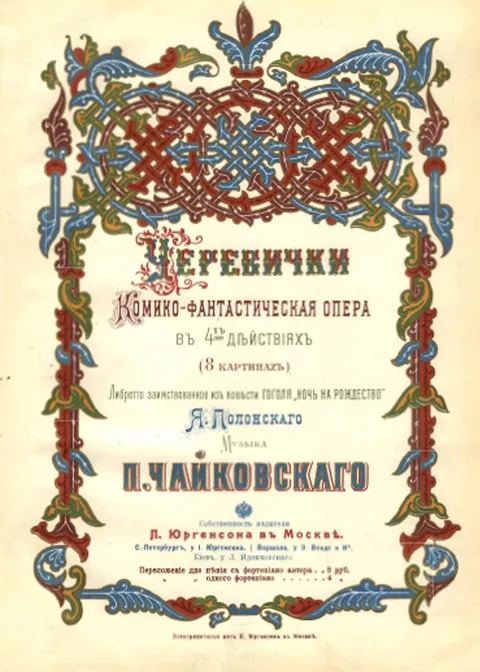
In 1885, Pyotr Jurgenson published the piano score of the opera [21] and the orchestral parts; the full score of the opera was only printed in 1898 [22]. Aleksandra Hubert assisted Tchaikovsky with proofreading and the piano arrangement of some numbers [23]. The third set of proofs, it seems, were checked by Tchaikovsky alone. On 8/20 July 1885 he wrote to Sergey Taneyev: "... I am overwhelmed with proofs of the opera" [24].

Responding to the enquiry by Pyotr Jurgenson regarding the possibility of selling individual numbers from Vakula the Smith [25], Tchaikovsky replied: "Vakula the Smith should have been destroyed a long time ago. One can certainly sell individual numbers, but only a few of them remain unchanged:

  • In the 2nd act—the entr'acte and 4th scene (I refer to the Vakula numbering, not that of Cherevichki).
  • In the 3rd act—the entr'acte and rusalkas' chorus.
  • In the 3rd act—the Polonaise and Minuet, both dance numbers
  • The duet of Oksana and Solokha ("Some say he has drowned", etc).
Continue readingShow less 2 more paragraphs That is it. All other numbers, including the overture, have been changed". In the same letter he told Jurgenson: "I certainly believe in the future of Cherevichki as a repertoire opera", Tchaikovsky wrote, "and in terms of music I regard it as among the best of my operas" [26].

The full score and vocal-piano reductions of Cherevichki were published in volumes 7 and 39 respectively of Tchaikovsky's Complete Collected Works (1951), edited by V. D. Vasilyev.

Autographs

The following manuscripts are preserved in the Glinka National Museum Consortium of Musical Culture in Moscow:

  • Full score of Overture and Act I.
  • Full score of Act II.
  • Full score of Acts III and IV.
  • Full score of the additional aria for Vakula (Act III, No. 17).
  • Vocal-piano arrangement, comprising pages from the printed edition of Vakula the Smith with autograph revisions and insertions.
  • Vocal-piano arrangement of Vakula the Smith, printed edition (Jurgenson, 1876), with Tchaikovsky's annotations.
  • Libretto, printed pages from Cherevichki and Vakula the Smith, with Tchaikovsky's annotations.

The Scientific Music Library of the RUS-SPk also has sets of parts for offstage band in the composer's hand in Act III, No. 19 and No. 23.

In Act III, No. 17, the melody of Vakula's Song (from bar 21) is based on the folk tune 'Oh, Don't Scare the Fearful' (Ой, не пугай, пугаченьку), taken from Aleksandr Rubets' collection of Ukrainian folksongs (part 1, No. 1) [27].

The Russian Dance in the same act (No. 22a), includes the folk tunes 'Do Not Fly, Falcon' (Не летаи же ты, сокол) — used as No. 5 of Vasily Prokunin's 65 Russian Folksongs — and 'My Green Vineyard' (Зеленок моё виноградье), which Tchaikovsky arranged as No. 11 of Fifty Russian Folksongs (1868–69).
As he wrote it

What he said about this work in his letters, from the first mention to the last. Each passage is quoted word for word from the letter; open the letter to read the rest.

While composing, 1885

  1. The full score of "Cherevichki", written out by Langer, was given by me to Pavel Mikhaylovich Pchelnikov in return for a receipt, which I have kept.

    To Sofiya JurgensonMaydanovoRead letter 2721a

  2. My opera will be entitled Cherevichki. I intend to change the title because there are other Vakula the Smiths — for instance, by Solovyov, Shchurovsky, etc.. In Moscow, I was promised that it would be staged there during the coming season.

    To Emiliya PavlovskayaMaydanovoRead letter 2672

  3. Please be good enough in your capacity as operational adjutant for the opera "Cherevichki" to carry out the following work.

    To Aleksandra HubertMaydanovoRead letter 2674

  4. I went to Moscow in the matter of my opera "Cherevichki" (a reworking of "Vakula the Smith") being accepted for production next season.

    To Lev DavydovMaydanovoRead letter 2693

  5. I've just returned from Moscow, where I spent around a week; a mound of letters has built up requiring replies, and so I'm sorry for not writing much again. The business with "Cherevichki" worked out splendidly.

    To Modest TchaikovskyMaydanovoRead letter 2694

  6. Might I take this opportunity to thank you once again, my dear friend, for the invaluable and cordial service you have shown me in advocating the staging of "Cherevichki".

    To Ippolit AltaniMaydanovoRead letter 2704

  7. I knew already that Cherevichki would not be staged in Petersburg — in fact, I hadn't even asked (and am not going to ask) for this opera to be produced this year.

    To Emiliya PavlovskayaMaydanovoRead letter 2708

  8. The other day I saw the models of the scenery for Cherevichki: it will have a magnificent décor. Did you know that in Moscow I cannot envisage anyone better than Klimentova for the role of Oksana, and that I am giving her this role?

    To Emiliya PavlovskayaMoscowRead letter 2710

All 72 letters

While composing, 1885

  1. My opera "Cherevichki", adapted from "Vakula the Smith", is being printed. I am now writing a large symphony after the programme of Byron's "Manfred".

    To Nikolay KonradiMaydanovoRead letter 2729

  2. To Sofiya JurgensonMaydanovoRead letter 2730

  3. I am working on the proofs for Cherevichki, and apart from that I am finishing off a very long symphony — alas, one with a programme, based on Manfred.

    To Herman LarocheMaydanovoRead letter 2730a

  4. To Sofiya JurgensonMaydanovoRead letter 2739

  5. Until now I hadn't shown Cherevichki in its renovated form to anyone, I had received no one's opinion or response, and that is why it was especially pleasant for me that the first agreeable response should come to me from you, my ever so…

    To Emiliya PavlovskayaMaydanovoRead letter 2747

  6. As for you, dear Emiliya Karlovna, I would like to ask you to put in a word for Cherevichki at every convenient opportunity, with a view to getting this opera included in next season's repertoire.

    To Emiliya PavlovskayaMaydanovoRead letter 2762a

  7. As for a meeting with you, my dream is now as follows: immediately after the production of "Cherevichki" to go to Italy, down to Naples, and in the early spring to take a steamer to Odessa, and from there via Poti to Tiflis.

    To Praskovya TchaikovskayaMaydanovoRead letter 2794

  8. Thank you for the "Cherevichki" advice. Your correction will, of course, be taken into consideration.

    To Nikolay TchaikovskyKamenkaRead letter 2804

  9. Solovyov's "Cordelia" hasn't been staged yet due to Altani's illness; since this is unlikely to go on before January, then I ought to forget about "Cherevichki".

    To Praskovya TchaikovskayaMaydanovoRead letter 2826

  10. With regard to "Cherevichki" permit me to inform you of the following. If Altani recovers and is in the near future able to resume his post, I can wish for nothing better than for him to learn and to conduct "Cherevichki".

    To Pavel PchelnikovMaydanovoRead letter 2829

  11. I was in Moscow last week; I'll be going there again on the 14th for a concert (I'm not going to Petersburg for the suite), and most importantly, to decide the fate of "Cherevichki".

    To Modest TchaikovskyMaydanovoRead letter 2832

  12. I'm very worried about the fate of "Cherevichki". Altani is ill; I was with him about 10 days ago, and it seems to me that he'll be barely able to leave the house this season.

    To Praskovya TchaikovskayaMaydanovoRead letter 2835

Afterwards

  1. For the present, I doubt that it could gain a foothold on any stage. If you are set on staging something of mine, then it would be better for me to advise you to take on "Cherevichki".

    To Mikhail Ippolitov-IvanovMaydanovoRead letter 2838

  2. I have done everything possible to have "Cherevichki" put on this current season; given Altani's illness, I even offered to prepare and conduct a few performances of "Cherevichki" myself – but nothing has yet come of all this.

    To Yuliya ShpazhinskayaSaint PetersburgRead letter 2847

  3. In Moscow, "Cherevichki" has been postponed until the next season. As a consequence of this, my finances have fluctuated significantly, and this season I won't receive even half of what I was expecting.

    To Anatoly TchaikovskyMaydanovoRead letter 2853

  4. It's still premature to talk about the distant future, but Aleksey and I are dreaming of going to you at the end of August, and staying until I'm called to the rehearsals of "Cherevichki", which will happen no earlier than December.

    To Praskovya TchaikovskayaMaydanovoRead letter 2897

  5. 5) Send me one copy of "Cherevichki", because I must prepare to conduct.

    To Pyotr JurgensonMoscowRead letter 2981

  6. With regard to a staging of "Cherevichki" there has been complete silence (I mean in Petersburg). Maybe, God willing, six years or so hence His Majesty will command a production, as was the case with "Onegin".

    To Emiliya PavlovskayaMaydanovoRead letter 3013

  7. I'll probably stay in Maydanovo until the production of "Cherevichki", and then God knows. They are trying to persuade me to conduct the first performance myself.

    To Anatoly TchaikovskyMaydanovoRead letter 3036

  8. They say that my opera ("Cherevichki") will be given on the Moscow stage in November, and I am being strongly urged to conduct the 1st performance myself.

    To Nadezhda von MeckMaydanovoRead letter 3037

  9. "Cherevichki" will be going on in November. For the time being I'm still intending to conduct, but it may well happen that I lose my nerve and withdraw.

    To Praskovya TchaikovskayaMaydanovoRead letter 3040

  10. The latter regarded me with fury, and will probably cause me trouble during the production of "Cherevichki".

    To Yuliya ShpazhinskayaMaydanovoRead letter 3059

  11. No doubt you will find that "Cherevichki" will be given at the very end of the season. I find Maykov extremely antipathetic; he is some sort of clerk, rather than the director of an artistic institution.

    To Yuliya ShpazhinskayaMaydanovoRead letter 3064

  12. The rehearsals of my opera "Cherevichki" shall be taking place in Moscow in the middle of November. Naturally, I certainly want and desire to attend the concert — but how could I do so if the opera will be on at the same time?

    To Eugen AlbrechtMoscowRead letter 3066

  13. "Cherevichki" will not be on before the middle of November, and even then I am not hopeful. I shall end the letter, because it is late and I am very tired.

    To Yuliya ShpazhinskayaMaydanovoRead letter 3068

  14. Why did you pay 1,000 francs to Jurgenson for "Les caprices d'Oksana" when this is an opera which cannot find any buyers in France???

    To Félix MackarSaint PetersburgRead letter 3082

  15. I hope to go to Maydanovo the day after tomorrow, the 6th, but very briefly, because rehearsals for "Cherevichki" are starting imminently in Moscow.

    To Praskovya TchaikovskayaSaint PetersburgRead letter 3087

  16. After "Cherevichki" I shall have to settle in the country without leaving and write with the utmost haste. I have just received your letter of 28 October, which was forwarded to me from Maydanovo.

    To Yuliya ShpazhinskayaSaint PetersburgRead letter 3088

  17. I could not be happier, the more so since it turns out, from news I've received, that rehearsals for "Cherevichki" will not commence until the end of November, so I can live and work here for around a fortnight.

    To Praskovya TchaikovskayaMaydanovoRead letter 3092

  18. As for "Cherevichki", I know only that they will not start to rehearse it before the 15th. I am immensely glad that I shall be able to rest for a few days at least in my solitude here.

    To Yuliya ShpazhinskayaMaydanovoRead letter 3093

  19. Suddenly a message came that I was needed for the rehearsals of "Cherevichki". At first it seemed absolutely impossible for me to go to Moscow.

    To Yuliya ShpazhinskayaMaydanovoRead letter 3106

  20. Now, of course, everything remains as it was. "Cherevichki" will go on, and I'll come to you in Piter for the holidays.

    To Modest TchaikovskyMoscowRead letter 3108

  21. I now have daily rehearsals for "Cherevichki".

    To Anton ArenskyMoscowRead letter 3110

  22. …not be writing to you properly for a while, because I now have the production of "Cherevichki", while at the same time I am writing "The Enchantress" with frantic haste, because I gave my word to present it to the Directorate by Lent.

    To Yuliya ShpazhinskayaMoscowRead letter 3116

  23. "Cherevichki" is being rehearsed every day, and still won't be going on before 15 January. This is an awkward time for a new opera, and the more rehearsals the better.

    To Praskovya TchaikovskayaMoscowRead letter 3121

  24. I conducted the orchestra at the first three performances of "Le caprice d'Oksane", and, to my great astonishment, I am reckoned to have acquitted myself of my task quite well.

    To Félix MackarMaydanovoRead letter 3170

  25. To Lidiya GenkeMoscowRead letter 3128

  26. The point is that I am now wholly taken up with my opera "Cherevichki", for which I will be conducting the orchestra on its first performance.

    To Ivan VsevolozhskyMoscowRead letter 3130

  27. I hope that she will keep her promise and come to the 1st performance of "Cherevichki", which in the meantime has been fixed for 15 January.

    To Eduard NápravníkMaydanovoRead letter 3133

  28. Well now, I've already conducted 7 rehearsals of Cherevichki. Each time I become calmer and more confident.

    To Anatoly TchaikovskyMaydanovoRead letter 3134

  29. I was very, very saddened that Olga Eduardovna isn't coming to "Cherevichki". But what if you were to come to Moscow for old times' sake?

    To Eduard NápravníkMaydanovoRead letter 3139

  30. Permit me to finish with the production of "Cherevichki" and with the presentation of the score of "The Enchantress" to the Petersburg directorate, and then I shall again not only become your diligent correspondent, but I shall at the very…

    To Yuliya ShpazhinskayaMaydanovoRead letter 3142

  31. "Cherevichki" to go on Monday 19th, should I reserve a box; will be happy if you can come.

    To Emiliya PavlovskayaMoscowRead letter 3144

  32. Firstly, as it happens, on that very day I am conducting the 3rd performance of "Cherevichki", and I cannot go back on my promise, because the ticket prices were raised for my sake and a subscription was announced for which I think all the…

    To Emiliya PavlovskayaMoscowRead letter 3152

  33. To Eduard NápravníkMoscowRead letter 3154

  34. I received this news just the morning after the first production of "Cherevichki". I'll just briefly describe to you how the 1st performance went.

    To Praskovya TchaikovskayaMoscowRead letter 3155

  35. The crowd at Cherevichki is enormous. The day after tomorrow I'll write to you about how the 2nd performance went.

    To Modest TchaikovskyMoscowRead letter 3156

  36. To Vladimir ShilovskyMoscowRead letter 3157

  37. I would have written you a brief report about the 1st performance of "Cherevichki", if the morning after a memorable evening for me, I had not received the unexpected of the death of my niece, whom I loved very much, and whose death is…

    To Yuliya ShpazhinskayaMoscowRead letter 3159

  38. The second performance of "Cherevichki" went more smoothly and evenly than the first. Krutikova didn't have her voice back, but she was still better than Svyatlovskaya.

    To Modest TchaikovskyMoscowRead letter 3162

  39. May I take this opportunity to inform Your Highness that my opera "Cherevichki" has already been successfully staged on three occasions.

    To Grand Duke Konstantin KonstantinovichMaydanovoRead letter 3166

  40. It seems to be that "Cherevichki", like "Onegin", won't particularly cause a stir, but little by little they will grow to love this opera.

    To Modest TchaikovskyMaydanovoRead letter 3168

  41. Please dispatch one copy of the libretto of "Cherevichki" to Sevastopol, Cathedral Street near the Real School, Popova House, for Yuliya Petrovna Shpazhinskaya.

    To Sofiya JurgensonMaydanovoRead letter 3173

  42. Just imagine, Yuliya Petrovna, that two weeks have flown by since Cherevichki was last on in Moscow, after having three full houses at inflated prices.

    To Yuliya ShpazhinskayaMaydanovoRead letter 3174

  43. I think I already wrote to you that my opera was performed under my direction three times in a row. People are saying that I am not without talent as a conductor — if you knew how much that gladdens me!!!

    To Félix MackarMaydanovoRead letter 3176

  44. I'm a little angry with you for not coming to "Cherevichki" after you made a big show about accepting money from me for the trip.

    To Anna MerklingMaydanovoRead letter 3180

  45. I have reservations about the suitability of performing the final chorus from "Cherevichki". It is too final; this is merely the end, presupposing that it's a long way from the start, with something-or-other going on between the two.

    To Sergey TaneyevMaydanovoRead letter 3183

  46. I had to produce the piano reduction quickly during the rehearsals for "Cherevichki" last year, amidst the commotion of Moscow life.

    To Ippolit ShpazhinskyMaydanovoRead letter 3367

  47. In the summer of 1885 I appreciated the punctiliousness of my relations with Jurgenson regarding the proofs of "Cherevichki"; the reason being that Sofya Ivanovna kept fastidious records about what, where and to whom things was sent.

    To Pyotr JurgensonFrolovskoyeRead letter 3667

  48. …entr'acte and 4th scene (I'm referring to the numeration of Vakula, rather than Cherevichki). 2) In the 3rd act, the entr'acte and chorus of rusalkas. 3) In the 3rd act, the Polonaise and Minuet are both dance numbers. 4) The duet for…

    To Pyotr JurgensonFrolovskoyeRead letter 4163

  49. I've asked Altani to procure me the orchestral parts for the overture to "Cherevichki", which I want to play in Petersburg on 1st Deecember.

    To Pyotr JurgensonMaydanovoRead letter 4555

  50. Thank you for forwarding "Cherevichki". Incidentally, would it be a bad thing to publish the dances from the same opera in full score?

    To Pyotr JurgensonMaydanovoRead letter 4562

  51. I shall start with the overture [to Cherevichki] at one o'clock sharp, which means that the March will be played approximately at 1:20, because the overture isn't particularly long.

    To Mily BalakirevSaint PetersburgRead letter 4566

  52. Comparing the overture to "Cherevichki" with the old edition, there are changes requiring new engraving. There are no changes to the dances.

    To Pyotr JurgensonSaint PetersburgRead letter 4567

Recordings

  1. Orchestra e Coro del Teatro Lirico di Cagliari

    Conductor: Gennady Rozhdestvensky

    Tchaikovsky Edition · 2000 · Brilliant Classics

Scores and recordings on IMSLPAll recordings on MusicBrainzSearch YouTubeSearch SpotifySearch Apple Music

Recording details from MusicBrainz and Wikidata, both CC0. Audio from the Internet Archive is used under the licence shown with it.

Hear it live

Concert listings worldwide are on Bachtrack. Upcoming Tchaikovsky concerts on Bachtrack

The world around this work

Who he was writing to and what else was happening in his life, 1885.

Letters that discuss it 70

and 58 more

People around it

Whom he wrote to most in these years, and who appears in the letters about this work.

209 letters survive from these years. Letters of 1885

Meanwhile in his life

  • February 1885 He revises Vakula the Smith as a new opera with the title Cherevichki.
  • 31 December 1884 / 12 January 1885 His niece Anna Davydova marries Nadezhda von Meck's son Nikolay.
  • 12/24 January 1885 Premiere of the Suite No. 3 in Saint Petersburg.
  • 14/26 February 1885 He rents a house in the village of Maydanovo, near Klin.
  • 22 February / 6 March 1885 Premiere of the Concert Fantasia in Moscow.
  • April 1885 At Maydanovo, he writes the symphony Manfred, suggested by Mily Balakirev.
  • September 1885 He starts work on the opera The Enchantress.
  • 5/17 December 1885 Premiere of the Jurisprudence March and Jurists' Song at the 150th anniversary dinner of the Imperial School of Jurisprudence in Saint Petersburg. Tchaikovsky is absent.

Chronology 1885

In the world meanwhile

Places in this story

Saint Petersburg · Moscow · Paris · Maydanovo · New York · London · Klin

Letters about this work

Letters cited by Tchaikovsky Research. Those not yet on this site open there.

24802504260526172657266126662678269227012703272027332772281328333115

Listen next

Notes

  1. From The Tchaikovsky Handbook, vol. 1 (2002), p. 64–65. ↩︎

  2. Letter 2480 to Pyotr Jurgenson, 28 April/10 May 1884. ↩︎

  3. See Letter 2605 to Nadezhda von Meck, 24 November/6 December 1884; Letter 2504 to Pyotr Jurgenson, 12/24–13/25 June 1884; Letter 2617 to Modest Tchaikovsky, 3/15 December 1884. ↩︎

  4. Letter 2605 to Nadezhda von Meck, 24 November/6 December 1884. ↩︎

  5. Letter 2617 to Modest Tchaikovsky, 3/15 December 1884. ↩︎

  6. Letter 2657 to Nadezhda von Meck, 16/28 February 1885. ↩︎

  7. Letter 2661 to Emiliya Pavlovskaya, 20 February/4 March 1885. ↩︎

  8. Letter 2666 to Modest Tchaikovsky, 4/16 March 1885. ↩︎

  9. Letter 2672 to Emiliya Pavlovskaya, 14/26 March 1885. ↩︎

  10. See date on the autograph full score, and Letter 2678 to Nadezhda von Meck, 3/15–9/21 April 1885. ↩︎

  11. See Letter 2693 to Lev Davydov, 26 April/8 May 1885. ↩︎

  12. Letter 2701 to Nadezhda von Meck, 30 April/12 May 1885. ↩︎

  13. See Letter 2703 to Pyotr Jurgenson, 2/14 May 1885. ↩︎

  14. The following sections of Cherevichki were newly composed or rescored: Overture (bars 63, 67–82); Act I, No. 1 (bars 193–207), No. 2 (bars 110–111, 127–168, 176), No. 3 (bars 97–111), No. 4 (bars 57–73, 86–103), No. 5 (bars 1–13, 22–40), No. 6 (bars 1–4, 31–178); Act II, No. 10 (bars 51–102), No. 11 (bars 25–82), No. 12 (bars 52–54), No. 13 (bars 65–94, 132–153), No. 14 (bars 78–96, 143–157, 168–182, 253–260); Act III, No. 17 (bars 8–16, 20–126), No. 19 (bars 114–164), No. 23 (bars 25–51); Act IV, No. 25 (bars 82–137, 315–339). Throughout the rest of the opera, Tchaikovsky made numerous alterations to dynamic, phrasing and tempo markings. ↩︎

  15. Until 1940, this version of the orchestration remained unknown and unperformed. ↩︎

  16. The composer's diaries show that on 22 November 1886 (O.S.) he met with Nikolay Chayev, who provided the text for the song, although there is no reference to their having discussed the opera. ↩︎

  17. See Letter 2674, 16/28 March 1885 and Letter 2692, 23 April/5 May 1885, to Aleksandra Hubert. ↩︎

  18. See Letter 2772 to Nadezhda von Meck, 22 September/4 October 1885; Letter 2833 to Nadezhda von Meck, 11/23 December 1885; Letter 2813 to Modest Tchaikovsky, 19 November/1 December 1885; and Chapter 1 of Tchaikovsky's Autobiographical Account of a Tour Abroad in the Year 1888. ↩︎

  19. Letter 3115 to Modest Tchaikovsky, 4/16 December 1886. ↩︎

  20. Letter 3155 to Praskovya Tchaikovskaya, 22 January/3 February 1887. ↩︎

  21. Passed by the censor on 14/26 June 1885. ↩︎

  22. Passed by the censor on 23 March/4 April 1898. The piano score of the opera Cherevichki, was republished in 1901, 1917 and 1940 using the same plates, but with slight retouchings to the titles of the numbers. ↩︎

  23. See Letter 2674, 16/28 March 1885; Letter 2692, 23 April/5 May 1885; Letter 2720, 11/23 June 1885; and Letter 2847a, undated, all to Aleksandra Hubert. ↩︎

  24. Letter 2733 to Sergey Taneyev, 8/20 July 1885. ↩︎

  25. See letter from Pyotr Jurgenson to Tchaikovsky, 30 June/12 August 1890 — Tchaikovsky State House-Museum, Klin at Klin. ↩︎

  26. Letter 4163 to Pyotr Jurgenson, 2/14 July 1890. ↩︎

  27. See Двести шестнадцать украивских напевов записал и издал А. И. Рубец (Moscow: P. Jurgenson, 1872). ↩︎

Pictures

Sources

Licence: CC BY-NC-SA 4.0. Tchaikovsky Research (en.tchaikovsky-research.net).

Cite this page

Plain text

Cherevichki. Dear Tchaikovsky, https://deartchaikovsky.com/en/works/th8-cherevichki/. Last updated 18 November 2026.

Chicago

“Cherevichki.” Dear Tchaikovsky. Last updated 18 November 2026. https://deartchaikovsky.com/en/works/th8-cherevichki/.

BibTeX

@misc{deartchaikovsky-works-th8-cherevichki,
  title = {Cherevichki},
  howpublished = {Dear Tchaikovsky},
  url = {https://deartchaikovsky.com/en/works/th8-cherevichki/},
  date = {2026-11-18},
}