New York

His only American tour was built around the opening of Andrew Carnegie's new Music Hall. On 5 May 1891 he conducted his Coronation March at the opening concert. In the same week he conducted the Suite No. 3 on his 51st birthday and the Piano Concerto No. 1 with Adele aus der Ohe as soloist.

Coordinates
40.765, -73.98

New York is the largest city in the United States of America, and part of the state of New York.

New York and the places around it in his lifeMap of the area around New York, with 1 other places from Tchaikovsky's life nearby. Arrows lead to the places he came from and went on to, most often Niagara Falls, Philadelphia, Rouen. The inset shows where this area lies, with Europe across the Atlantic.Niagara Falls → New York: 1 timeNew York → Niagara Falls: 1 timeNew York → Philadelphia: 1 timeRouen → New York: 1 timePhiladelphiaNew York
Arrived fromWent on toThicker lines: more journeys.A name with an arrow is farther away, beyond the edge of the map.

New York in his time

1891His only American journey: nearly four weeks in the spring of 1891, when he crossed the Atlantic to conduct at the opening of Andrew Carnegie's new Music Hall.

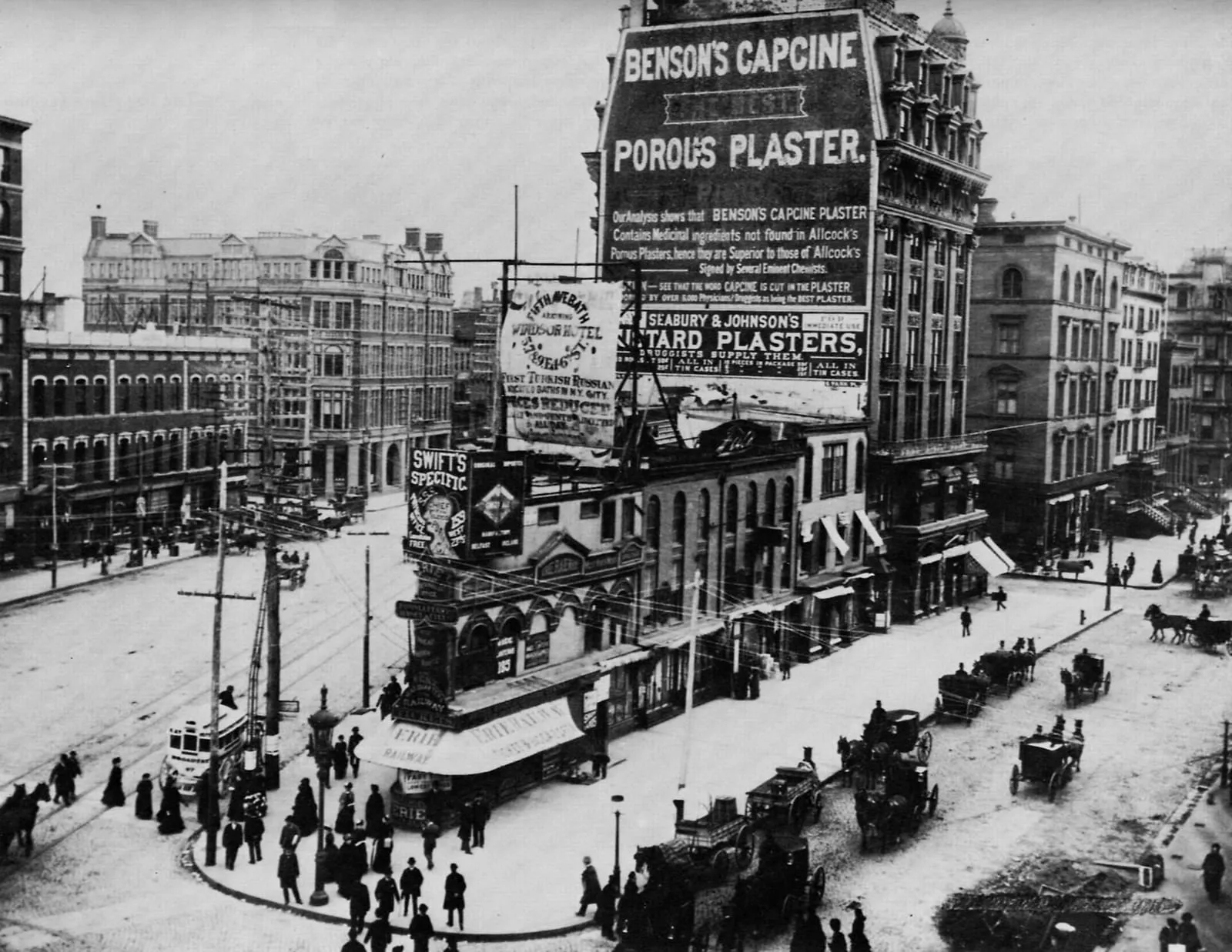
Photograph from above of a wide street crossing with horse-drawn cabs and a horse car, telegraph poles and tall buildings covered in painted advertisements
Fifth Avenue and Broadway where they cross at 23rd Street, with horse cars, cabs and painted advertisements, about 1884 Unknown author, public domain, Wikimedia Commons

Cottages and nine-storey houses

Manhattan had passed a million inhabitants in the 1870s. The Brooklyn Bridge, the longest suspension bridge in the world, had opened in 1883, and the Statue of Liberty in 1886. Steel frames were letting buildings rise past the old limit of about fifteen storeys; the World Building of 1890 is counted as the city's first skyscraper.

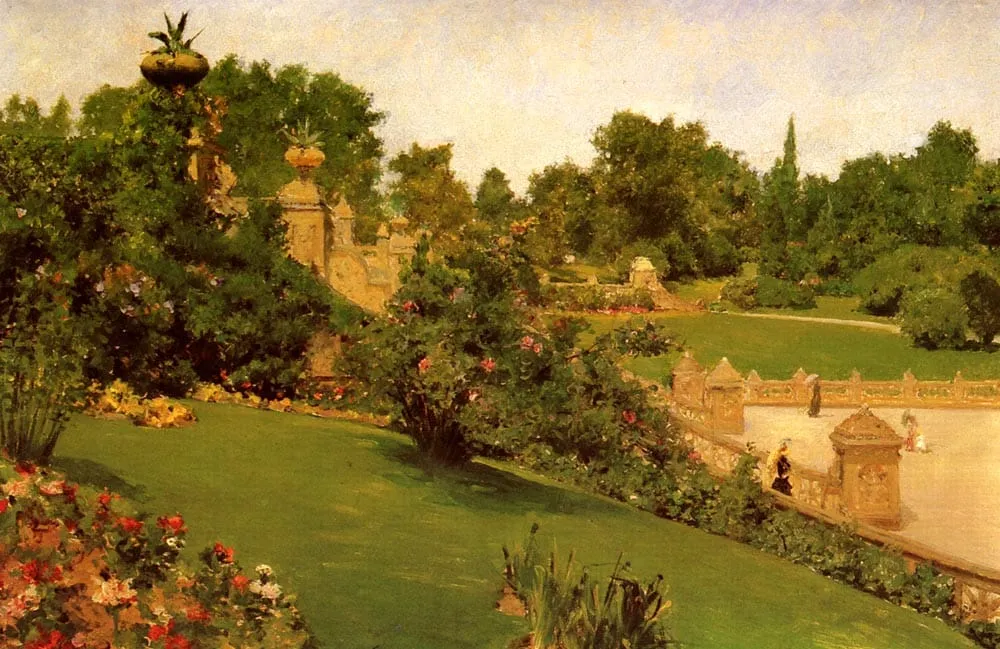
On his first evening he strolled along Broadway and found one- and two-storey houses standing between buildings of nine floors. His hotel room had electric and gas light, a bath with hot and cold water and a speaking device to the office. The weather was fine but too hot, and the trees had long been in leaf. He found Central Park, completed in 1876, "magnificent".
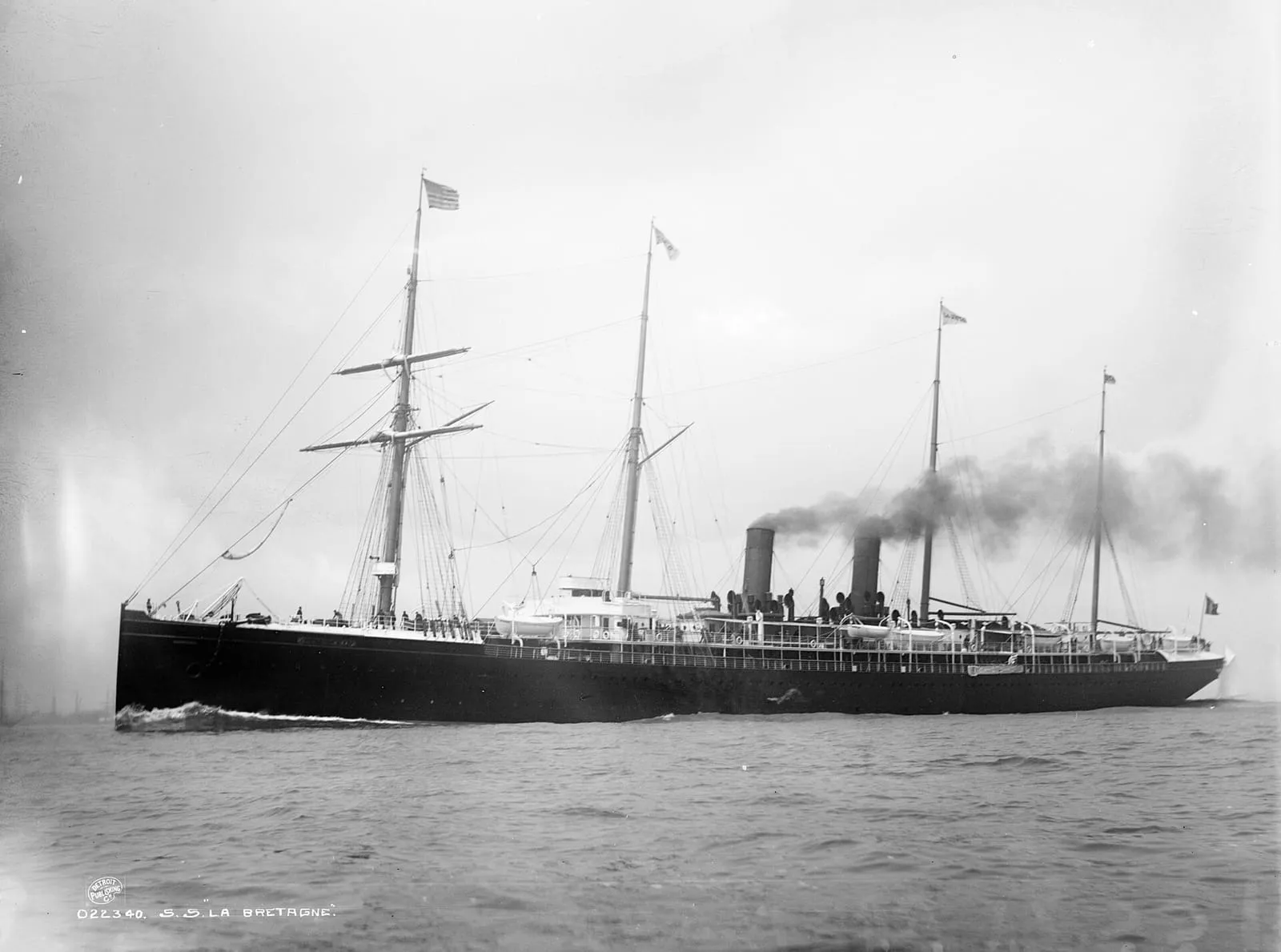
Photograph of a long black steamship with two smoking funnels and four masts under way on calm water
La Bretagne, the liner that carried him from Le Havre to New York, 1890–1895 John S. Johnston, public domain, Wikimedia Commons

Nine days on La Bretagne

He sailed from Le Havre on 18 April 1891 on La Bretagne of the Compagnie Générale Transatlantique, a 151-metre liner launched in 1885 that made 17 knots. In the diary he sent to Modest he called her "a genuine floating palace". There were 80 people in first class and several hundred emigrants, most of them from Alsace, who danced to a harmonica in good weather.

Off the Newfoundland banks the ship slowed in fog, sounding a siren every half hour. On 24 April it ran into a hurricane, at its worst at ten that night, and he sat it out in the corner of his cabin sofa. After a long customs interrogation he landed on 26 April at 5.30 in the afternoon and was taken to the Hotel Normandie on Broadway at 38th Street. He went home on 21 May on the Hamburg liner Fürst Bismarck.

Painting of a green lawn with flowering bushes sloping down to a carved stone terrace where two women walk
The Terrace at the Mall in Central Park. Painting by William Merritt Chase, 1890 William Merritt Chase, public domain, Wikimedia Commons

The Music Hall on Seventh Avenue

The Music Hall at Seventh Avenue and 57th Street, now Carnegie Hall, was built in 1889–91 for the Oratorio Society and the New York Symphony Society, to designs by William Tuthill. It opened on 5 May 1891 with the Old Hundredth hymn and a concert conducted by Walter Damrosch and Tchaikovsky, who led his Coronation March. On 7 May, his 51st birthday, he conducted the Third Suite, and on 9 May the First Piano Concerto with Adele aus der Ohe. The first violins alone filled eleven desks.

Morris Reno, who had bought the land for the hall, was among those who met him off the ship. He spent a day with the publisher Schirmer, then left for Niagara Falls, Baltimore and Philadelphia.

In his words

New York is a very beautiful and very original city. On the main street single-storey cottages alternate with houses of 9 floors.

In my suite, as well as in all the other rooms in all the hotels, there is electric and gas lighting, and a toilet with a bath and water closet, plenty of extremely comfortable furniture, a device for speaking to the hotel office should one require anything

I like New York more and more. Incidentally, there's a magnificent Central Park here. And remarkably people of my age can remember very well when cows used to graze on its site.

Before and after

Each row is one stay, from his first to his last surviving letter written here, between where he wrote from just before and just after.

Came fromNew YorkWent on to
Niagara Falls until 11 May 13 – 14 May 1891 Philadelphia from 18 May
Rouen until 18 April 18 April – 11 May 1891 Niagara Falls from 11 May

Works written here

Letters written here

189119 letters

Mentioned in letters

Letters in which Tchaikovsky names this place.

18761 letter
189146 letters
18922 letters
18931 letter

Events here

Sources

Licence: CC BY-NC-SA 4.0. Tchaikovsky Research (en.tchaikovsky-research.net).

Cite this page

Plain text

New York. Dear Tchaikovsky, https://deartchaikovsky.com/en/places/new-york/. Last updated 18 November 2026.

Chicago

“New York.” Dear Tchaikovsky. Last updated 18 November 2026. https://deartchaikovsky.com/en/places/new-york/.

BibTeX

@misc{deartchaikovsky-places-new-york,
  title = {New York},
  howpublished = {Dear Tchaikovsky},
  url = {https://deartchaikovsky.com/en/places/new-york/},
  date = {2026-11-18},
}