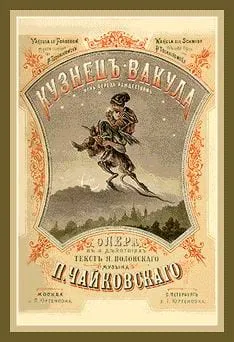
Instrumentation
The opera is scored for solo voices, mixed chorus, and an orchestra comprising of piccolo, 2 flutes, 2 oboes, 2 clarinets (in A, B-flat, C), 2 bassoons + 4 horns (in F), 2 trumpets (in E, F), 3 trombones, tuba + 3 timpani, triangle, tambourine, cymbals, bass drum + harp, violins I, violins II, violas, cellos and double basses. An on/offstage military (wind) band consisting of woodwinds, horns, cornets, tuba and timpani is also used in Act III (Nos. 14 and 18).
There are thirteen singing roles:
- Vakula (Вакула) — tenor
- Solokha (Солоха) — mezzo-soprano
- Chub (Чуб) — 1st bass
- Oksana (Оксана) — soprano
- Devil (Бес) — 1st bass
- Schoolmaster (Школьный учитель) — tenor
- Mayor (Пан Голова) — 2nd bass
- Panas (Панас) — 2nd tenor
- His Highness (Светлейший) — 2nd bass
- Master of Ceremonies (Церемониймейстер) — 2nd bass
- Attendant (Дежурный) — 2nd tenor
- Old Cossack (Старый запорожец) — 2nd bass
- Wood Goblin (Голос лешего) — 2nd bass.
Movements and duration
The titles, numbering and tempo markings are taken from the first edition of the vocal-piano reduction, published in 1876. The titles of numbers in Russian (Cyrillic) are taken from the published score, with English translations added in bold type. Vocal incipits are given in the right-hand column, with transliterations below in italics.
A complete performance of the opera lasts around 100 minutes.
Libretto
The initiative for the opera Vakula the Smith was a competition organised by the directorate of the Russian Musical Society, to produce an opera on the subject of Nikolay Gogol's Christmas Eve (Ночь перед Рождеством), which had been published as the second story in the collection Evenings on a Farm Near Dikanka (Вечера на хуторе близ Диканьки) (1831–32). The libretto had previously been compiled by Yakov Polonsky for the composer Aleksandr Serov, who did not then make use of it.
On 19 February/3 March 1873, the directors of the Russian Musical Society announced the competition to a number of musical artists for their consideration.
Continue readingShow less 8 more paragraphs
In a letter of 7/19 March 1873 to the Vice-Chairman of the Society, Prince Dmitry Obolensky, Tchaikovsky wrote of his interest in this project. Recognizing that "the instructions by which the competitors should be guided... were compiled with the utmost expediency and presented clearly and accurately", Tchaikovsky further expressed his views concerning "some problems which might arise when awarding the prize. The Board of Directors will be aware that opera, like all vocal compositions, differs from an overture or a symphony in that it does not have a traditional form, firmly established by the great masters of classical art. At the present time it is clear that there are differing opinions concerning the manner in which the operatic text should be set. One view is that operas of the past, particularly Italian operas, were guilty of a lack of intelligent application of music to the scenes, while adhering to formal musical set pieces (such as arias, duets and ensembles). Others, in pursuit of the greatest possible reason, have concluded that opera should evolve in an organically integrated fashion, and that to have a series of individual numbers is artistic nonsense because in life, and therefore in opera, people should not speak to each other at the same time; also that recitatives expressing the feelings of a character by slavishly imitating the conversational intonations of voice, must be the only rational form of opera. Regardless of the intrinsic beauty of opera, given that it can be approached with such preconceptions even before consideration is given the merits of the music itself, let alone the practicalities of composition — it is unthinkable that the judges should find themselves in a position to consider all approaches as equally valid. I fear that our composers' passions would not be deterred by such considerations, and they might well insist that their opera should not be of a form which runs contrary to their aesthetic principles. For this reason such a competition, however generally beneficial it may be, should take account of the fact that operas are not a straightforward type of composition.
So that this difficulty might be overcome, would it not be possible for the Board of Directors to specify that the type of music which predominantly corresponds to Mr Polonsky's text should either be essentially separate numbers, or on the other hand, it should follow the most modern style of opera?" [2].
The rules for the competition were published in May 1873, but the question raised by Tchaikovsky was not addressed. The composers were given creative freedom, and the rules specified only the closing date for entries (1/13 August 1875) and the overall subject (Gogol's Christmas Eve). The composers were allowed to alter Yakov Polonsky's libretto, to expand and reduce it at their discretion, and could even use another libretto. There were two prizes of 1500 and 500 rubles, and the rules also stipulated that the winner of the competition would receive the publication rights to the opera [3].
In May 1876, Tchaikovsky suggested some changes to Polonsky, which were incorporated into the first edition of the libretto published by Pyotr Jurgenson that year. However, the second edition (Saint Petersburg: E. Groppe, 1878) restored Polonsky's original text, which corresponded to the published vocal-piano reduction.
Synopsis
The story is set in Ukraine and Saint Petersburg, during the reign of Catherine the Great.
Act I. On a moonlit night in the Ukrainian village of Dikanka (Scene 1), the witch Solokha is approached by the amorous Devil. The Devil is upset with the smith Vakula (Solokha's son) for painting an ugly picture of him in the local church. As he flies off with Solokha, the Devil raises a snowstorm and steals the moon, so as to wreck Vakula's courtship of Oksana, daughter of a Cossack, Chub, who is now seen stumbling drunkenly through the darkness with his friend Panas. In Chub's hut (Scene 2), Oksana is admiring herself in her mirror and has little time for Vakula's wooing when he arrives. When Chub lurches in, covered with snow, Vakula fails to recognise him and throws him out. Oksana furiously drives Vakula away, but then regrets her behaviour.
Act II. While Solokha is flirting with the Devil in her hut (Scene 1), they are interrupted by a knock at the door. The Devil hides in a sack while she admits the mayor (Pan Golova), who then also sings of his love for Solokha. After another knock at the door, the mayor hides in another sack, and the scene is repeated in turn with the schoolmaster and Chub, each hiding in the sack as the next one declares his love for Solokha. The final guest is Vakula. Unhappy love must have made him weak, he thinks, as he staggers out carrying the mysteriously heavy sacks, to make space in the hut for the Christmas festivities. Outside (Scene 2), Oksana is among a crowd of carollers. She admires a pair of slippers (cherevichki) which a friend is wearing. When Vakula, arriving with the sacks, offers to find her a better pair, she mockingly promises to marry him if he will bring the Tsarina's own slippers. Vakula leaves miserably, still carrying the sack containing the Devil, while the mayor, schoolmaster and Chub emerge from the other sacks, to the astonishment and amusement of the carollers.
Act III. On the moonlit bank of the river (Scene 1), Vakula is tempted by the water-spirits (rusalkas) to throw himself into the waters. But when the Devil creeps out of the sack and tries to bargain for his soul, Vakula seizes him by the tail and, with the Devil at his mercy, he leaps on his back and forces him to fly to the Tsar's palace in Saint Petersburg. They arrive at the palace (Scene 2) at the same time as a band of Cossacks, who have been granted an audience with the Tsaritsa. While a ball is in progress in the Great Hall of the palace (Scene 3), Vakula and the Cossacks are received in the throne room by the Prince (“His Highness”). Vakula's request for the slippers is met with amusement, but his wish is granted, and amid the festivities he slips away again on the Devil's back. On a sunny Christmas morning in front of the church in Dikanka (Scene 4), all the villagers are rejoicing, except for Solokha and Oksana, who are worried about Vakula's disappearance. Suddenly Vakula is seen approaching, carrying the slippers he has brought for Oksana, who admits that she has loved him all along. Chub gives the young couple his blessings, to general rejoicing [4].
Composition
Until mid/late May 1874, Tchaikovsky was occupied with other work, and there are no references to Vakula the Smith in his letters. Only after the production of The Oprichnik (which deeply disappointed him), did he turn to Gogol's subject.
In a letter to Vasily Bessel of 18/30 May 1874, the composer asked to be sent the rules of the composition for Vakula the Smith: "...it is essential that I receive them as soon as possible" [5]. It would therefore appear that his work on the opera commenced no earlier than May 1874.
Continue readingShow less 18 more paragraphs
On 30 May/12 June 1874, Tchaikovsky informed Bessel [6] that he was travelling to Nikolay Kondratyev's country estate. Here he began work on the opera. It is not possible to establish precisely the dates of the rough draft, apart from a note indicating that Act II was completed on 17/29 June 1874. In a letter to Modest Tchaikovsky of 18/30 June, the composer wrote: "I have ventured, contrary to your advice, to write Vakula" [7].
Modest Tchaikovsky asserted that, "in the middle of July O.S., Pyotr Il'ich travelled to Usovo, where he brought the almost-finished rough sketches of the entire opera, so that on his arrival he could set about the instrumentation" [8].
"The opera is completely finished", Tchaikovsky wrote to Vasily Bessel on 19/31 October, "but the piano score remains to be done. I sat over it all summer, thinking that the closing date for entries was 1 January O.S., but it now turns out that I have to wait until next November for the judging to take place" [9].
In 1878, Tchaikovsky recalled from Nizy: "...here over the course of three summer months I wrote the whole of Vakula the Smith" [10].
The date on the manuscript score confirms that the instrumentation was complete by 21 August/2 September 1874, but the piano score was not completed until the end of October when Tchaikovsky, dissatisfied with the efforts of Eduard Langer and Aleksandr Razmadze who had undertaken to make the arrangement, set about this work himself [11]. While composing the opera, Tchaikovsky believed that the closing date for the competition was 1/13 January 1875. On discovering that the closing date was in fact 1/13 August 1875, he approached the theatre via Eduard Nápravník and Gennady Kondratyev to seek permission to withdraw the opera from the competition, but this request was denied [12].
"All my thoughts are presently on my precious child, my dear Vakula. You cannot imagine how much I love him! I feels as though I would go out of my mind if he proved to be a failure. The prize does not matter to me — my only wish is for Vakula to be staged in the theatre. The parts have already been copied out, and I'm carefully reviewing everything it before I send it to Petersburg" [13].
On 18/30 May 1875 he wrote to Nikolay Rimsky-Korsakov: "I promised to be in Piter and to play you my ill-fated opera [1] (I call it ill-fated because there is no sillier position for a composer than, having written an opera, not to have the right for the time being to acknowledge it as his own). If I did not fulfil this promise it is because, for various reasons, I was unable to escape to Petersburg, despite all my wishes. You, of course, lose out on nothing by not hearing my opera, for one day you will hear it, but I lose out on an awful lot. I feel that Nadezhda Nikolayevna and you would have praised me for some of "Vakula", and I thirst for your praise and approval as a flower thirsts for heavenly dew. I shall submit this opera to the competition any day now and am very distressed by the thought that at this moment, there may perhaps already exist other, and better,"Vakulas" than mine. The prize does not interest me at all, but its production is now the main preoccupation of my life, and if it does not happen, I think that I shall go out of my mind." [14].
In the competition, the opera Vakula the Smith was submitted anonymously under the Latin motto Ars longa, vita brevis ["Art is long, life is short"].
In October 1875, the Moscow Register reported that Tchaikovsky had been awarded the prize of 1500 rubles for the opera.
On 1/13 October 1875, Nikolay Rimsky-Korsakov wrote to Tchaikovsky: "I have carefully gone through your Vakula. I will discuss this in detail when we meet, but I will tell you now that it has much that pleases me and much that displeases me, but nonetheless this is by far the best of your operas (the first two I do not know, but you yourself have disowned them). Its many deficiencies, in my opinion, were solely due to the libretto. I am absolutely sure that you have still written an opera which will go with a crescendo on its own merits. I liked very much the scene with the mayor, schoolteacher, devil and Chub in the first scene of the second act, and also the scene with Chub and Panas in the first during the snowstorm. Solokha and the chorus were marvellous. Oksana's song in the first act was very sweet, but suffered from an excess of sentimentality that did not sit well with Oksana, but this was the fault of the libretto and not you. The fantastic flight, built around the theme "In the saddle" [Оседлаю помело], was not wholly to my taste, but perhaps it will play better with the orchestra (I still have not seen the full score). I thought the Polonaise was a little heavy-handed. But what an outstanding and, above all, original harmonist you are! I intended to speak with you about the opera when we meet, but I could not restrain myself from expressing my thoughts... Your opera (I do not doubt for a moment) is worthy of the prize" [15].
The standard of the other operas entered in the competition was very poor, Nikolay Rimsky-Korsakov concluded. "Apart from your opera, not one of the other entrants would have been worthy of the prize or of a performance, in my opinion" [16].
However, Vakula the Smith was not warmly received at its premiere in 1876 (see below), and for the 1878 revival Tchaikovsky discussed the work's deficiencies with Eduard Nápravník, and on the advice of the latter he decided to make a number of alterations and cuts in the opera. He wrote of these to Nápravník on 7/19 November 1878: "Here are the changes which, following your advice, I have made in "Vakula":
1) At the end of the first scene I found it possible to make a significant cut, which, it seems to me, is extremely beneficial to the general effectiveness of this scene. I have struck out the whole scene of Chub with Panas, as well as the following chorus (a repetition of what has gone before), and from the chorus's words "creep into the clearing" through one-and-a-half bars I'm jumping directly to the coda, i.e. in the rough copy of the full score which my brother will be giving you, this cut commences on bar 5 of the 38th page, and finished on bar 3 of the 45th.
2) I've tinkered with the orchestration throughout the end of the second scene. Starting from 350px I've struck out all the wind instruments, with the exception of the 1st flute and 1st clarinet, which preserve the notes: 150px Instead of two horns in unison, only the first horn alone will enter on the fourth bar of page 82 and the fourth bar of 83. On pages 85 and 86 I've struck out all the woodwinds, and also the second pair of horns and trumpets; in this passage I've put the strings mf instead of f.
3) On the 87th page I've allowed myself to make a cut and alterations in this passage, which I strongly urge you to agree to. This should present no difficulties whatsoever for the orchestra, although Oksana wil have to learn the words "I both want to weep and cry with laughter" with different music, which should also be no trouble for Mrs Raab. The change occurs after Vakula's departure, the orchestra playing another five bars and stopping on the 6th, at the first quaver. Here Oksana sings recitatives to the words "want to weep", after which a quartet plays three chords, before Oksana says "and cry with laughter". Then after the cut the orchestra enters, playing the last six bars of the scene as before, but omitting one bar for the sake of rhythmic symmetry. In short, this whole passage will be refashioned as follows: 350px If it proves difficult for you to insert the three chords into the quartet parts, then one bar after the words "want to weep" may be omitted. But I most earnestly implore you and Mrs Raab to consent to this insignificant alteration.
4) In the 1st scene of Act 3, page 38, I've changed the instrumentation of two bars: 350px
5) In the 3rd scene of the same act on page 114 I've changed the instrumentation of two bars.
Apart from these unimportant corrections, I can do no more. Wherever I wanted to make substantial changes to the orchestral accompaniment, in order to enhance the voices, I encountered insurmountable obstacles, i.e. I would either have to change not only the orchestra, but the music itself, or to leave everything as it was. I had to settle for the latter. For example, in the scene with Vakula and the Devil, after the dances in the palace no words are audible at all, because the complex figuration in the orchestra prevent the singers from singing freely — but how could I improve this without radically altering the music?" [17].
Arrangements
At the end of August 1874, Tchaikovsky brought the manuscript of the opera back to Moscow, where Eduard Langer and Aleksandr Razmadze began to arrange the vocal-piano reduction. However, by October, Tchaikovsky had become dissatisfied with their work, and so he decided to complete the task himself [18]. As part of this work he made arrangements for piano duet (4 hands) of the Russian and Cossack Dances from Act III (Nos. 16 and 17), and of the Overture to the opera.
Performances
On 22 November/4 December 1874, at a concert of the Moscow branch of the Russian Musical Society, Nikolay Rubinstein conducted the overture, described on the concert bill as "overture to an unfinished opera" [19].
In early/mid-December, Tchaikovsky received official notification that the opera was scheduled for performance in the next season on the stage of the Mariinsky Theatre in Saint Petersburg [20].
Continue readingShow less 3 more paragraphs
On 20 November/2 December 1876, Eduard Nápravník conducted the Minuet, Russian Dance and Cossack Dance (Act III, Nos. 15–17) at the 2nd Russian Musical Society concert in Saint Petersburg. The premiere of the complete opera took place just four days later, on 24 November/6 December 1876, at the Mariinsky Theatre under the same conductor, and the following cast: Fyodor Komissarzhevsky (Vakula), Anna Bichurina (Solokha), Ivan Matchinsky (Chub), Wilhelmina Raab (Oksana), Ivan Melnikov (Devil), Nikolay von Derwiz (Schoolmaster), Osip Petrov (Mayor), Vasily Vasilyev II (Panas), Fyodor Stravinsky (His Highness), and Pavel Dyuzhnikov (Attendant).
Afterwards, Tchaikovsky wrote to Sergey Taneyev: "Vakula was a spectacular flop. The first two acts passed amid sepulchral silence, with the exception of the overture and the first duet, which were applauded. In the scene with the mayor and especially the clerk there was much laughter, but no applause or curtain-calls. After the third and fourth acts (the third was divided into two) I was called for a few times, but with loud hissing from a substantial part of the public. The second performance fared somewhat better, but all the same it is possible to say with some confidence that the opera did not please, and that it will hardly last out more than five or six performances. It is worth noting that at the dress rehearsal everyone, including Cui, predicted that it would be an enormous success. That made the opera's failure all the more painful and distressing for me. I shall not conceal the fact that I am badly shaken and disheartened. The main thing is that I cannot complain about the performers or the staging. Everything was done diligently, attentively, and even lavishly. The designs were simply splendid [...] it is I who am to blame for the opera's failure. It is too crammed with details, too densely orchestrated and too poor in vocal effects. Only now do I understand why, if you remember, when I played Vakula for the first time at Rubinstein's, you all remained so cool and dissatisfied. The style of Vakula is in no way operatic; it lacks breadth and sweep" [21].
The opera was produced a total of 18 times between 1876 and 1879.
Critical reception
Tchaikovsky gave his considered view of Vakula the Smith in a letter to Nadezhda von Meck of 30 October/11 November 1878: "Vakula went off as it did on its first production, i.e. smoothly and without a hitch, but it is routine, pallid and colourless. There is one person on who becomes angry every time he hears this opera. That person is me. Lord, how many unpardonable errors in this opera were made not by others, but by me! I did everything I could in order to give a good account of all the places which might themselves be pleasing, but if only I had held my purely musical inspiration in check, and thought more about the staging and decoration that are essential ingredients of operatic style. The whole opera suffers throughout from a layering, a surplus of detail, and tiresome chromatic harmonies, and from a lack of shape and completeness in the individual numbers. C'est un menu surchargé de plats épicés [22]. It has many tasty morsels, but little plain and healthy food. I realize all too well the deficiencies in my operas, which unfortunately are irreparable. But hearing it afresh, I will take something away for the future" [23].
Nevertheless, Tchaikovsky retained an affection for Vakula the Smith: "... while recognizing its deficiencies as an opera, I would still place it amongst the first rank of my creations. I wrote this music with love and with enjoyment, just like Onegin, the Fourth Symphony and the Second Quartet" [24].
Publication
The opera was due to be published by Vasily Bessel, but Tchaikovsky rejected this and instead gave Pyotr Jurgenson the rights to the edition [25]. In February and March 1876, Tchaikovsky corrected the proofs of the edition. In a letter of 3/15 March to Modest Tchaikovsky he wrote: "I am still pressing on with the never-ending proofs of Vakula, which is due to go to press in two weeks" [26].
The vocal-piano reduction of the opera was published in April 1876 [27], but the full score was never brought out. In 1885, Tchaikovsky reworked Vakula the Smith as Cherevichki, making significant changes and additions to the original version.
The full score of the excerpts of Vakula the Smith that were not later incorporated into Cherevichki were published for the first time in 1956 in volume 35 of Tchaikovsky's Complete Collected Works, edited by V. D. Vasilyev, as a supplement to the vocal-piano reduction of the whole opera.
Autographs
The fragments from Tchaikovsky's full score which were not re-used in Cherevichki are now preserved in the Klin House-Museum Archive (a1, No. 10).
The following fragments from his vocal-piano reduction of the opera are held by the Glinka National Museum Consortium of Musical Culture in Moscow:
- Overture
- Act I, No. 1 and No. 2 (start)
- Act I, No. 2 (conclusion) and No. 3
- Act II, Nos. 4 and 5, manuscript copy (by Eduard Langer?) with Tchaikovsky's annotations
- Act II, Nos. 6 to 8 and opening of No. 9, manuscript copy (by Eduard Langer and Aleksandr Razmadze?) with Tchaikovsky's annotations
- Act II, No. 8
- Act II, Nos. 9 to 11
- Act III, Nos. 12 to 15
- Act III, Nos. 16 to 18
- Act III, No. 19, manuscript copy by Aleksandr Razmadze with Tchaikovsky's annotations
- Act III, No. 20
- Overture and Act III, from end of No. 11 up to No. 20, manuscript copy of Eduard Langer's piano reduction [28]
- Acts I and II, manuscript copy with Tchaikovsky's annotations
- Act III, manuscript copy with Tchaikovsky's annotations (including his 4-hand arrangements of Nos. 16 and 17)
Recordings
No complete commercial recordings of Vakula the Smith (rather than its revised form as Cherevichki) are known to us. However, a studio recording of the entire opera was made in 1989 by the BBC Philharmonic Orchestra and the Chorus of Opera North, conducted by Edward Downes, with the following soloists: David Bender (Vakula), Anne Collins (Solokha), Donald Maxwell (Devil), Clive Bayley (bass), Susan Roberts (Oksana), Nicholas Folwell (Mayor/His Excellency), and Neil Jenkins (Panas/Schoolmaster). Patricia Routledge provided narration between scenes. This was first broadcast on BBC Radio 3 on 23 December 1989, and repeated on 12 May 1990 and 10 February 2007, but has never been made commercially available. [29]
Dedication
The opera is dedicated to the memory of the Grand Duchess Yelena Pavlovna (1806–1873), former patroness of the Russian Musical Society, in whose memory the opera competition had been organised.
Related works
In Act I, No. 1, Solokha's Song («Ой, как светит месяц») is based on the Ukrainian folk tune 'Once Upon a Time' (Ой, коля були).
The Russian Dance in Act III (No. 16), includes the folk tunes 'Do Not Fly, Falcon' (Не летаи же ты, сокол) — used as No. 5 of Vasily Prokunin's 65 Russian Folksongs — and 'My Green Vineyard' (Зеленок моё виноградье), which Tchaikovsky arranged as No. 11 of Fifty Russian Folksongs (1868–69).