Yevgeny Onegin

Yevgeny Onegin (Евгений Онегин), also known as Eugene Onegin [1], Op. 24, was Tchaikovsky's fifth completed opera, which he described as 'lyrical scenes in 3 acts and 7 tableaux'. It was written and orchestrated between May 1877 and January 1878, with revisions in March 1879, October 1880, August 1885, and June-July 1891.

Genre
Operas
Composed
1877–78
Description
Lyrical scenes in 3 acts and 7 tableaux
First performed
17/29 March 1879, Moscow
Catalogue
TH 5 · Op. 24 · ČW 5

The story

Tatyana, a shy girl on a country estate, falls in love with a visitor, Onegin, and writes him a letter, but he coolly turns her down. Annoyed by gossip at her name-day ball, Onegin flirts with her sister Olga to spite his friend Lensky, who loves her, and kills Lensky in the duel that follows. Years later he meets Tatyana again in Saint Petersburg, now married to Prince Gremin, and falls in love with her; she still loves him, but sends him away.

Libretto

Synopsis

The action takes place in western Russia and in Saint Petersburg during the 1820s.

Act I. In the garden of the Larin country estate (Scene 1), Mrs Larina reminisces about her youth with the nurse Filippyevna, while her daughters Tatyana and Olga sing duets. The peasants have gathered in the harvest, and dance to amuse their mistress. Olga's suitor, Lensky, brings his friend Onegin. Later (Scene 2), Tatyana asks her nurse about her marriage. She writes a passionate letter to Onegin, declaring her love for him, which the nurse agrees to deliver. The following morning (Scene 3) Onegin meets Tatyana in another part of the Larins' garden. He coolly rejects her letter, telling her he was not meant to marry.

Act II. Tatyana's name-day ball is in progress in the main reception room of the Larin house (Scene 1). At Lensky's insistence, Onegin attends, but when he hears people gossiping about him, he takes revenge on Lensky by flirting with Olga. Lensky angrily confronts Onegin, and challenges him to a duel. Reluctantly, Onegin agrees. Next morning at a rustic water mill on the banks of the wooded stream (Scene 2), Lensky awaits Onegin's arrival, and wonders whether Olga will shed a tear if he dies. Both Lensky and Onegin regret the events of the previous night, but neither man will back down. The duel takes place, and Onegin shoots Lensky dead.

Act III. Many years have elapsed, and Onegin is still bored with life. In the ballroom of a nobleman's house in Saint Petersburg (Scene 1), he encounters Tatyana, who is now married to Prince Gremin. Tatyana's transformation from a naive country girl to a dazzling grande dame captivates him. In the drawing room of Prince Gremin's house (Scene 2), Tatyana meets Onegin, and accuses him of loving her now only because she is rich and famous. She still loves him, but is determined to be faithful to Gremin, and does not yield to her passion. She dismisses Onegin, who is now a broken man [13].

Where the story comes fromShow less

The libretto was devised by Tchaikovsky, with some assistance from Konstantin Shilovsky, after the novel in verse Yevgeny Onegin (1837) by Aleksandr Pushkin (1799–1837). Although Shilovsky's name appears on the published score as co-librettist, his involvement seems to have been confined to helping draft the basic scenario.

During 1876 and the first few months of 1877, Tchaikovsky had been looking for a subject for a new opera: "On this road my next planned stop is an opera, and [...] I will go my way without letting myself be put off" [2]. In the spring of 1877, a subject was finally found. On 18/30 May the composer wrote to Modest Tchaikovsky: Shilovsky, and now he's working on my scenario at full steam [3]. Here's a synopsis of the scenario for you: Act I. Scene One. When the curtain opens, the old woman Larina and her nurse are recalling old times and making jam. Duet for the old women. Singing can be heard from the house. This is Tatyana and Olga singing a duet to a text by Zhukovsky [4], accompanied by a harp. The peasants appear with the last sheaf, singing and dancing. Suddenly a young Cossack announces: guests. Commotion. Enter Yevgeny and Lensky. Formalities of presentation and refreshments (ligonberry water). Yevgeny, Lensky, and the women share their impressions of each other between themselves: a quintet à la Mozart. The old women leave to prepare supper. The young people are left to walk in pairs. They alternate (as in "Faust" [5]). Tatyana is shy at first, then falls in love. Scene 2. Scene with the nurse and Tatyana's letter. Scene 3. Scene of Onegin's explanation with Tanya. Act 2, Scene 1. Tatyana's name day. The ball. Scene with Lensky's jealousy. He insults Onegin and challenges him to a duel. General horror. Scene 2. Lensky's aria before dying and a pistol duel. Act 3. Scene 1. Moscow. A ball, at the Nobility. Tanya meets a whole string of aunts and cousins. They sing a chorus. Appearance of the General. He falls in love with Tatyana. She tells him her story and agree to enter into marriage with him. Scene 2. Petersburg. Tatyana is waiting for Onegin. He appears. A huge duet. Tatyana explains her feelings of love for Yevgeny and struggles. He pleads with her. The husband appears. Duty above all. Onegin flees in despair" [6].

In the composer's personal library at Klin, there is a volume of Pushkin's works containing the novel in verse Yevgeny Onegin. On the margins of the book's pages one can still see the notes which the composer made while drawing up the libretto, including an adaptation of the text of Tatyana's scene with the nurse and Lensky's aria from Scene 5. The descriptions of the principal characters are marked off in pencil.

In a series of letters written by Tchaikovsky we find striking descriptions of the protagonists of his opera. By comparing these statements with the notes in the book it is possible to carry out an interesting analysis of the composer's work on the libretto [7].

Tchaikovsky also talks about his enthusiasm for the subject of Pushkin's Yevgeny Onegin in letters to Anatoly Tchaikovsky on 18/30 May and to Lev Davydov on 19/31 May 1877 [8].

What Tchaikovsky found attractive in this subject was the opportunity to "convey through music everyday, simple, universally human emotions, far removed from anything tragic or theatrical" [9]. "You cannot imagine how crazy I am about this subject", he wrote to his brother Modest; "How glad I am to be free of Egyptian princesses, pharaohs, poisonings, and stilted effects of all kinds. What a mine of poetry there is in Onegin" [10]. "I am ever so keen to set about working on my opera", the composer wrote to Nadezhda von Meck; "I have instructed Shilovsky to draw up a libretto for me which is taken from Pushkin's poema [11] Yevgeny Onegin! A bold idea, isn't it?! Those few people to whom I have spoken about my intention to write an opera with this subject were at first surprised at my proposition, but then they would go into raptures over it. This opera will, of course, be without any strong dramatic action, but on the other hand it will have an interesting everyday life aspect to it, and, moreover, just think how much poetry there is in all this! The scene alone between Tatyana and her nurse is priceless!... Pushkin's text will act on me in a most inspiring fashion" [12].

Instrumentation

The opera is scored for solo voices, mixed chorus, and an orchestra comprising piccolo, 2 flutes, 2 oboes, 2 clarinets (in A, B-flat), 2 bassoons + 4 horns (in F), 2 trumpets (in F), 3 trombones + 4 timpani + harp, violins I, violins II, violas, cellos, and double basses.

There are ten singing roles:

  • Larina (Ларина) — mezzo-soprano
  • Tatyana (Татьяна) — soprano
  • Olga (Ольга) — contralto
  • Filippyevna (Филиппьевна) — mezzo-soprano
  • Yevgeny Onegin (Евгений Онегин) — baritone
  • Lensky (Ленский) — tenor
  • Prince Gremin (Князь Гремин) — 1st bass
  • Captain (Ротный) — 2nd bass
  • Zaretsky (Зарецкий) — 2nd bass
  • Triquet (Трике) — 2nd tenor.

Movements and duration

Tchaikovsky's original score contains an introduction and 22 individual numbers. The three acts are further divided into seven scenes. The titles of numbers in Russian (Cyrillic) are taken from the published score, with English translations added in bold type. Vocal incipits are given in the right-hand column, with transliterations below in italics. The numbering, titles and tempo are taken from the second edition of the full score (published in 1891).

A complete performance of the opera lasts around 140 minutes.

Composition

On 29 May/10 June 1877, Tchaikovsky arrived at Konstantin Shilovsky's estate at Glebovo, where in the course of his month's stay there he worked with great enthusiasm on his opera [14].

By 9/21 June, Tchaikovsky had made sketches for Scene 2 in Act I (Tatyana's scene with her nurse) and most of Scene 1. In a letter informing his brother Modest about this the composer wrote: "I got your letter yesterday, dear Modya. At first your criticisms about my having chosen Onegin made me angry, but that was only for an instant. Even if my opera is not stage-worthy, even if it has little action to offer, the point is that I am in love with the image of Tatyana; I am enchanted by Pushkin's verses and am writing music to them because that's what I want to do. I am completely absorbed in the composition of my opera" [15].

Continue readingShow less 20 more paragraphs

On 15/27 June, he wrote: "I have divided up my day in the most regular manner; I am working very thoroughly at fixed hours, and, since there is nothing whatsoever that stops me from getting down to my work, the opera is going very well. The whole first act in three scenes is already finished, and today I've started work on the second [...] You can criticize Yevgeny Onegin as much as you like, but I must say that I am writing my music with great pleasure and I know for sure that the poetic quality of the subject and the ineffable beauty of the text will hold their own" [16]. "...I have spent a whole month in Glebovo in complete calm and happiness, and I have written two thirds of my opera there," Tchaikovsky would later inform his brother Modest on 5/17 July 1877 [17].

On 27 June/9 July, he returned to Moscow for his wedding to Antonina Milyukova on 6/18 July 1877 [18]. On 27 July/8 August, the composer left Moscow alone to travel to Kamenka, where he stayed with his sister Aleksandra's family for one-and-a half months and continued working on Yevgeny Onegin, as well as on the Fourth Symphony. Thus, work on the opera was interrupted for about a month, but by 27 August/8 September he had completed the orchestration of Scene 1 in Act I and immediately made a piano arrangement of it [19].

Following the breakdown of his marriage in September, Tchaikovsky travelled abroad in early/mid-October [20]. On reaching Clarens, in Switzerland, he soon resumed work on the opera [21], and there he completed the orchestration of Act I [22].

On 16/28 November, Tchaikovsky wrote to Nadezhda von Meck from Venice: "... I have set about furiously finishing the orchestration of Scene 1 in Act II of Onegin (Act 1 and Scene 1 of Act II have to be ready as soon as possible, so that I can send them to Moscow, where in all likelihood they are to be staged at Conservatory performances). My work has come along very well, so that already today I have finished the whole orchestration. I just have to add the voice parts, place marks, and make a piano arrangement" [23]. The following date is indicated at the end of the manuscript of the score for Scene 1 of Act II: "Venice, 28 (16) November 1877".

In December, Tchaikovsky was engrossed in orchestrating his Fourth Symphony, which he had almost always worked on at the same time as his opera.

In San Remo, on 2/14 January 1878, the composer began orchestrating Act III of the opera. Tchaikovsky's letters do not provide any information on when he made the sketches for Act III. It is possible that part of the music for Act III had already been written in Glebovo ("I wrote the greater part of "Onegin" at Glebovo, and I'd like very much to have all the rest written before the start of the academic year, but I don't know whether I'll manage it", he told his brother Modest on 8/20 July 1877) [24]. The remaining sketches were made while Tchaikovsky was abroad, concurrently with his work on the instrumentation [25].

On 5/17 January, the composer wrote to his brother Anatoly: "... I have managed to get a lot done—amongst other things, I spent one-and-a-half hours orchestrating your favourite aria: 'To love all ages are obedient' (Любви все возрасты покорны)" [26].

On 6/18 January, Tchaikovsky informed Nadezhda von Meck: "I am writing the orchestral score for Act III of the opera" [27]

At the end of the manuscript of the score for Act III we find the following date: "San Remo 25 (13) Jan[uary] 1878" [28]

On 14/26 January: "Today I have completed the orchestration of Act III of the opera. Now I just have to finish off in rough Scene 2 of Act II and write an introduction..." [29]

On 16/28 January: "After lunch I picked up some music paper and set off for the mountains alone in order to finish the Duel scene, which is still not fully composed. With difficulty I managed to find a spot where there was nobody else. My work went well" [30]

On 17/29 January: "My work is going splendidly, and I have now started on the last difficult part of the opera, that is the introduction" [31]

On 18/30 January: "I have just finished the introduction. There are at most two weeks or so of work left for me to do" [32]

On 20 January/1 February: "Today, at last, I have finished writing and orchestrating right up to the very end. All that remains to be done is to make a piano arrangement of everything that I have written afresh—in short, this means a week's work, no more" [33]

On 25 January/6 February: "Today I have started work on the piano reduction of the opera" [34]

On 28 January/9 February: "I have finished the piano reduction. Now all that's left to do is to insert the markings and make a fair copy of the libretto. Then the opera will be fully complete. What will its fate be?!" [35]

On 30 January/11 February: "I have finished the opera completely. Now I'm just copying out the libretto again, and as soon as everything is ready, I'll send it off to Moscow" [36]

On 3/15 February, Tchaikovsky informed Karl Albrecht that the day before he had dispatched to Nikolay Rubinstein: "1) a microscopic introduction to come before Act I; 2) Scene 2 of Act II; 3) Act III." In this very same letter, he requested Albrecht to ask Sergey Taneyev if he could "alter anything in the piano reduction that strikes him as un-piano like, inconvenient or difficult to play" and also to "ask Samarin to read through the libretto carefully [...] and correct in the stage directions anything that he considers to be silly, inconvenient, awkward, etc. I also want him to pay particular attention to the final verse. For the sake of musical and theatrical demands I was forced to dramatize rather strongly the scene of Tatyana's discussion with Onegin. At the end, as I have it, Tatyana's husband appears and with a gesture orders Onegin away. Whilst this happens I had to have Onegin say something, and so I put the following verse into his mouth: 'O death, o death! I go to seek thee out!' I cannot help thinking all the time that this is silly and that he ought to be saying something else. But I just can't think up what! So I'm asking I[van] V[asilyevich] to do me an inestimable service and help me out of this difficulty" [37].

Before the first production of the opera in March 1879, this final line for Onegin was later replaced by the words: "Disgrace! Anguish! O how pitiable is my fate!" [38], and further alterations were made to this scene in October 1880 (see below).

For a revival of the opera in 1885, Ivan Vsevolozhsky, the Director of the Imperial Theatres for Saint Petersburg, asked the composer to insert an Ecossaise into the first scene of Act III. A letter of 10/22 August 1885 from Vsevolozhsky to Pavel Pchelnikov has come down to us, in which Vsevolozhsky sets forth the reasons why a new dance number was required for the Saint Petersburg ball scene [39]. On 21 August/2 September 1885, Tchaikovsky wrote to Pyotr Jurgenson: "I've had a meeting with Vsevolozhsky, who asked me to write a dance number for the second ball in Onegin. Given that new decorations and costumes are currently being fitted out for this ball, and given also that they are taking so much trouble to ensure the success of Onegin, I could not refuse, in spite of my disinclination, and I agreed to fulfil Vsevolozhsky's request. We had a long discussion about the kind of dance that was to be added until, finally, we settled on an Ecossaise..." [40].

Arrangements

The vocal-piano reduction was arranged by Tchaikovsky between August 1877 and January 1878. The piano part is inserted at the bottom of each page of the autograph full score, and Act I (except for the Introduction) was arranged almost simultaneously with the orchestration: begun by 27 August/8 September and completed by 20 October/1 November 1877 [41]. Acts II and III were arranged in the period 25 January/6 February to 28 January/9 February 1878 [42].

Performances

Tchaikovsky was aware of the innovative nature of his opera and thought that Yevgeny Onegin, due to its lack of stage effects and "as it is insufficiently lively and interesting for it to be to the public's liking", would "never become established as a staple of the opera repertoire in major theatres" [43]. He set very high artistic demands regarding an eventual staging of his opera. They are stated most fully in his letter to Karl Albrecht of 3/15 December 1877: This is what I need for Onegin: 1) singers of medium quality, but they must have been drilled well and should be reliable; 2) singers, who will also be able to act simply but well; 3) the staging doesn't have to be lavish but it must be strictly in keeping with the period; the costumes must absolutely be from the period in which the opera's action takes place (the 1820s); 4) the choruses should not be like a herd of sheep, as is the case on the stage of the Imperial theatres—rather, they must be people who really are participating in the plot of the opera; 5) the conductor must be [...] a true leader of the orchestra" [44].

In the opera-houses at the time conventionalism and routine very much held sway. The composer wrote to Nadezhda von Meck: "... the more I think about the performance of this opera, the more I am convinced that it is impossible, i.e. a performance which would correspond to my dreams and intentions" [45]. "How Pushkin's charming picture will be debased when it is transferred onto the stage, with all its routine, with its senseless traditions..." [46]. That is why Tchaikovsky did not want to start negotiations for a staging of Yevgeny Onegin in the [Imperial] theatres. "I would much rather hand over this opera for the stage of the Conservatory, and in fact this is what I actually wish to do. For there at least we won't have that banal routine of the official theatres [...] Besides, the Conservatory gives its performances as private events, as it were, en petit comité. That is more suitable for my modest work, which I will not even call an opera if it is ever published. I will call it lyrical scenes or something like that" [47].

Continue readingShow less 9 more paragraphs

After completing the orchestration of Act I of the opera, Tchaikovsky sent it to Nikolay Rubinstein, requesting him to stage this act together with Scene 1 of Act II in a production at the Conservatory [48]. "... I think that in a meticulous staging, with a level of performance such as we have been seeing [at the Conservatory] so far, this opera, with its wonderful text, simple human emotions and situations, definitely ought to produce a poetic effect" [49]. In a letter of 10/22 November, Tchaikovsky wrote to Rubinstein with details on how the roles were to be allocated [50]. However, the planned performance of excerpts from the opera on the stage of the Moscow Conservatory during the 1877–78 season did not take place [51].

The first four scenes of Yevgeny Onegin were presented in a public dress rehearsal at the Conservatory on 16/28 December 1878. The whole opera was staged for the first time on 17/29 March 1879, at the Maly Theatre in Moscow, in a performance by students from the Moscow Conservatory, conducted by Nikolay Rubinstein and directed by Ivan Samarin. The soloists were: Maria Reiner (Larina), Mariya Klimentova-Muromtseva (Tatyana), Aleksandra Levitskaya (Olga), Zinayda Konshina (Filippyevna), Sergey Gilev (Onegin), Mikhail Medvedev (Lensky), Vasily Makhalov (Gremin/Captain) and Dmitry Tarkhov (Zaretsky/Triquet).

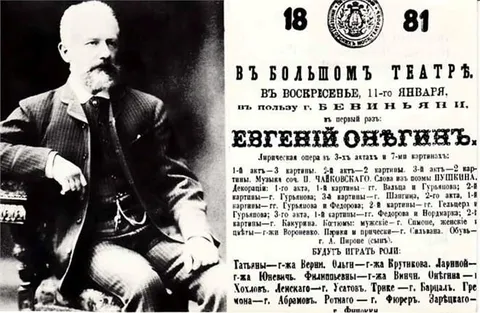
The first professional performance of the opera took place at the Bolshoi Theatre in Moscow on 11/23 January 1881, conducted by Enrico Bevignani, with the following soloists: Mariya Yunevich (Larina), Yelena Verni (Tatyana), Aleksandra Krutikova (Olga), Matilda Vinci (Filippyevna), Pavel Khokhlov (Onegin), Dmitry Usatov (Lensky), Abram Abramov (Gremin), Otto Führer (Zaretsky), Anton Bartsal (Triquet).

Extracts from Yevgeny Onegin were performed for the first time in Saint Petersburg (played and sung from the piano score) on or around 6/18 March 1879 in a private performance at the home of Yuliya Abaza [52], who also sang the role of the Nurse. Tatyana was sung by Aleksandra Panayeva, Olga by Yelizaveta Lavrovskaya, Onegin by Ippolit Pryanishnikov, Lensky by Pyotr Lodi, with Sofya Malozyomova providing the piano accompaniment.

On 22 April/4 May 1883, the opera was staged at the Kononov Theatre in Saint Petersburg by the Musical-Dramatic Amateur Circle in a performance conducted by Karl Zike and directed by K. A. Potekhin, with Yelena Samoylova (Larina), Yevgenia Tsezar-Insarova (Tatyana), M. I. Dyakonova (Olga), P. G. Kaplan (Filippyevna), Vladimir Alennikov II (Onegin), Ya. M. Moshkovich (Lensky), V. I. Iller (Gremin), Aleksandr Aleksandrov (Zaretsky), P. I. Ivanov (Captain), A. A. Karenin (Triquet).

It was not until 19/31 October 1884 that Yevgeny Onegin was staged at the Mariinsky Theatre in Saint Petersburg in a performance conducted by Eduard Nápravník [53], with soloists: Yekaterina Koncha (Larina), Emiliya Pavlovskaya (Tatyana), Mariya Slavina (Olga), Anna Bichurina (Filippyevna), Ippolit Pryanishnikov (Onegin), Mikhail Mikhaylov (Lensky), Mikhail Koryakin (Gremin), Nikolay Dementyev (Zaretsky), Vladimir Sobolev (Captain) and A. Ye. Muratov (Triquet). The next season's revival of the opera at the Mariinsky on 19 September/1 October 1885 was the first to include the Ecossaise (Act III, Nos. 20 & 21).

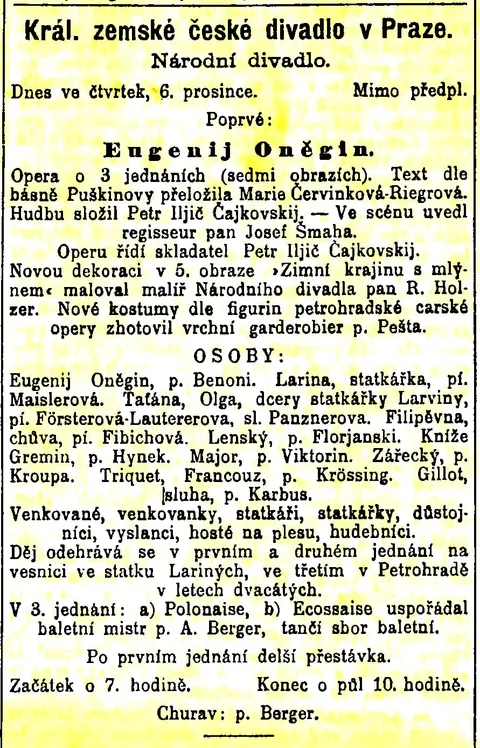
Tchaikovsky himself conducted the opera on three occasions: at the National Theatre in Prague on 24 November/6 December 1888 (with Berta Foerstrová-Lautererová as Tatyana, and in a Czech translation by Marie Červinková-Riegrová); at the Bolshoi Theatre in Moscow on 18/30 September 1889; and with Ippolit Pryanishnikov's opera company in Moscow on 26 April/8 May 1892.

Yevgeny Onegin was also staged in Odessa on 18/30 May 1890 by the Russian-Italian Opera Company, conducted by Ippolit Pryanishnikov, and at the Hamburg Opera Theatre on 7/19 January 1892, with Gustav Mahler conducting. It was staged for the first time in London in an English translation at the Olympic Theatre on 5/17 October 1892: Mademoiselle Selma (Larina), Fanny Moody (Tatyana), Lily Moody (Olga), Aleksandra Svyatlovskaya (Filippyevna), Eugène Oudin (Onegin), Iver McKay (Lensky), Charles Manners (Gremin), conducted by Henry Wood.

In the United States, the opera was first given a complete concert performance at Carnegie Hall in New York on 19 January/1 February 1908, conducted by Walter Damrosch (in an English translation). The first fully-staged performance took place at the Metropolitan Opera in New York on 24 March 1920, conducted by Artur Bodanzky (in an Italian translation).

Critical reception

Ever since he started work on this opera, enchanted by the poetic spirit of Pushkin's original, Tchaikovsky would always retain his great affection for the music that he wrote for his setting of the novel. In a letter to Sergey Taneyev on 2/14 January 1878 Tchaikovsky wrote: "I wrote this opera because one fine day I felt an inexpressible urge to set to music everything in Onegin that is just asking to be turned into music. I did this as best as I could. I worked on the opera with an indescribable enthusiasm and pleasure, not worrying too much as to whether it had action, effects etc. [...] I need people, not puppets; I would gladly tackle any opera [subject] in which, even if it did not have any powerful and unexpected effects, I should find beings like me, experiencing emotions which I too have experienced and can understand [...] I am looking for an intimate but powerful drama, based on a conflict of situations which I have experienced or witnessed myself, and which are able to touch me to the quick [...] Yes, this is an opera without any prospects; I knew this when I was writing it, and still I completed it and I shall definitely have it published [...] I wrote it because I was obeying an irresistible inner attraction. I assure you that it is only under this condition that one should write operas. As for thinking about effects and worrying about how it will work on the stage, that is only necessary to a certain degree. Otherwise, what you'll get is something effective, entertaining, perhaps even beautiful and interesting, but not fascinating, not actually alive" [54].

In another letter to Taneyev, dated 24 January/5 February 1878, Tchaikovsky again wrote: "... If it is true, as you claim, that opera is action, and that there is no action in my Onegin, then I am perfectly willing to call Onegin not an opera but whatever you like: scenes, a stage adaptation, a poema [55], just as you wish. I wanted to write a musical illustration to Onegin, whereby I had no choice but to resort to the form of drama and I am ready to take upon myself all the consequences of my notorious inability to understand the stage and to choose suitable subjects for it. It seems to me that all its inadequacies for the stage are redeemed by the charm of Pushkin's verses. However, in this regard I have certain misgivings which are much more important than the fear that the audience will not be shuddering with curiosity to find out the denouement of the plot. I'm referring to the sacrilegious impertinence with which, much against my will, I had to add to many of Pushkin's verses either my own or, in some places, verses by Shilovsky. That's what I am afraid of, that's what's really troubling me! As for the music, I should like to point out to you that if there was ever any music written with genuine enthusiasm, with love for the plot and characters it is inspired by, then that is the music to Onegin. I was melting and quivering with indescribable delight when I wrote it. And if even just the slightest portion of what I felt when composing this opera finds a response in the listeners, then I will be very satisfied and I want for no more" [56].

Publication

On 4/16 February 1878, Tchaikovsky wrote to Pyotr Jurgenson: "Now the piano reduction is complete, and I would be immensely glad if you were able to arrange for it to be engraved in the near future. This opera, so it seems to me, is more likely to be successful in homes and on concert stages than on the grand stage, and that is why the fact that its score will be published long before it enters the repertoire of the major theatres is not at all unfavourable. The success of this opera must begin from below, rather than from above. That is, it is not the theatre that will make it known to the public, but, on the contrary, the public, by becoming acquainted with it little by little, may come to love this opera, and then the theatre can stage it in order to satisfy the public's need" [57].

From the end of July to mid-September 1878, Tchaikovsky worked on correcting the proofs of the first edition of the piano score [58]. In October 1878, the piano score of Onegin was published (both as a complete set and as individual numbers) [59].

Continue readingShow less 8 more paragraphs

When sending back the corrected proofs to Pyotr Jurgenson (on 2/14 August 1878), Tchaikovsky had asked him to entitle the opera: "'Yevgeny Onegin'. Lyrical scenes in 3 acts". This is essential. For many reasons I don't want to call this thing an opera" [60].

In early 1880, Pyotr Jurgenson on his own initiative started making arrangements for having the opera's full score engraved—something that Tchaikovsky was not happy about [61]. In December 1880, the full score of the opera with the piano arrangement inserted as a supplement was published. In this edition the original version of the opera's final scene was retained (including Onegin's final line: "O death, o death! I go to seek thee out!...").

When the piano score was republished in 1881, amendments were made to the final scene. Corrections and amendments were also made by the author in 1891 [62], when preparing the second edition of the full score [63]. Tchaikovsky expressed the wish to remove the piano reduction from the score, but Pyotr Jurgenson did not comply with this request, and just changed the marking of the piano lines a little [64].

The textual variants in the three editions are mainly to do with the ending of the final scene. In 1880, when preparations were underway for the first production of the opera on the stage of the Bolshoi Theatre in Moscow, Tchaikovsky, following a request by his brother Anatoly [65], altered somewhat the text and stage directions for the final scene. On 17/29 October 1880, the composer wrote to Anatoly: "Although personally I don't agree with you and think that Pushkin, by various hints and allusions, entitles one as it were to let this scene conclude the way I did, I have paid heed to your advice and attempted to change the scene, as you will see from the enclosed sheets. Firstly, on page 242, instead of the direction that Tatyana is to fall into Onegin's arms, etc. I have written: Onegin draws closer. After that he sings what is written on that page, still addressing her as You [66]; then it just continues as it was before; at the very end, however, I have changed Tatyana's words—namely, she is no longer to be on the brink of giving in and losing her resolve, but will instead keep going on about duty; Onegin does not try to embrace her, but just implores her in words; then, instead of "I am dying!" Tatyana now says: Farewell forever! and disappears, whilst he, after standing there dazed for a few minutes, utters his concluding words. The general does not come in" [67].

The amendments indicated by Tchaikovsky referred to the text of the scene starting from Tatyana's response after Onegin's words: "... there is no other way for you" [... тебе другой дороги нет] (Andante molto mosso) and going up to the end of the scene. The changes to the stage directions indicated by Tchaikovsky in the letter quoted above were not made, except for the last one, and in all editions of the opera the stage directions for the original version of this scene have been retained.

In the 1891 edition many of the tempo observations were changed; cuts were made in the finale of Act II and in the Polonaise that opens the final act [68], and in Act III a chorus was replaced by the Ecossaise which Tchaikovsky had written at the request of Ivan Vsevolozhsky in 1885.

A German edition of the vocal-piano reduction (translated by August Bernhard) was published sometime before 1891 by D. Rahter in Hamburg.

Tchaikovsky's full score and vocal-piano reduction were published in volumes 4 (1948) and 36 (1946) respectively of the composer's Complete Collected Works, edited by Ivan Shishov (1950). They include the original versions of passages subsequently revised in later editions.

Autographs

Tchaikovsky's autograph full score, which includes the piano part for his vocal-piano reduction, is now preserved in the Glinka National Museum Consortium of Musical Culture in Moscow in two volumes, containing the Introduction and Act I and Acts II and III. The latter omits the additional Ecossaise (Act III, Nos. 20 and 21), the autograph of which is held at the Central Music Library of the Mariinsky Theatre in Saint Petersburg (VII.1.4.154).

A manuscript copy of the vocal-piano reduction in Karl Albrecht's hand, and containing annotations by Tchaikovsky and Sergey Taneyev, can be found in the Glinka National Museum Consortium of Musical Culture, Moscow. The same archive also holds a first edition of the score published by Jurgenson in 1880, containing Tchaikovsky's annotations when preparing the second edition (1891).

The sketches and rough draft of the opera Yevgeny Onegin have been lost. From the composer's correspondence with Nadezhda von Meck, we know that the rough draft was sent to her [69].

The autograph libretto is also preserved in the Glinka National Museum Consortium of Musical Culture in Moscow.

For the Russian dance in Act I — 'Across the Little Bridge' (Уж как по мосту-мосточку) — Tchaikovsky used the folksong 'Twine Round, Little Cabbage' (Вейся, не вейся, капустка). There is good reason to suppose that the composer borrowed this song from a collection of folksongs written down by S. N. Rachinskaya, a relative of Sergey Rachinsky. In December 1875, Sergey Rachinsky brought these songs with him to show them to Tchaikovsky. In a letter of 18/30 December 1875 [70], the composer asked him for permission to take them abroad with him, as he set off from Moscow on 20 December 1875/1 January 1876 [71].

For Triquet's couplets [72] the composer used the song "Le repos" by the French composer Amédée de Beauplan [73].
Where he wrote it

May 1877 – February 1878: 24 stays in 16 places. Numbered in the order he reached each place, from where he came from to where he went next, traced from the place and date of his letters.

Dates are New Style (N.S.), the calendar used in the West. In Russia, on the Old Style calendar, the date was 12 days earlier.

  1. Moscow4 January – 8 June 1877 · 41 letters
  2. Glebovo21 June – 5 July 1877 · 4 letters
  3. Moscow15 July – 18 July 1877 · 5 letters
  4. Saint Petersburg20 July – 25 July 1877 · 6 letters
  5. Moscow27 July – 7 August 1877 · 8 letters
  6. Kiev9 August 1877 · 1 letter
  7. Kamenka14 August – 18 September 1877 · 7 letters
  8. Kiev21 September 1877 · 1 letter
  9. Moscow24 September – 6 October 1877 · 6 letters
  10. Saint Petersburg13 October 1877 · 3 letters
  11. Berlin17 October 1877 · 3 letters
14 more stays
  1. Geneva21 October 1877 · 2 letters
  2. Clarens23 October – 12 November 1877 · 21 letters
  3. Paris13 November – 14 November 1877 · 3 letters
  4. Florence18 November 1877 · 1 letter
  5. Rome19 November – 22 November 1877 · 5 letters
  6. Venice23 November – 30 November 1877 · 7 letters
  7. Vienna1 December – 13 December 1877 · 18 letters
  8. Venice14 December – 27 December 1877 · 25 letters
  9. Milan28 December 1877 · 1 letter
  10. San Remo31 December 1877 – 7 January 1878 · 19 letters
  11. Milan9 January 1878 · 1 letter
  12. Genoa11 January 1878 · 1 letter
  13. San Remo13 January – 2 February 1878 · 27 letters
  14. Went on toNice3 February 1878 · 1 letter

As he wrote it

What he said about this work in his letters, from the first mention to the last. Each passage is quoted word for word from the letter; open the letter to read the rest.

While composing, 1877–1878

  1. This opera will be: "Yevgeny Onegin". The scenario is beautifully put together.

    To Anatoly TchaikovskyMoscowRead letter 564

  2. Lizaveta Andreyevna was silent and smiled good-naturedly, when suddenly she said: What about taking on "Yevgeny Onegin"?.

    To Modest TchaikovskyMoscowRead letter 565

  3. I don't remember whether I wrote to you that I've chosen the subject of "Yevgeny Onegin" for an opera. What do you say to that?

    To Modest TchaikovskyMoscowRead letter 568

  4. I received your letter yesterday, dear Modya. Initially, your criticism of the choice of "Onegin" angered me, but this lasted only an instant.

    To Modest TchaikovskyGlebovoRead letter 570

  5. Scoff at "Yevgeny Onegin" as much as you want, but I'm writing my music with great pleasure, and I know for sure that the poetry of the subject and the indescribable beauty of the text will prevail.

    To Anatoly TchaikovskyGlebovoRead letter 571

  6. To Anatoly TchaikovskyGlebovoRead letter 573

  7. I spent the whole of June at Kostya's, where was very pleasant for me, and where I wrote to whole acts of my new opera — but just imagine, it's not "Ephraim", but rather "Yevgeny Onegin"!

    To Vladimir ShilovskyMoscowRead letter 578

  8. I wrote the greater part of "Onegin" at Glebovo, and I'd like very much to have all the rest written before the start of the academic year, but I don't know whether I'll manage it.

    To Modest TchaikovskySaint PetersburgRead letter 580

All 238 letters

While composing, 1877–1878

  1. To Konstantin ShilovskyMoscowRead letter 589

  2. And that is precisely how I composed "Onegin", without setting myself any extraneous goals. As it has turned out, though, "Onegin" will not be interesting on the stage.

    To Nadezhda von MeckKamenkaRead letter 597

  3. I have finished the instrumentation of the first act of "Onegin"; all that remains for me to do is to insert the markings and the inscriptions.

    To Nikolay RubinsteinClarensRead letter 623

  4. I have started to work quite assiduously and have completed the instrumentation of the first act of my opera, which I sent to Moscow yesterday, addressed to Nikolay Grigoryevich.

    To Karl AlbrechtClarensRead letter 624

  5. I sent you the 1st act of "Onegin" on Monday, i.e. 4 days ago, but just imagine my horror! Yesterday it was returned to me, on the grounds that the paper it was wrapped in had been torn to shreds.

    To Nikolay RubinsteinClarensRead letter 630

  6. In Clarens I completed the orchestration of the first act of "Onegin" and sent it to Rubinstein. Farewell, my dear friend.

    To Nadezhda von MeckParisRead letter 635

  7. I think that by now you will have had the 1st act of "Onegin" for a while. This is how I would distribute the roles:

    To Nikolay RubinsteinRomeRead letter 642

  8. …set about completing the instrumentation of the 1st scene of the 2nd act of "Onegin" (the 1st act and 1st scene of the 2nd act have to be ready as soon as possible in order to send them to Moscow where, in all likelihood, they will be…

    To Nadezhda von MeckVeniceRead letter 648

  9. 3) Have you seen any of the 1st act of "Onegin"? Did you like it or not?

    To Nikolay KashkinViennaRead letter 660

  10. I say this with regard to Onegin. You sugared very nicely and appetizingly the pill which I had to swallow.

    To Karl AlbrechtVeniceRead letter 671

  11. I also received the good news that the first act of "Onegin" has delighted my comrades, including Rubinstein. I was very fearful of their censure.

    To Nadezhda von MeckVeniceRead letter 673

  12. It seems to me that the intent of Karlusha's diplomatic note is precisely that it will be difficult to stage "Onegin" this year.

    To Nikolay RubinsteinVeniceRead letter 675

  13. …together with Rubinstein and someone else you played through the first act of my "Onegin", from another, that you have written a symphony, and from yet another letter that you were due to take part in a symphonic evening concert.

    To Sergey TaneyevVeniceRead letter 681

  14. I've been waiting for some time for a reply from Kashkin. And as for you, golubchik, write about anything to me that doesn't concern "Onegin".

    To Karl AlbrechtVeniceRead letter 687

  15. There's something else I would have liked to discuss, but I'm very tired and will put it off until another time. When will I find out for sure whether Onegin is being put on or not?

    To Nikolay RubinsteinSan RemoRead letter 713

  16. It may very well be that you are right in saying that my opera is not effective on the stage. But to this I should like to reply that I don't give a damn about its ineffectiveness on the stage.

    To Sergey TaneyevSan RemoRead letter 716

  17. None of my Moscow friends, despite all my requests, have yet explained to me how my classes are going, and best of all, no-one has written a word to me about whether "Onegin" is going on!

    To Anatoly TchaikovskySan RemoRead letter 718

  18. I thank you both for your warm words about Onegin. Now, that for me is 10,000,000,000,000,000,000,000 times more valuable than the patronising encouragement of some Frenchman.

    To Karl AlbrechtSan RemoRead letter 720

  19. I also earnestly request you to take on the printing of my opera "Yevgeny Onegin". This opera was written in wholly exceptional circumstances.

    To Pyotr JurgensonSan RemoRead letter 725

  20. I will not squabble with you further regarding the effectiveness or ineffectiveness of "Onegin" on the stage.

    To Sergey TaneyevSan RemoRead letter 738

  21. Rubinstein was very put out by the imperious tone of a telegram that Davydov sent him, demanding the score of "Yevgeny Onegin".

    To Anatoly TchaikovskySan RemoRead letter 744

  22. After all, since September I have not once touched a piano; 7) The seventh point bears a direct relation to Onegin. I simply want to ask you to write to me when you have a minute to spare.

    To Karl AlbrechtSan RemoRead letter 748

  23. Then I will say: if you please, but on such and such a condition, etc.! As for performances at the Conservatory, these would be most advantageous for "Onegin".

    To Pyotr JurgensonSan RemoRead letter 750

  24. You won't believe how glad I am that you like "Onegin". I value your opinion very, very much.

    To Sergey TaneyevClarensRead letter 799

  25. To Sergey TaneyevClarensRead letter 807

  26. In the first scene of the 2nd act of "Onegin" there are couplets for Triquet. These couplets are very

    To Pyotr JurgensonKamenkaRead letter 812

  27. To Pyotr JurgensonKamenkaRead letter 816

  28. Last evening I played through almost the whole of "Yevgeny Onegin"! The author was the sole listener.

    To Modest TchaikovskyBrailovRead letter 844

  29. Thank you for the letter and for the Lensky passage. I still haven't received "Onegin", but I'm working with great diligence and won't delay you.

    To Pyotr JurgensonVerbovkaRead letter 865

  30. I still haven't received a single note of "Onegin", but yesterday the receipt arrived, and I hope that today or tomorrow the package itself will appear.

    To Pyotr JurgensonVerbovkaRead letter 870

  31. I haven't received "Onegin". Why not?

    To Pyotr JurgensonVerbovkaRead letter 872

  32. …10 to 12 cucumbers every morning in my presence, then I work on the proofs of "Yevgeny Onegin", afterwards we generally go for walks together, predominantly to Vysokoye, in the evening Sasha Peresleni acts the fool, Tanya acts up in various…

    To Anatoly TchaikovskyVerbovkaRead letter 881

  33. I've received the proofs of "Onegin", and will be tinkering with them for some time; there are a fair number of mistakes, the majority of which are my fault, but also that of the proofreader.

    To Pyotr JurgensonVerbovkaRead letter 883

  34. I kiss you numerous times. I'm still tinkering with the proofs of "Onegin".

    To Anatoly TchaikovskyVerbovkaRead letter 884

  35. I asked you to entitle it thus: Yevgeny Onegin Lyrical scenes in 3 acts. This is essential.

    To Pyotr JurgensonVerbovkaRead letter 885

  36. Even the proofreading of "Onegin" has been brought to the desired conclusion. I played through the entire opera here, and it caused quite an effect.

    To Anatoly TchaikovskyVerbovkaRead letter 887

  37. "Yevgeny Onegin" has finally been handed over. It's very sweet for me to think that you'll be visiting me at the beginning of October, as will Modest.

    To Anatoly TchaikovskyMoscowRead letter 915

  38. The other day I sent you the proofs of "Onegin".

    To Eduard NápravníkMoscowRead letter 923

  39. Correspondence is neither "conveyed", nor "managed" — but rather conducted. I saw Bessel, who is hurling thunder and lightning at Osip Ivanovich because of "Onegin".

    To Pyotr JurgensonSaint PetersburgRead letter 946

  40. There has been a misunderstanding regarding the rough manuscript of "Onegin". I wanted to put it in order first, but my Aleksey, based on the inscription "To Nadezhda Filaretovna von Meck", instructed that it be brought to you.

    To Nadezhda von MeckKamenkaRead letter 959

  41. Ask Kashkin to write to me about how the concerts went, how the rehearsals of "Onegin" are going, and about the Conservatory in general.

    To Pyotr JurgensonFlorenceRead letter 978

  42. My friend, please, send me the rough manuscript of "Onegin" — I want to put it in order.

    To Nadezhda von MeckFlorenceRead letter 980

  43. What about Yevgeny Onegin? In a week's time it will be staged.

    To Karl AlbrechtFlorenceRead letter 990

Afterwards

  1. I still don't have any news about how the performance of Onegin went. This is something that interests me terribly.

    To Karl AlbrechtParisRead letter 1030

  2. Write to me, golubchik, how "Onegin" is being done at Abaza's, i.e. on stage with a chorus, or in the hall and just solo?

    To Anatoly TchaikovskyClarensRead letter 1050

  3. Why haven't you written me a word about "Yevgeny Onegin"? I've still yet to hear anything.

    To Pyotr JurgensonClarensRead letter 1055

  4. Until now I had known nothing about the performance of "Onegin", but today I received an issue of "The Voice", in which there is a feuilleton by Laroche, and from that I did manage to find out one or two things, including some information…

    To Sergey TaneyevClarensRead letter 1056

  5. Did you know that "Onegin" will be performed at Abaza's in Petersburg? Lavrovskaya, Abaza, Panayeva, Pryanishnikov and Lody will be singing.

    To Pyotr JurgensonClarensRead letter 1061

  6. Today I read the programme for the Musical Society concert in "New Time", and to my surprise, I saw the letter scene from "Yevgeny Onegin".

    To Anatoly TchaikovskyClarensRead letter 1068

  7. Mr Tchaikovsky asked me to enquire of you how it came to pass that in Petersburg the singer Kamenskaya has twice performed the letter scene from "Yevgeny Onegin"?

    To Pyotr JurgensonClarensRead letter 1069

  8. To Lidiya KolsMoscowRead letter 1137

  9. I was very pleased by what you wrote to me about "Onegin". I dare say that after the death of the poor Grand Duke, the performance won't be taking place!

    To Pyotr JurgensonParisRead letter 1114

  10. I was all the more overjoyed at the news that "Onegin" is going ahead, as I'd decided it would have been cancelled due to the poor young Grand Duke's death.

    To Pyotr JurgensonParisRead letter 1125

  11. On 1st April I'll be receiving 1000 rubles from Nadezhda Filaretovna. Besides this, they'll probably owe me something from Moscow for "Onegin".

    To Anatoly TchaikovskyParisRead letter 1130

  12. Nevertheless, it's unlikely that I'll make it to you before the middle of April. On Saturday 17th March, my "Onegin" is going on in Moscow, and I want to hear it without fail.

    To Lev DavydovSaint PetersburgRead letter 1135

  13. On Friday I am going with my brothers to Moscow to hear "Onegin" and will return with them to Petersburg, where I shall live until Easter, which my dear old father is determined to celebrate with me.

    To Nadezhda von MeckSaint PetersburgRead letter 1136

  14. Generally, I was the unfortunate victim here, who was being forcibly dragged from one place to another. It isn't this that torments me, but the fact that I didn't furnish you with a seat at "Yevgeny Onegin".

    To Yekaterina PeresleniSaint PetersburgRead letter 1138

  15. This letter contained information about "Onegin" and much else. For God's sake, forgive me, dear friend, for the inconvenience.

    To Nadezhda von MeckSaint PetersburgRead letter 1142

  16. I would ask you to hold onto this portrait for the time being, or if possible, to give the same to S. A. Bernard, who is due to send me all the performers from "Onegin" shortly.

    To Pyotr JurgensonKamenkaRead letter 1157

  17. I'll do the same for the rest of the cast of "Onegin". I won't deprive you of anything today, because there's no time — the train is about to leave.

    To Karl AlbrechtKamenkaRead letter 1158

  18. I mean, I haven't once thanked you yet for the essential assistance which you rendered to me in connection with Yevgeny Onegin!

    To Konstantin ShilovskyKamenkaRead letter 1181

  19. I'm very happy that you have given "Onegin" to Aleksandra Ivanovna. To tell the truth, I should have felt somewhat awkward to assign this work to Taneyev.

    To Pyotr JurgensonKamenkaRead letter 1182

  20. I received news from Jurgenson that on 13 June in Moscow the whole of "Onegin" will be performed once more for the Grand Duke Konstantin Nikolayevich.

    To Anatoly TchaikovskyKamenkaRead letter 1195

  21. "Yevgeny Onegin", opera. 5) Tchaikovsky. 12 morceaux of moderate difficulty. 6) Tchaikovsky. Sonata. 7) Tchaikovsky.

    To Pyotr JurgensonKamenkaRead letter 1202

  22. I'm looking forward with great interest to the proofs of "Yevgeny Onegin". I knew that there were minor oversights, but I didn't think there were many.

    To Pyotr JurgensonKamenkaRead letter 1205

  23. One from S. I. Jurgenson, who writes to me expressing incredibly enthusiastic feelings in connection with Onegin being given on the 11th for the Grand Duke Konstantin Nikolayevich, and another from Marie.

    To Modest TchaikovskyKamenkaRead letter 1207

  24. I think that you exaggerate the virtues of my music, and I doubt that "Onegin" was a magnificent work. But undoubtedly this music was deeply felt to the utmost degree, and that it was the product of a deep and sincere passion.

    To Sofiya JurgensonKamenkaRead letter 1208

  25. 1) I marked the individual numbers in "Onegin" in your store, on the copy that you gave me, which it goes without saying remained with you.

    To Pyotr JurgensonKamenkaRead letter 1213

  26. The best known of his compositions are 4 operas (The Oprichnik, Vakula the Smith, Onegin, The Maid of Orleans), 4 symphonies, several symphonic poems (The Tempest, Romeo and Juliet, Francesca da Rimini), 3 string quartets, two concertos…

    To Meyers Konversations-Lexikon (editors of)KamenkaRead letter 1229a

  27. As for "Onegin", then I still have every hope that he'll be found. However, I've still had no news on that subject from Kondratyev.

    To Pyotr JurgensonKamenkaRead letter 1230

  28. I still don't understand anything regarding the proofs of "Onegin". What do you mean?

    To Pyotr JurgensonKamenkaRead letter 1236

  29. I was also surprised to learn that "Onegin" was on at K. Shilovsky's, and that they were expecting me there. I've never heard anything like that before.

    To Modest TchaikovskySimakiRead letter 1259

  30. 1) I do not have either the full score of the Serenade, nor the copy of "Onegin" with the separate numbers marked.

    To Pyotr JurgensonSimakiRead letter 1264

  31. I should really not wish to offend Messer, who has always given me the impression of a good-natured fellow, and whose attentions to "Onegin" (represented by proofs that were completely incomprehensible to me) touched me.

    To Pyotr JurgensonSimakiRead letter 1272

  32. Tomorrow morning I'm sending you the suite and "Onegin". There are quite a few misprints in the suite.

    To Pyotr JurgensonKamenkaRead letter 1304

  33. Yesterday I sent off to Jurgenson: 1) the score of the suite, and 2) "Onegin" with the corrections you made.

    To Yury MesserKamenkaRead letter 1306a

  34. I wrote this music with love, with pleasure, just like "Onegin", the 4th Symphony and 2nd quartet.

    To Nadezhda von MeckKamenkaRead letter 1311

  35. 5) From "Yevgeny Onegin", I've consented to his performing the waltz and any vocal number he pleases, but the polonaise is excluded.

    To Pyotr JurgensonSaint PetersburgRead letter 1325

  36. Bessel ought to have sent you Batyushka's work on "Onegin". Have you received it?

    To Pyotr JurgensonParisRead letter 1345

  37. I'll be free to review the full score of "Yevgeny Onegin" in Petersburg, where I'll be somewhere around the first of March.

    To Pyotr JurgensonRomeRead letter 1422

  38. I should like to do the proofs of "Onegin" over 2 or 3 weeks, which I'll spend in Petersburg. There I'll also orchestrate the concerto, which is already completely ready in the form of two pianos.

    To Pyotr JurgensonRomeRead letter 1430

  39. But then he will be playing my Sonata and two fantasias on themes from "Onegin": one by Liszt, the other by Pabst. He will be giving the same performance at his concert in Petersburg, so I shall hear him either there or here in any case.

    To Nadezhda von MeckSaint PetersburgRead letter 1444

  40. Furthermore, I am obliged to spend the whole day visiting someone or other without fail — well, in short, I have absolutely no time to think about the proofs of "Onegin" here.

    To Pyotr JurgensonSaint PetersburgRead letter 1459

  41. …have the honour of replying to your questions point by point: 1) In the Onegin waltz my indications were not made carelessly, as you deigned to put it, but quite precisely — that is, in the violin, legato occurs only where it has been…

    To Karl AlbrechtKamenkaRead letter 1518

  42. If you were rich, I should have begged you to buy the performance fees for "The Maid" and "Onegin" from me for 4 thousand.

    To Pyotr JurgensonBrailovRead letter 1525

  43. P. S. Who is this singing "Onegin"? Write to me if you find out.

    To Anatoly TchaikovskyKamenkaRead letter 1583

  44. Write to me about who will be singing in "Onegin"?

    To Anatoly TchaikovskyKamenkaRead letter 1594

  45. I have received news that while my "Maid" is being staged in Petersburg, "Yevgeny Onegin" will be on at the Bolshoi Theatre in Moscow.

    To Nadezhda von MeckKamenkaRead letter 1601

  46. To Anna MerklingKamenkaRead letter 1602

  47. To Anatoly TchaikovskyKamenkaRead letter 1614

  48. On Saturday I have to talk with Bevignani about "Onegin", which he's putting on for his benefit; on Sunday, Klindworth is giving a formal dinner in my honour; my "Italian Capriccio" is on next week, and I want to hear at least one…

    To Modest TchaikovskyMoscowRead letter 1629

  49. Did I write to you, my dear, that "Yevgeny Onegin" is being going on in a properly-staged performance at the Bolshoi Theatre in Moscow?

    To Nadezhda von MeckSaint PetersburgRead letter 1632

  50. The rehearsal of "Onegin" is today. Will you be coming?

    To Modest TchaikovskyMoscowRead letter 1637

  51. Here (i.e. in Moscow), "Yevgeny Onegin" is on at the same time. Thank you for remembering me.

    To Anna Aleksandrova-LevensonMoscowRead letter 1640

  52. I was at the rehearsal of "Onegin" today, left delighted with the soloists' performances of the 1st act, and I couldn't refuse Bevignani's earnest request to attend the orchestral rehearsal and the performance.

    To Modest TchaikovskyMoscowRead letter 1647

  53. I'll be back by the 5th, i.e. for the last rehearsals of "Onegin". I couldn't refuse Bevignani his request to attend the rehearsals and the first performance, set for 11 January.

    To Modest TchaikovskyMoscowRead letter 1651

  54. I presume that if Lyova and Tanya recover, they'll go to see "Onegin" and "The Maid of Orleans" in Moscow and Petersburg.

    To Modest TchaikovskyKamenkaRead letter 1661

  55. But what restores some of my good spirits, my dear maestro, is that Onegin has won your sympathy. I have always considered this the favourite son of my works

    To Enrico BevignaniRomeRead letter 1693a

  56. …aware, in the last season two of my operas were produced on the Imperial stages ("Yevgeny Onegin" in Moscow and "The Maid of Orleans" in Petersburg), both with significant success, giving me reason to hope that, upon the resumption of…

    To Konstantin PobedonostsevKamenkaRead letter 1759

  57. …from the RMS this year, amounting to 300 rubles, or exceptionally 1000, when Onegin was on, and last year with regard to the mass.

    To Pyotr JurgensonRomeRead letter 1911

  58. You write that "Onegin" isn't going on, and that I ought to have petitioned Begichev. Far from it!

    To Pyotr JurgensonRomeRead letter 1926

  59. Completely agree to "Onegin" performance. Proofs sent, and also ask to send three hundred rubles.

    To Pyotr JurgensonKamenkaRead letter 2142

  60. Whereupon, I embrace you and thank you with all my heart for the fact that "Onegin"s libretto is already being printed.

    To Pyotr JurgensonKamenkaRead letter 2381

  61. After all, "Mazepa" and "Yevgeny Onegin" aren't in three acts because they are shorter than other operas, but because such a division was demanded for artistic reasons and staging considerations.

    To Pyotr JurgensonKamenkaRead letter 2388

  62. I am glad that "Onegin" is still holding its own on the Kharkov stage.

    To Ilya SlatinMoscowRead letter 2408

  63. The Sovereign has ordered that "Onegin" be staged next season. The roles are already cast, and the choruses are already rehearsing.

    To Nadezhda von MeckSaint PetersburgRead letter 2454

  64. In Kharkov, between trains, I managed to go into the city, have lunch and go for a stroll. Passing by the theatre, I saw "Yevgeny Onegin" advertised for that evening.

    To Anatoly TchaikovskyKamenkaRead letter 2463

  65. If I'm not mistaken, "Mazepa" has been on once in Piter, and "Onegin" once in Moscow. Get the pennies that are due to me.

    To Pyotr JurgensonKamenkaRead letter 2489

  66. As you quite rightly state, I can only confine myself to thanking Ms Skalkovskaya for her readiness to sing in "Onegin".

    To Aleksandr ZhedrinskyKamenkaRead letter 2501

  67. But, in any event, I have to attend the production of "Yevgeny Onegin" in Petersburg. I am thinking of this with the usual trepidation and dread.

    To Nadezhda von MeckRead letter 2528

  68. But I'm far more concerned about "Lizaveta Nikolayevna" than "Onegin". Please, be philosophical and prepare yourself for victory at the cost of many petty quibbles, which are inevitable in such cases.

    To Modest TchaikovskyPleshcheyevoRead letter 2544

  69. They say that "Onegin" will be given in Petersburg in October. In which case, I won't be staying here long.

    To Praskovya TchaikovskayaPleshcheyevoRead letter 2546

  70. Nápravník's letter is in answer to my question: when will "Onegin" be on, and when will I be needed there? He replies that it will probably be on around 20 October, and that he'll let me know in due time.

    To Pyotr JurgensonPleshcheyevoRead letter 2555

  71. I received a letter from Nápravník informing me that "Onegin" will probably be on around 20 October. This means we'll be seeing each other soon.

    To Modest TchaikovskyPleshcheyevoRead letter 2558

  72. Besides "Onegin", I've also been summoned there by Modest, who needs to see me about something at once. I'll be coming to Moscow again immediately after the production of "Onegin", so I'll be seeing you soon in any case.

    To Pyotr JurgensonPleshcheyevoRead letter 2563

  73. "Onegin" is scheduled for Friday the 19th, but this is hardly likely; the costumes still aren't ready. I'll send you a message as soon as everything has been determined more exactly.

    To Pyotr JurgensonSaint PetersburgRead letter 2568

  74. "Onegin" going on Friday.

    To Pyotr JurgensonSaint PetersburgRead letter 2569

  75. "Yevgeny Onegin" was a success; the takings were magnificent. The Sovereign will be here tomorrow, and I have to stay until he attends "Onegin", because I hear from all sides how favourably he is disposed towards me.

    To Pyotr JurgensonSaint PetersburgRead letter 2576

  76. Here, "Yevgeny Onegin" has produced great delight, if not enthusiasm. Bookings for today's performance, which opened on Monday, were all taken by the 1st day.

    To Pyotr JurgensonSaint PetersburgRead letter 2577

  77. To Mily BalakirevSaint PetersburgRead letter 2580

  78. I was supposed to leave on the 30th, but the day before the theatre let it be known that the Sovereign would surely be attending the 4th performance of "Onegin" on the 31st, and so I was obliged to stay in Piter for another 2 nights.

    To Praskovya TchaikovskayaBerlinRead letter 2583

  79. What does it mean, however, knowing that "Onegin" is a success! (indeed, will it really last?). I feel a lightness in my soul as I haven't felt in ages, and I haven't enjoyed solitude so much in ages as I do now.

    To Modest TchaikovskyBerlinRead letter 2584

  80. If you don't have it in the safe, then make arrangements for most kind Osip Ivanovich to receive the performance fees for 8 productions of "Onegin" and 4 of "Mazepa", and take my next fee from Moscow yourself.

    To Pyotr JurgensonDavosRead letter 2596

  81. To Lev DavydovParisRead letter 2605a

  82. I did not have the opportunity to read your review of my opera "Yevgeny Onegin" when it appeared in "New Time", because I happened to be abroad.

    To Aleksey SuvorinMoscowRead letter 2622

  83. I am still engrossed in an atrociously difficult and terribly urgent job, and so even to you, my dear benefactress, I can only write a few lines in reply to your ever so nice report on Onegin and Mazepa.

    To Emiliya PavlovskayaMoscowRead letter 2630

  84. Thank you for all the nice things you say about my music — I am glad that you like Onegin.

    To Emiliya PavlovskayaMaydanovoRead letter 2672

  85. Thanks for your sweet, wonderful letter. I am awfully glad that Onegin is still on the repertoire and continues to draw the public.

    To Emiliya PavlovskayaMaydanovoRead letter 2685

  86. The time in which "Onegin" is set is also not particularly distant from ours — but the Crimean War, the emancipation of the serfs, and the reign of Alexander II in general draw a sharp dividing line between the 1st and 2nd halves of the…

    To Pavel PereletskyMaydanovoRead letter 2690

  87. I had a meeting with Vsevolozhsky, who asked me to write a new dance for the 2nd ball in "Onegin".

    To Pyotr JurgensonMaydanovoRead letter 2751

  88. Regarding the money, I wanted to receive the fees for 9 productions of "Onegin", and despite every possible effort, it turns out that I can't have the money for another week.

    To Anatoly TchaikovskyMaydanovoRead letter 2853

  89. Among my operas, it is Yevgeny Onegin which has had the most success. It is thanks to the gracious attention of His Majesty the Emperor that it is being performed in Petersburg.

    To Félix MackarMaydanovoRead letter 2854

  90. Presumably you should have 1500 of my money, if we count the Musical Society royalties from Moscow and the fees due from one performance of "Onegin" in Petersburg, if that took place at the end of April.

    To Pyotr JurgensonParisRead letter 2954

  91. …from them yet?, and 2) when you have the opportunity, ask Osip Ivanovich whether "Onegin" was staged after Easter?

    To Pyotr JurgensonMaydanovoRead letter 2992

  92. The greater part of "Onegin" was written and scored in this villa, where there was a boarding-house run by a certain Madame Mayor, a very nice lady.

    To Emiliya PavlovskayaMaydanovoRead letter 3013

  93. …sent, at his request, either to him or directly to Mr Emile Sauret the waltz from Yevgeny Onegin with errors in the parts such that it couldn't be played without the score.

    To Pyotr JurgensonSaint PetersburgRead letter 3081

  94. So address your letters to me as follows: Moscow, Jurgenson, to be forwarded to Mr P. T.. I have written to Jurgenson what you asked me to tell him regarding the Waltz from Onegin.

    To Félix MackarSaint PetersburgRead letter 3082

  95. Mr ***, speaking about Mr Nápravník's importance in relation to the repertoire of the Imperial Russian Opera, mentions in passing that Mr Nápravník "positively discouraged me from putting the opera "Yevgeny Onegin" on the official stage".

    To Musical Review (editor of)MoscowRead letter 3123a

  96. We were never together at Nápravník's, except only in 1874 when "Onegin" was not yet conceived. I can easily show this.

    To Vasily BesselMoscowRead letter 3127

  97. Yesterday I returned to the country for 2 weeks, and I'm hastening to talk with you. I want to explain to you why thus far I have yet to deny the slander printed against you concerning "Onegin".

    To Eduard NápravníkMaydanovoRead letter 3133

  98. Secondly, I would need to prepare myself before conducting "Onegin", and I don't have time for that. Thirdly, are you aware, my dear and cherished friend, that I am in a state of terrible grief?

    To Emiliya PavlovskayaMoscowRead letter 3152

  99. To Emiliya PavlovskayaMoscowRead letter 3164

  100. It seems to be that "Cherevichki", like "Onegin", won't particularly cause a stir, but little by little they will grow to love this opera.

    To Modest TchaikovskyMaydanovoRead letter 3168

  101. But in that case, dear Monsieur Détroyat, why not stage in Paris one of my six operas which have already been staged in Petersburg, and of which some (especially one of them: Yevgeny Onegin) have had a resounding success.

    To Léonce DétroyatFrolovskoyeRead letter 3598a

  102. Marya Frantsovna! I have now received your dear letter and translation of the libretto of "Yevgeny Onegin".

    To Marie Červinková-RiegrováFrolovskoyeRead letter 3668

  103. To Aleksandr ZilotiMoscowRead letter 3673

  104. …was awkward to raise the matter myself, because I thought that the production of Onegin had perhaps been postponed or cancelled altogether, given that since February I hadn't received any news from Prague.

    To Eduard NápravníkFrolovskoyeRead letter 3674

  105. When is the first performance of "Onegin"? I should very much like to conduct it myself.

    To Adolf ČechFrolovskoyeRead letter 3676

  106. First of all, I think you with all my heart for your troubles in sending the drawings and furnishings of "Onegin" to Prague.

    To Vladimir PogozhevFrolovskoyeRead letter 3682

  107. Whereupon, it seems, I'll be going to Prague, for a production of "Onegin". I think I'll be spending December at home, in Russia.

    To Anatoly TchaikovskyFrolovskoyeRead letter 3683

  108. I even think that my agent Mr Zet in Petersburg has already sent a letter to Prague enquiring whether it might not be possible to postpone Onegin until January.

    To Adolf ČechFrolovskoyeRead letter 3687a

  109. Now both the one and the other are complete, and I shall quite soon have to give up my rural seclusion. On 5 November I have a concert in Petersburg, and after that I'm going to Prague for a production of my Yevgeny Onegin.

    To Anna BrodskyFrolovskoyeRead letter 3688

  110. Around 5/17 November I have to give a concert of my own works in Petersburg; from there I am going to Prague, and possibly also to Warsaw and Vienna. I'm going to Prague because Onegin is being staged there, and also because of a concert.

    To Félix MackarFrolovskoyeRead letter 3690

  111. Mr Director! I thank you warmly for your invitation to come to Prague on the occasion of the performance of "Yevgeny Onegin".

    To František ŠubertFrolovskoyeRead letter 3694

  112. I have a very big favour to ask you. It seems that you have irrevocably fixed the first performance of "Onegin" for 30/18 November.

    To František ŠubertFrolovskoyeRead letter 3696

  113. Around 1 November I should be in Petersburg, where I'm staying until the 12th; the following day I'm off to Prague for the production of "Onegin".

    To Praskovya TchaikovskayaFrolovskoyeRead letter 3697

  114. On the 13th I'm off to Prague, where they'll be expecting me for the final rehearsals and for the first performance of Onegin.

    To Anatoly TchaikovskyFrolovskoyeRead letter 3701

  115. Highly respected Herr Čech Today, for the first time in my life, I picked up the printed full score of "Onegin" and looked through it!

    To Adolf ČechFrolovskoyeRead letter 3702

  116. I have finished my work and am now preparing for my concerts and for conducting "Onegin" in Prague.

    To Yuliya ShpazhinskayaFrolovskoyeRead letter 3705

  117. In three days I am going to Piter; my concert is on 5th November; on 12th November I am taking part in a Musical Society concert, then I shall be dashing off to "Yevgeny Onegin" in Prague on 18 or 20 November.

    To Mikhail Ippolitov-IvanovFrolovskoyeRead letter 3710

  118. On the 12th I am also participating in a Musical Society concert, and the next day I have to leave for Prague for rehearsals of my "Onegin".

    To Nadezhda von MeckFrolovskoyeRead letter 3711

  119. …editors of the Parisian newspapers will travel so far for the pleasure of hearing "Onegin" and it is more probable that Monsieur Mackar is quite wrong about the "passes" and railway "permits", and if I communicate this proposition to you it…

    To František ŠubertFrolovskoyeRead letter 3713

  120. As to the time I must spend with you discussing "Onegin", then it would be best if this could all be done on Friday. What time would be convenient for you?

    To Eduard NápravníkSaint PetersburgRead letter 3723

  121. From the first day of my arrival I began rehearsals for the concert, and afterwards, for "Yevgeny Onegin. The rehearsals took up the whole day, and in the evenings there were invitations to visits and celebrations.

    To Yuliya ShpazhinskayaViennaRead letter 3734

  122. Within three days of my arrival there, a concert was given at the National Theatre which was made up exclusively of my compositions, and after that there took place, on 24 November/6 December, the first performance of Yevgeny Onegin.

    To Grand Duke Konstantin KonstantinovichFrolovskoyeRead letter 3736

  123. "Onegin" has been on quite frequently in Moscow; won't you be taking the money for this season? Something in the order of a thousand rubles are probably due.

    To Pyotr JurgensonSaint PetersburgRead letter 3744

  124. I have received your friendly lines and thank you cordially for the good news that you gave me about "Onegin". This makes me completely happy, as I am very fond of this opera.

    To Adolf ČechSaint PetersburgRead letter 3745

  125. Thank you also for the pleasant news about "Onegin", and about the fact that I have been chosen as a member of the "Umĕlecká Beseda".

    To Adolf PateraFrolovskoyeRead letter 3749

  126. With this, Mr Director, please allow me to thank you on this occasion for "Onegin" and please accept my best regards.

    To František ŠubertFrolovskoyeRead letter 3769

  127. Yesterday I was visited by an old friend of mine from the provinces, who told me that the performer of the role of Tatyana in the latest Moscow production of "Onegin" was magnificent.

    To Mariya Klimentova-MuromtsevaFrolovskoyeRead letter 3770

  128. To Antonín DvořákFrolovskoyeRead letter 3772

  129. Sittard would very much like you to send him Onegin and The Maid of Orleans. Please do so at my expense.

    To Daniel RahterHannoverRead letter 3816

  130. Dear friend! 1) London might be putting on "The Maid of Orleans" or "Onegin", although I don't understand why they say "Mazepa" conflicts with Byron.

    To Pyotr JurgensonTiflisRead letter 3846

  131. Next year, for example, they want to give a new production of "Onegin" — but they have no Tatyana! Astonishing!

    To Mariya Klimentova-MuromtsevaFrolovskoyeRead letter 3883

  132. I have a very busy time ahead: on 10th September, rehearsals for "Onegin" will begin in a new production in Moscow. This is followed by preparations for the concerts, and the concerts themselves.

    To Anatoly TchaikovskyKamenkaRead letter 3926

  133. I have now already been here for a week, and the day after tomorrow I am going to a nearby village to see my niece, and then on to Moscow. There I shall attend rehearsals and conduct the first performance of a new production of "Onegin".

    To Yuliya ShpazhinskayaKamenkaRead letter 3928

  134. While in Kiev, I heard "Onegin" at the theate. The production was splendid, the ensemble good, but amongst the actors, except perhaps for Medvedev, I did not care for any of them in particular.

    To Varvara ZarudnayaFrolovskoyeRead letter 3929

  135. …for me to be in Petersburg that day, because the first performance of my opera "Onegin" is due to take place on the 15th (in a new production) in Moscow, and I have already given my word to attend rehearsals and to conduct the performance…

    To George Alexander Mecklenburg-StrelitzFrolovskoyeRead letter 3930

  136. Tomorrow I'm on my way to Moscow, where rehearsals are starting for a new production of "Onegin". The performance takes place on the 15th.

    To Anatoly TchaikovskyFrolovskoyeRead letter 3931

  137. I beg to inform you that "Onegin" will not be on Friday 15th, but rather on Monday 18th. Thus you have no need to hurry with the packing.

    To Aleksey SofronovMoscowRead letter 3934

  138. "Onegin" will be on Monday, 18th, but if not, then I'll be leaving for Petersburg on Tuesday 19th anyway, in which case the opera will be on after my return from Petersburg.

    To Modest TchaikovskyMoscowRead letter 3937

  139. To Anna FrideburgMoscowRead letter 3941

  140. Firstly, this is more in the spirit of the times, and secondly, the harp is reminiscent of Onegin. Thus, you need to order a false piano in the style of Louis XVI, but they can play an ordinary piano in the orchestra.

    To Modest TchaikovskyFlorenceRead letter 4049

  141. There have been things that I've written slowly, for example, "The Enchantress" and the 5th symphony, and they were not successful, while I composed the ballet in 3 weeks, and "Yevgeny Onegin" also incredibly quickly.

    To Modest TchaikovskyFlorenceRead letter 4058

  142. 3) Please, if it's not too much trouble, ask the Moscow directorate for the royalties from "Yevgeny Onegin". I should like to receive a good half of these any day now.

    To Pyotr JurgensonFrolovskoyeRead letter 4113

  143. But I gave this word before I had to conduct "Onegin" in Moscow and almost caused a scandal, and as a result of this circumstance I have given up conducting operas for good.

    To Ippolit PryanishnikovFrolovskoyeRead letter 4250

  144. As for my contract with Pollini, I thought you knew from Osip Ivanovich that I concluded it over a month ago. I have Pollini the right to stage "Onegin", "the Queen" and "Beauty", on all stages in Germany and Austria-Hungary.

    To Pyotr JurgensonKamenkaRead letter 4278

  145. I willingly give you permission to arrange the aria from "Yevgeny Onegin" and I will be very happy if this work will give you the opportunity to earn the money that you require.

    To Pavel VarguninFrolovskoyeRead letter 4288

  146. Regarding the libretto certifications for "The Maid of Orleans", "Mazepa", and "Onegin", permit me to defer this until we meet and discuss it in person.

    To Pyotr JurgensonFrolovskoyeRead letter 4311

  147. You recall how he felt towards "Yevgeny Onegin", how he liked and took an interest in it, and in general how he has previously liked my music.

    To Ivan VsevolozhskyFrolovskoyeRead letter 4324

  148. I'm borrowing the score of "Onegin". I'm writing to Boris today to have it sent to me.

    To Pyotr JurgensonMaydanovoRead letter 4408

  149. To Boris JurgensonMaydanovoRead letter 4409

  150. 2. I ask you to send me the full score of "Yevgeny Onegin" for corrections.

    To Boris JurgensonMaydanovoRead letter 4416

  151. Borya! For the proofs of the full score of "Onegin" I require the vocal-piano reduction (its most recent edition)

    To Boris JurgensonMaydanovoRead letter 4428

  152. But I had reason to be uncertain of his reliability, and now I'm doing a mass of proofs myself of various things, new and old, including the score of "Yevgeny Onegin"!!!!

    To Sergey TaneyevMaydanovoRead letter 4429

  153. My work, complicated by proofreading (I am correcting the score of "Onegin" and the "Voyevoda" dances, was going reasonably before the trip to Piter.

    To Aleksandr ZilotiMaydanovoRead letter 4433

  154. Until now it has been progressing slowly and sluggishly, mainly because of the fact that alongside this I had some intolerably tedious work—proofreading the full score of "Yevgeny Onegin", which Jurgenson is republishing.

    To Vladimir DavydovMaydanovoRead letter 4442

  155. Well, Sasha, I struggled with the proofs of the score of "Yevgeny Onegin". What a mess it was!!!

    To Aleksandr ZilotiMaydanovoRead letter 4443

  156. Pollini suddenly decided that they had to stage "Onegin" first, and since they hadn't prepared for this, it couldn't be given until November.

    To Modest TchaikovskyMaydanovoRead letter 4469

  157. Now he has become convinced that it will be more advantageous for us both if we start off with "Onegin" in Germany.

    To Sophie MenterMaydanovoRead letter 4477

  158. I need to wait for the theatres to bring in the money for me, but as luck would have it, the poor Grand Duchess expires, the actors fall ill, and Onegin isn't on in either Petersburg or Moscow.

    To Anatoly TchaikovskyMaydanovoRead letter 4480

  159. Then there will be a trip to Hamburg for the production of "Onegin" and to Prague for "The Queen of Spades". Then more work, more travel, more commotion, and so on, without end.

    To Yuliya ShpazhinskayaMaydanovoRead letter 4493

  160. As for the assignment of roles, I should very much like the same dear artists and artistes who took part in Onegin to sing in The Queen of Spades.

    To Adolf ČechMaydanovoRead letter 4513

  161. I am going to Hamburg and Prague for the staging of my operas ("Onegin" in Hamburg and "The Queen" in Prague), and shall not be returning until Lent.

    To Mikhail Ippolitov-IvanovMaydanovoRead letter 4514

  162. I'm needed at the theatre today (a new tenor is debuting in "Onegin", and the Directorate have entrusted me to determine whether he is suitable).

    To Sergey TaneyevMoscowRead letter 4525

  163. It's sufficient to have mise en scène for "Onegin, "Mazepa" and "The Queen".

    To Pyotr JurgensonMaydanovoRead letter 4557

  164. You write that you're sending me pages from the full score of "Onegin" for correction. However, I have not received these pages.

    To Pyotr JurgensonMaydanovoRead letter 4562

  165. Pollini telegraphs me that he has still not yet received the musical materials for "Onegin". When might it be expected to reach him there?

    To Pyotr JurgensonSaint PetersburgRead letter 4567

  166. Herewith I am sending you the (not quite complete) full score of "Onegin". It is a pity that I did not have occasion to see you and determine whether there is reason for you to consider yourself a musician by vocation.

    To Aleksandr ZverzhanskyMaydanovoRead letter 4569

  167. The fact is that from Warsaw, where I have to conduct a concert, I am going to Hamburg to attend a performance of "Onegin".

    To František ŠubertMaydanovoRead letter 4575

  168. I'm having to conduct Onegin myself, as Pollini has very much landed me with it. Tender kisses and hugs to you all.

    To Modest TchaikovskyWarsawRead letter 4590

  169. Tomorrow I'm going to Hamburg, and two days later (i.e. on 7/19th), I'll be conducting "Yevgeny Onegin" at the Hamburg Theatre.

    To Anna MerklingBerlinRead letter 4591

  170. The singers, the orchestra, Pollini, the stage directors, the conductor (his name is Mahler) are all in love with "Yevgeny Onegin".

    To Vladimir DavydovHamburgRead letter 4593

  171. The 1st production of "Onegin" took place yesterday. It seems to have been a success, i.e. they called for me after each scene, but the applause seemed to me to be a little thin.

    To Nikolay KonradiHamburgRead letter 4594

  172. To finish the news about myself, I'll tell you that I came directly from Hamburg, where I attended the 1st production of "Onegin".

    To Yuly KonyusParisRead letter 4596

  173. It seemed to me that "Onegin" didn't have a thunderous success in Hamburg. I was called for after almost every scene, but the Applaus was miserly.

    To Pyotr JurgensonParisRead letter 4598

  174. In Hamburg I attended the 1st production of "Onegin". The production was good, and the singer who sang the role of Tatyana turned out to be better than any of the Russians I've heard in this role.

    To Aleksey SofronovParisRead letter 4600

  175. 1) On my way to Hamburg, I grabbed a copy of Yevgeny Onegin by Sennewald, in order to prepare for my conducting. Looking through it I found, to my surprise, all sorts of numerous errors.

    To Pyotr JurgensonMaydanovoRead letter 4606

  176. Yesterday I heard a very good performance of Robert, and at today's matinée, "Onegin". Tatyana was sung by Eichenwald.

    To Ivan VsevolozhskyMoscowRead letter 4617

  177. At Shrovetide in Moscow we went 3 times to "The Queen" and twice to "Onegin". How about that?

    To Modest TchaikovskyMaydanovoRead letter 4625

  178. Just imagine that at Shrovetide the Bolshoi Theatre did 5 of my operas, i.e. "Onegin" twice, and "The Queen of Spades" 3 times.

    To Anatoly TchaikovskyMaydanovoRead letter 4627

  179. To Jan SeifertSaint PetersburgRead letter 4631

  180. I thank you profoundly for your intention to acquaint the Viennese public with my opera "Onegin". You cannot imagine how much this pleases me, and how touched I am by your kind intentions.

    To František ŠubertMaydanovoRead letter 4639

  181. But I think that in the autumn I shall be able to visit the banks of the Kura. I'm in Moscow to fulfil my promise to conduct three operas for Pryanishnikov: "Faust", "The Demon", and "Onegin".

    To Mikhail Ippolitov-IvanovMoscowRead letter 4657

  182. So far I've conducted "Faust" and "The Demon", while "Onegin" is still to come. I see Panya relatively often.

    To Anatoly TchaikovskyMoscowRead letter 4671

  183. I'm absolutely frantic — I'd forgotten that I have an orchestral rehearsal for "Onegin" today!!! It starts at 11 o'clock and finishes at 4!!!

    To Praskovya TchaikovskayaMoscowRead letter 4672

  184. My Moscow torment finished with my conducting "Onegin", and of course, with an ovation. By the way, about Moscow.

    To Modest TchaikovskySaint PetersburgRead letter 4678

  185. On Thursday next week the one hundredth performance of "Onegin" will take place in Petersburg, which I have to miss, because I need to sit at home for some time, at least 2 weeks, and slave over the proofs again, as well as composing an…

    To Anatoly TchaikovskyKlinRead letter 4781

  186. I'll be attending the 100th performance of of "Onegin". My dream is to finish the symphony in December, and to conduct two concerts in Odessa in January.

    To Aleksandr ZilotiKlinRead letter 4789

  187. I hereby declare that I see no reason why the Music Office of the Imperial Theatres should not issue the authorised orchestral parts for "Yevgeny Onegin" to Conservatory Director Mr J. I. Johansen.

    To Eugen AlbrechtSaint PetersburgRead letter 4795

Recordings

  1. Staatskapelle Dresden

    Conductor: James Levine

    Eugen Onegin · 1987 · Deutsche Grammophon

More recordings 3
  1. Novosibirsk State Opera Orchestra

    Conductor: Samuel Friedmann

    Eugene Onegin (Novosibirsk State Opera Orchestra, Choir and Soloists feat. conductor: Samuel Friedmann) · 1996 · Arte Nova Classics

  2. Orchestre de Paris

    Conductor: Semyon Bychkov

    Eugene Onegin · 1993 · Philips Digital Classics

  3. Orquesta del Teatro Bolshoi

    Conductor: Boris Khaikin

    Eugene Onegin · 1955 · Opera d’Oro

Scores and recordings on IMSLPAll recordings on MusicBrainzSearch YouTubeSearch SpotifySearch Apple Music

Recording details from MusicBrainz and Wikidata, both CC0. Audio from the Internet Archive is used under the licence shown with it.

Hear it live

Concert listings worldwide are on Bachtrack. Upcoming Tchaikovsky concerts on Bachtrack

The world around this work

Who he was writing to and what else was happening in his life, 1877–1878.

Letters that discuss it 237

and 225 more

People around it

Whom he wrote to most in these years, and who appears in the letters about this work.

508 letters survive from these years. Letters of 1877

Meanwhile in his life

  • May 1877 He begins to write the opera Yevgeny Onegin.
  • January 1878 He travels to San Remo, where he completes the Symphony No. 4 and Yevgeny Onegin.
  • 1877 The couple spend their honeymoon in Saint Petersburg.
  • January 1877 He strikes up a close friendship with the violinist Iosif Kotek.
  • 13/25 February 1877 He nervously conducts his Slavonic March at the Bolshoi Theatre in Moscow.
  • March 1877 He makes sketches for his Symphony No. 4.
  • 25 February / 9 March 1877 Premiere of Francesca da Rimini in Moscow.
  • 26 March / 7 April 1877 Antonina Milyukova writes her first letter to Tchaikovsky.
  • 20 May / 1 June 1877 He meets Antonina Milyukova for the first time in Moscow.
  • 23 May / 4 June 1877 He proposes marriage to Antonina Milyukova.

Chronology 1877

In the world meanwhile

Places in this story

Moscow · Klin · Saint Petersburg · Glebovo · Kamenka · Clarens · Venice · San Remo · Prague · Odessa · Hamburg · London · New York · Milan · Berlin · Paris · Verbovka

Letters about this work

Letters cited by Tchaikovsky Research. Those not yet on this site open there.

4275525665695775966216927197227267287307357407437458869952356

Listen next

Notes

  1. Entitled "Evgenii Onegin" in TH, and "Eugene Onegin" in ČW. ↩︎

  2. Letter 552 to Vladimir Stasov, 29 April/11 May 1877. ↩︎

  3. In the final version of the scenario only Scene 1 in Act III was altered: the ball in Moscow (where Tatyana was supposed to meet the general, and he seeks her hand in marriage) was replaced by a ball in Saint Petersburg (where Tatyana meets Onegin). ↩︎

  4. The duet of Tatyana and Olga in the final version of the opera is written to words by Pushkin—the poem The Singer (Певец). ↩︎

  5. See the entry on Charles Gounod for Tchaikovsky's thoughts on Faust. ↩︎

  6. Letter 565 to Modest Tchaikovsky, 18/30 May 1877. ↩︎

  7. See the following letters: Letter 692 to Nadezhda von Meck, 16/28 December 1877, from Milan: "[After an abysmal performance of Marchetti's opera Ruy Blas at the Teatro dal Verme] I thought about my opera. Where shall I find a Tatyana such as Pushkin imagined her, and such as I have tried to illustrate musically? Where is the artist who, to some extent at least, comes up to the ideal of Onegin—that cold dandy who is permeated to the marrow with the bon ton of high society? Where shall we find a Lensky, an eighteen-year-old youth with thick curls, with the impetuous and original gestures of a young poet à la Schiller? How Pushkin's charming picture will be debased when it is transferred onto the stage, with all its routine, its senseless traditions, its veteran artists and artistes, who quite shamelessly, like Aleksandrova, Kommisarzhevskye tutti quanti, will take on the roles of sixteen-year-old girls and beardless youths!"; Letter 2356 to Nadezhda von Meck, 28 September/10 October–30 September/12 October 1883 (Here Tchaikovsky defends the plot and characters of Pushkin's novel against his benefactress, who just acknowledged the beauty of its verses. He emphasizes how Tatyana is "not just a provincial girl who falls in love with a dandy from the capital" but rather "a maidenly soul full of pure feminine beauty, untouched as yet by real life", and that "Pushkin splendidly, with true genius, expressed the power of this maidenly love, and from my earliest years I have always been stirred to the depths of my heart by the poetic spirit of Tatyana after Onegin has first appeared before her. Thus, if I was ablaze with the fire of inspiration when I wrote the Letter Scene, that fire was kindled within me by Pushkin...". Tchaikovsky also points out how "profoundly dramatic and moving" Lensky's death is); Letter 671 to Karl Albrecht, 3/15 December 1877 from Venice (Tchaikovsky stresses here that his opera had to be staged at the Moscow Conservatory before he would even think of handing it over to the Imperial Theatres, and says that there was no point in waiting for "an ideal Tatyana, an ideal Onegin, and an ideal Lensky" to turn up; rather the young students from the Conservatory, headed by Mariya Klimentova, who had been learning the role of Tatyana, were exactly what he wanted for his new opera); Letter 748 to Karl Albrecht, 3/15 February 1878 from San Remo; and Letter 738 to Sergey Taneyev, 24 January/5 February 1878. ↩︎

  8. Letter 564 to Anatoly Tchaikovsky, 18/30 May 1877: "Tolya! I am going to write a delightful opera, which is perfectly suited to my musical character. You will be very surprised when I tell you the opera's title. Everyone to whom I've talked about this was surprised at first but would then go into raptures. And do you know who gave me this idea? Lavrovskaya. This opera will be Yevgeny Onegin! I have a splendid scenario drawn up for it"; and Letter 566 to Lev Davydov, 19/31 May 1877. ↩︎

  9. Letter 597 to Nadezhda von Meck, 30 August/11 September 1877. ↩︎

  10. Letter 565 to Modest Tchaikovsky, 18/30 May 1877. For Tchaikovsky's views on Aida and its exotic Grand Opera setting, see the entry on Giuseppe Verdi. ↩︎

  11. In the nineteenth-century Russian tradition, «поэма» was generally used to refer to a large-scale literary work with some important underlying 'poetic' idea, irrespective of whether or not it was actually written in verse (as in the case of Pushkin's Yevgeny Onegin). Thus, Nikolay Gogol's novel Dead Souls (1st part, 1842) was referred to as a «поэма» by the great critic Vissarion Belinsky (1811–1848) and by all subsequent Russian writers. Likewise, Fyodor Dostoyevsky would also speak admiringly of his rival Ivan Turgenev's novel A Nest of the Gentry (1859) as a «поэма» —note by Luis Sundkvist. ↩︎

  12. Letter 569 to Nadezhda von Meck, 27 May/8 June 1877. ↩︎

  13. From The Tchaikovsky Handbook, vol. 1 (2002), p. 38. ↩︎

  14. See the following letters: Letter 564 to Anatoly Tchaikovsky, 18/30 May 1877; Letter 571 to Anatoly Tchaikovsky, 15/27 June 1877; Letter 565 to Modest Tchaikovsky, 18/30 May 1877; Letter 568 to Modest Tchaikovsky, 23 May/4 June 1877; Letter 570 to Modest Tchaikovsky, 9/21 June 1877; and Letter 569 to Nadezhda von Meck, 27 May/8 June 1877. ↩︎

  15. Letter 570 to Modest Tchaikovsky, 9/21 June 1877. ↩︎

  16. Letter 571 to Anatoly Tchaikovsky, 15/27 June 1877. ↩︎

  17. Letter 577 to Modest Tchaikovsky, 5/17 July 1877. ↩︎

  18. For more details on Tchaikovsky's marriage, see the entry for Antonina Milyukova. ↩︎

  19. See Letter 596 to Anatoly Tchaikovsky, 27 August/8 September 1877 and Letter 597 to Nadezhda von Meck, 30 August/11 September 1877. ↩︎

  20. On 2/14 (?) October 1877, Tchaikovsky departed abroad with his brother Anatoly. They arrived in Berlin on 4/16 October — note by Luis Sundkvist. ↩︎

  21. See Letter 621 to Modest Tchaikovsky, 17/29 October 1877. ↩︎

  22. See Letter 635 to Nadezhda von Meck, 1/13 November 1877, from Paris. ↩︎

  23. Letter 648 to Nadezhda von Meck, 16/28 November 1877. ↩︎

  24. Letter 580 to Modest Tchaikovsky, 8/20 July 1877. ↩︎

  25. See Letter 730 to Anatoly Tchaikovsky, 15/27–18/30 January 1878. ↩︎

  26. Letter 718 to Anatoly Tchaikovsky, 5/17–7/19 January 1878. ↩︎

  27. Letter 719 to Nadezhda von Meck, 6/18 January 1878. ↩︎

  28. The date on the manuscript was probably added once the main compositional work had been completed, after which some minor amendments may also have been made. ↩︎

  29. Letter 728 to Nadezhda von Meck, 14/26 January 1878. See also Letter 726 to Anatoly Tchaikovsky, 12/24–14/26 January 1878. ↩︎

  30. Letter 730 to Anatoly Tchaikovsky, 15/27–18/30 January 1878. ↩︎

  31. Letter 730 to Anatoly Tchaikovsky, 15/27–18/30 January 1878. ↩︎

  32. Letter 730 to Anatoly Tchaikovsky, 15/27–18/30 January 1878. ↩︎

  33. Letter 735 to Nadezhda von Meck, 20 January/1 February–21 January/2 February 1878. ↩︎

  34. Letter 740 to Nadezhda von Meck, 25 January/6 February 1878. ↩︎

  35. Letter 743 to Nadezhda von Meck, 28 January/9 February 1878. ↩︎

  36. Letter 745 to Nikolay Rubinstein, 30 January/11 February 1878. ↩︎

  37. Letter 748 to Karl Albrecht, 3/15 February 1878. ↩︎

  38. See the correction to the libretto in Letter 1614 to Anatoly Tchaikovsky, 17/29 October 1880, quoted below. ↩︎

  39. Letter from Ivan Vsevolozhsky to Pavel Pchelnikov, 10/22 August 1885 — Klin House-Museum Archive. ↩︎

  40. Letter 2751 to Pyotr Jurgenson, 21 August/2 September 1885. The Ecossaise appears twice: firstly in No. 20, where it replaced 28 bars of earlier material (after bar 28), and again at the close of No. 21 (from bar 75). ↩︎

  41. See Letter 596 to Anatoly Tchaikovsky, 27 August/8 September 1877, and Letter 623 to Nikolay Rubinstein, 20 October/1 November 1877. ↩︎

  42. See |Letter 740, 25 January/6 February 1878, and Letter 743, 28 January/9 February 1878, to Nadezhda von Meck. ↩︎

  43. See Letter 722 to Nadezhda von Meck, 9/21 January 1878, from San Remo. See also Letter 597 to Nadezhda von Meck, 30 August/11 September 1877, from Kamenka; and Letter 716 to Sergey Taneyev from San Remo, 2/14 January 1878 (a very important letter in which Tchaikovsky again expresses his aversion to Grand Opera settings such as Verdi's Aida, where one saw "puppets" rather than living people on the stage, and admits that he was resigned to Onegin never being a success). ↩︎

  44. Letter 671 to Karl Albrecht, 3/15 December 1877, from Venice. See also Letter 740 to Nadezhda von Meck, 25 January/6 February 1878, from San Remo, and Letter 750 to Pyotr Jurgenson, 4/16 February 1878, also sent from San Remo. ↩︎

  45. Letter 886 to Nadezhda von Meck, 2/14–5/17 August 1878, from Verbovka. ↩︎

  46. Letter 692 to Nadezhda von Meck, 16/28 December 1877. ↩︎

  47. Letter 716 to Sergey Taneyev, 2/14 January 1878. ↩︎

  48. See Letter 623 to Nikolay Rubinstein, 20 October/1 November 1877. ↩︎

  49. Letter 630 to Nikolay Rubinstein, 27 October/8 November 1877. For details on how Act I was completed and dispatched to Rubinstein, see also Letter 635 to Nadezhda von Meck, 1/13 November 1877. ↩︎

  50. Letter 642 to Nikolay Rubinstein, 9/21 November 1877. ↩︎

  51. See Anatoly Tchaikovsky's letter to the composer, 28 January/9 February 1878 — Klin House-Museum Archive. ↩︎

  52. Yuliya Fyodorovna Abaza (née Stubbe; d. 1915), German-born Russian concert singer (mezzo-soprano). She was much admired by such writers as Ivan Turgenev and Fyodor Dostoyevsky. When Tchaikovsky resigned from the Ministry of Justice in April 1863 to concentrate on studying music and started giving private piano lessons later that year in September, he had some coaching from Yuliya Stubbe (as Tchaikovsky also needed to earn some extra money as a piano accompanist). Apparently she had treated the young Tchaikovsky rather arrogantly, and when she met him again many years later (around 1880) she pretended that she had never seen him before. This amusing anecdote is recounted by Aleksandra Panayeva-Kartsova in her memoirs of the composer, included in Воспоминания о П. И. Чайковском (1980), pp. 128–129. In the commentary for this edition (p. 382) the date of this private performance of Yevgeny Onegin in Yuliya Abaza's house is given as 6/18 March 1879 — note by Luis Sundkvist. ↩︎

  53. Nápravník had previously conducted excerpts from the opera in concert performances in Saint Petersburg. On 26 January/7 February 1880 the Chorus (Act I, No. 2), Scena and Onegin's Aria (Act I, No. 12), Onegin's Arioso (Act III, No. 21), Closing Scena (Act III, No. 22) and the Entr'acte & Waltz (Act II, No. 13), had been given at the 7th RMS symphony concert, with Ippolit Pryanishnikov as Onegin and Mariya Kamenskaya as Tatyana. In a charity concert at the Petropavlovsk Academy on 25 March/6 April 1880, Aleksandra Panayeva sang the role of Tatyana in the Letter Scena (Act I, No. 9). ↩︎

  54. Letter 716 to Sergey Taneyev, 2/14 January 1878. ↩︎

  55. See Note 11 above for the special meaning of 'poema' (поэма) in the nineteenth-century Russian context. ↩︎

  56. Letter 738 to Sergey Taneyev, 24 January/5 February 1878. ↩︎

  57. Letter 750 to Pyotr Jurgenson, 4/16 February 1878. ↩︎

  58. See Letter 883 to Pyotr Jurgenson, 29 July/10 August 1878; Letter 885 to Pyotr Jurgenson, 2/14 August 1878; and Letter 887 to Anatoly Tchaikovsky, 3/15 August 1878, all sent from Verbovka. ↩︎

  59. Letter from Pyotr Jurgenson to Tchaikovsky, 24 October/5 November 1878 — Klin House-Museum Archive. The piano score had been passed by the censor on 30 September/12 October 1878. ↩︎

  60. Letter 885 to Pyotr Jurgenson, 2/14 August 1878. ↩︎

  61. See Letter 1422 to Pyotr Jurgenson, 5/17 February 1880 and Letter 1518 to Karl Albrecht, 24 June/6 July 1880. ↩︎

  62. Pyotr Jurgenson's negotiations with Tchaikovsky regarding a second edition of the full score started in June 1891—see Jurgenson's letter of 8/20 June 1891 to the composer and Tchaikovsky's Letter 4408 to Jurgenson, 14/26 June 1891. In July 1891, Tchaikovsky was busy correcting the proofs (see Letter 4442 to Vladimir Davydov, 22 July/3 August 1891). Tchaikovsky made an interesting note for himself on the letter that Jurgenson had sent him on 7/19 August 1891, which shows what he was concerned about in this new edition: "The score of Onegin is to be corrected without any hurrying; the voice parts have to correspond to the score; the piano reduction has to be brought into line with the score". ↩︎

  63. See the authorial corrections in the published score and Letter 4606 to Pyotr Jurgenson, 28 January/9 February 1892. ↩︎

  64. The full score without the piano arrangement was published by Muzgiz [the Soviet State Music Publishing House] in П. И. Чайковский. Полное собрание сочинений, том 4 (1948). ↩︎

  65. As Abram Gozenpud convincingly argues in Dostoyevsky and the Musical and Dramatic Arts. A Study [Достоевский и музыкально-театральное искусство—исследование] (Leningrad, 1981), pp. 167–169, Anatoly Tchaikovsky, who had attended Fyodor Dostoyevsky's famous speech at the unveiling of the Pushkin monument in Moscow on 8/20 June 1880, persuaded his brother to change the ending of the opera so that it was closer to Pushkin's much more restrained conclusion because of the powerful impression which Dostoyevsky's interpretation of Tatyana had made on the public. (The speech was published later that year, in August). In his impassioned speech, Dostoyevsky had described Tatyana as the "apotheosis of Russian womanhood" and asserted that it could never even have so much as crossed her mind to betray her husband and run away with Onegin, as she was incapable of founding her happiness on the misfortune of someone else. Mariya Klimentova, who was due to appear as Tatyana in the first professional production of Yevgeny Onegin at the Bolshoi Theatre in October 1880 (just as she had sung Tatyana at the opera's premiere by students of the Moscow Conservatory in March 1879), had apparently also sought out Dostoyevsky's advice on how she should portray her heroine. For more details see the entry on Fyodor Dostoyevsky — note by Luis Sundkvist. ↩︎

  66. i.e. the formal 'you' ('Вы') rather than 'thou' ('ты'). ↩︎

  67. Letter 1614 to Anatoly Tchaikovsky, 17/29 October 1880. ↩︎

  68. In the Act II Finale (No. 16), bar 36 was rewritten, the following 13 bars were excised, and the next 6 bars of Lensky's part were rewritten. In the Polonaise (Act III, No. 19) bars 41–48, 106–113, 124–131 were deleted. ↩︎

  69. See a letter from Nadezhda von Meck to Tchaikovsky, 4/16 November 1878 (Klin House-Museum Archive), as well as Letter 959 to Nadezhda von Meck, 6/18 November 1878 and Letter 995 to Nadezhda von Meck, 1/13 December 1878. ↩︎

  70. Letter 427 to Sergey Rachinsky, 18/30 December 1875. ↩︎

  71. The transcription of the song Twine round, little cabbage made by S. N. Rachinskaya was published in: The Great Russian in His Songs, Customs, Traditions, Beliefs, Fairy-Tales, Legends etc. Material compiled and arranged by P. V. Shein (Великорусс в своих песнях, обрядах, обычаях, верованиях, сказках, легендах и т.п. Материалы, собранные и приведённые в порядок П. В. Штейном), Vol. 1, Part 1 (published by the Academy of Sciences, Saint Petersburg, 1898), p. 134, No. 547. The foreword to this compilation is dated 1867, which indicates that it was being prepared long before its eventual publication. ↩︎

  72. Tchaikovsky wrote two sets of couplets for Monsieur Triquet: one which is all in French ("À cette fête conviée") and one which is a macaronic blend of French and broken Russian («Какой прекрасный этот день»). For more information, see the opera guide produced by English National Opera and The Royal Opera Eugene Onegin (1988), p. 26— note by Luis Sundkvist. ↩︎

  73. Amédée de Beauplan was the nom-de-plume of Amédée Rousseau (1790–1853), a French librettist and writer of popular songs. His song "Le repos" ("Dormez, dormez, chères amours") was used in the vaudeville La Sonnambule (1819) by Scribe and Delavigne and became very popular, with various arrangements for piano being made subsequently — note by Luis Sundkvist. ↩︎

Pictures

Sources

Licence: CC BY-NC-SA 4.0. Tchaikovsky Research (en.tchaikovsky-research.net).

Cite this page

Plain text

Yevgeny Onegin. Dear Tchaikovsky, https://deartchaikovsky.com/en/works/th5-yevgeny-onegin/. Last updated 18 November 2026.

Chicago

“Yevgeny Onegin.” Dear Tchaikovsky. Last updated 18 November 2026. https://deartchaikovsky.com/en/works/th5-yevgeny-onegin/.

BibTeX

@misc{deartchaikovsky-works-th5-yevgeny-onegin,
  title = {Yevgeny Onegin},
  howpublished = {Dear Tchaikovsky},
  url = {https://deartchaikovsky.com/en/works/th5-yevgeny-onegin/},
  date = {2026-11-18},
}