Prague

He stayed here 3 times between 1888 and 1892.

Coordinates
50.0811, 14.4133

Prague (Praha) is the capital and largest city of Czechia, situated on the River Vltava in central Bohemia.

Prague and the places around it in his lifeMap of the area around Prague, with 23 other places from Tchaikovsky's life nearby. Arrows lead to the places he came from and went on to, most often Klin, Leipzig, Paris. The inset shows where this area lies in Europe.Prague → Klin: 1 timeLeipzig → Prague: 1 timePrague → Paris: 1 timeSaint Petersburg → Prague: 1 timeSalzburg → Prague: 1 timePrague → Vienna: 1 timeBerlinWarsawBaselBayreuthCologneDresdenHannoverItterMagdeburgMontbéliardMunichSodenZürichBreslauFrankfurt am MainLindauMannheimMyslowitzNurembergWiesbadenLeipzigSalzburgViennaPrague
Arrived fromWent on toOther places in his lifeThicker lines: more journeys.A name with an arrow is farther away, beyond the edge of the map.

Prague in his time

1888–1892The Czech capital that welcomed him as an envoy of all Russia in 1888, gave Eugene Onegin its first staging abroad that December and staged The Queen of Spades in 1892.

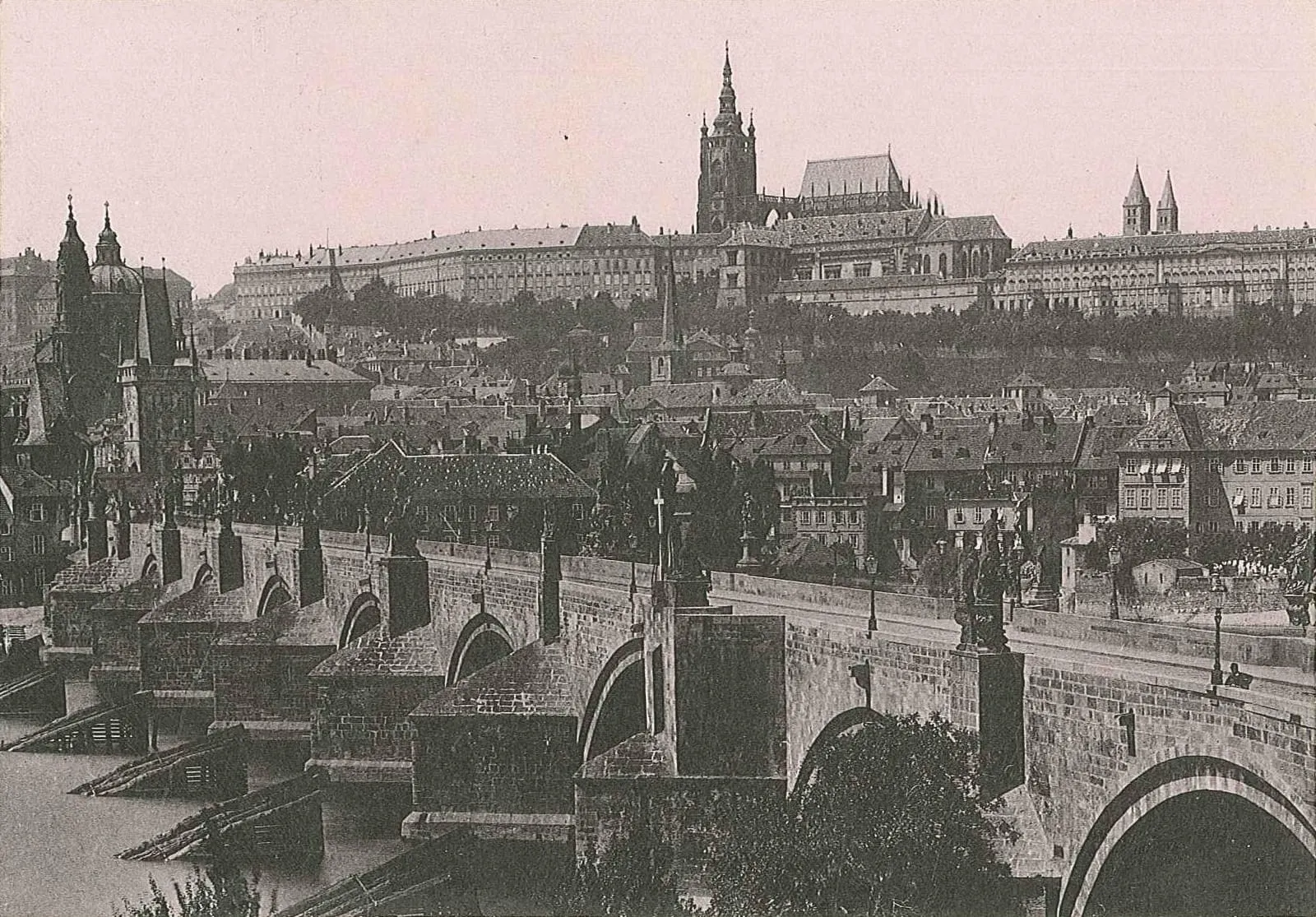
A long stone bridge with statues crossing the river toward a hillside of roofs, with the castle and the tower of St Vitus Cathedral on the ridge above
The Charles Bridge and Prague Castle, about 1880 Unknown author, public domain, Wikimedia Commons

Gaslight on the Vltava

Prague was the capital of the Kingdom of Bohemia and the third city of Austria-Hungary. In 1890 it had 182,530 inhabitants, or 310,483 with its suburbs, and 83.5 per cent of them spoke Czech. In the Old Town and the Jewish quarter the streets were narrow and crooked; the New Town was laid out wide. The city was lit by gas, with electric light in only a few places. Horse trams had run since 1875 and covered about 19 kilometres; in the 1890s some 200 fiacres and more than 250 droshkies plied for hire.

The city was changing between his visits. A flood in September 1890 tore down three arches of the Charles Bridge, and the Jubilee Exhibition of 1891 brought Prague its first electric tram, at Letná, and the steel lookout tower on Petřín hill, built in four months.
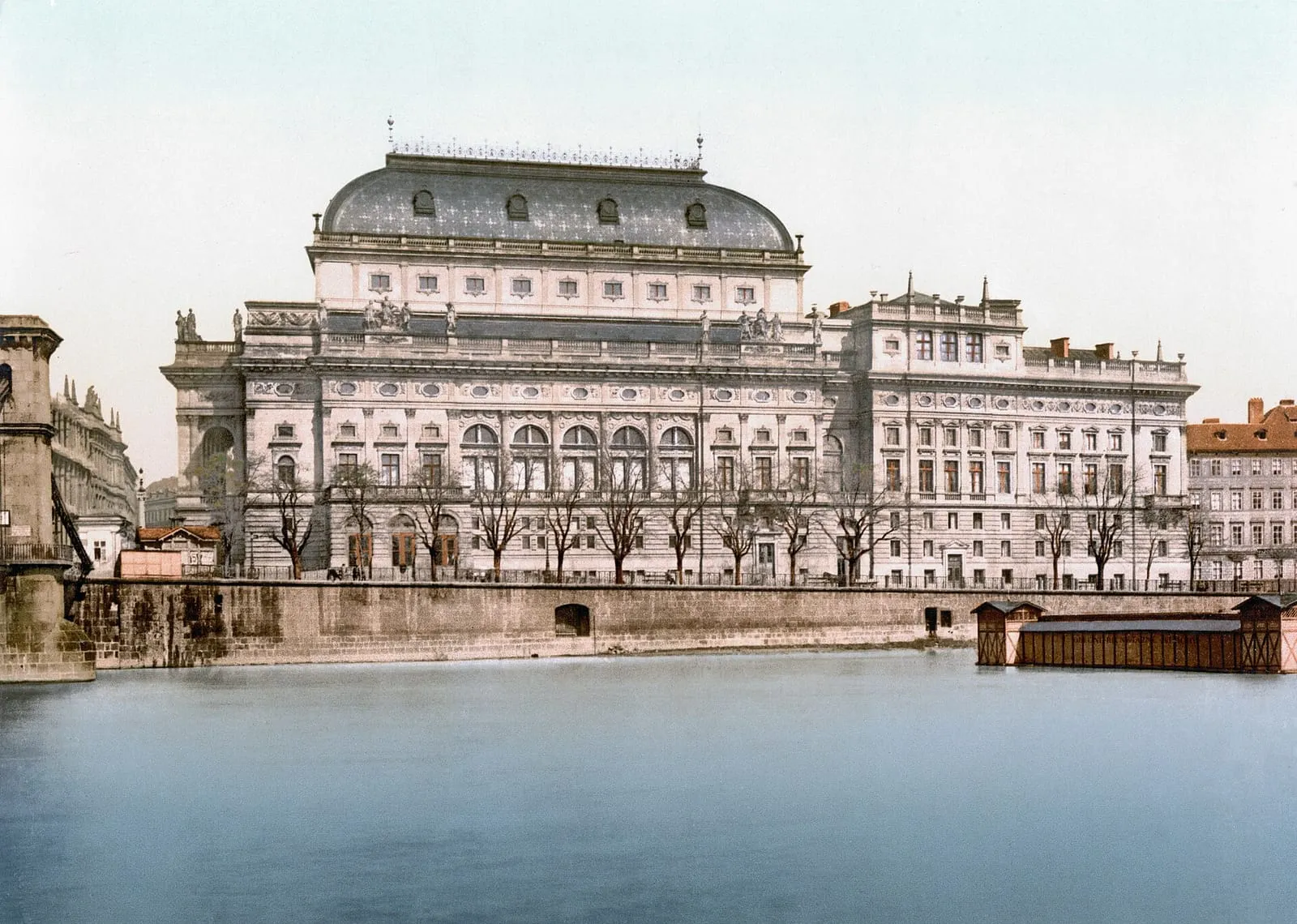
A colour-tinted view of a large neo-Renaissance theatre with a dark curved roof, standing on an embankment above the river
The National Theatre from across the Vltava, before 1898, with a pier of the old chain bridge at the left Unknown author, public domain, Wikimedia Commons

A crowd at Kralupy

On 12 February 1888 he left Leipzig for Prague with Aleksandr Ziloti, by way of Kralupy on the Prague–Dresden line, open since 1851. Past the border the chief conductor asked whether he was Tchaikovsky and fussed over him all the way. At Kralupy, the last station before Prague, a crowd met them, and a deputation rode with them into Prague. In Prague there were children with bouquets, a speech in Russian and a long one in Czech, and he walked to his carriage between two walls of people shouting "Glory".

His hotel gave him a suite of several rooms, and a carriage stood ready for him all day. When he came back that November to stage Eugene Onegin, his letters went to the Hôtel de Saxe.

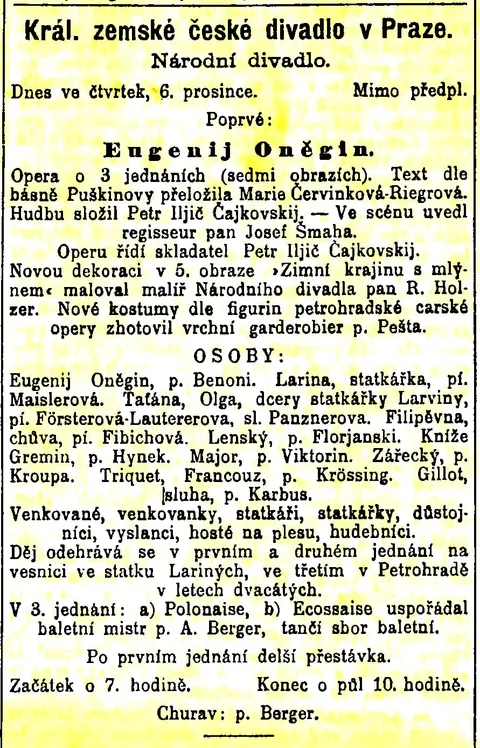
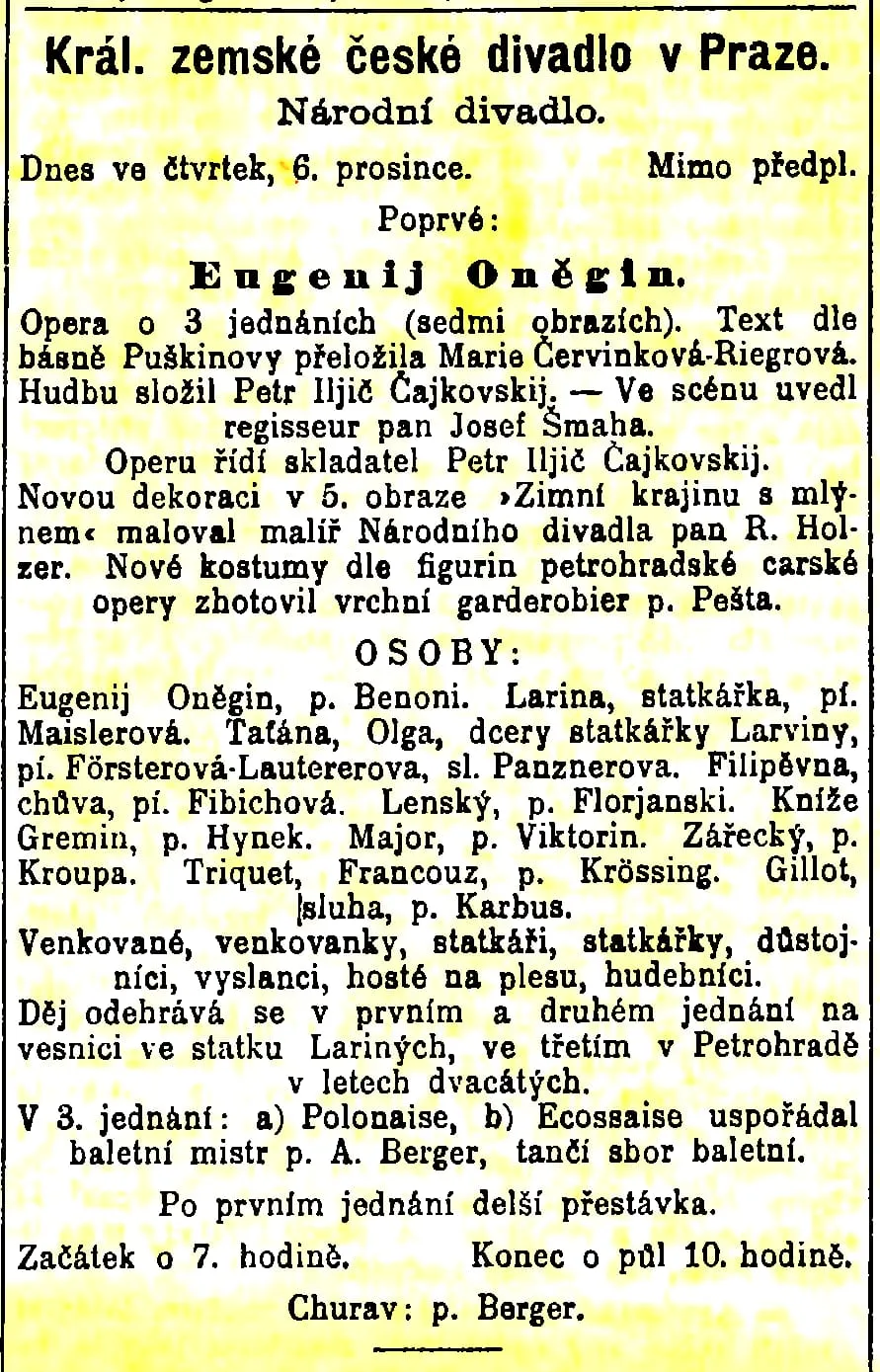
A Czech newspaper theatre notice headed Národní divadlo, announcing Eugenij Oněgin with its cast list
Notice in Národní listy for the first Prague Eugene Onegin on Thursday 6 December 1888: "the composer Pyotr Ilyich Tchaikovsky conducts", from seven until half past nine Unknown author, public domain, Wikimedia Commons

The Rudolfinum and the National Theatre

On 19 February 1888 he conducted at the Rudolfinum, a concert hall opened in 1885: Romeo and Juliet, the First Piano Concerto with Ziloti, the Violin Concerto with Karel Halíř, and The Year 1812. At the banquet he read a speech in Czech. Two days later he conducted at the National Theatre, rebuilt after its 1881 fire, seating 2,200 and lit by electricity. Adolf Čech then conducted Act II of Swan Lake, its first staging outside Russia. Antonín Dvořák sat with him for two hours the morning after he arrived and had him to dinner.

On 6 December 1888 he conducted Eugene Onegin at the National Theatre in a Czech translation by Marie Červinková-Riegrová, the opera's first staging abroad. A concert of his works on 30 November brought in only 300 gulden, and he gave the money to the artists' pension fund. He came back briefly in October 1892, when Čech conducted The Queen of Spades there.

In his words

At the station there was a mass of people, deputations, children with bouquets, and two speeches: one in Russian, the other, at length, in Czech ; I responded.

Today was the first rehearsal; I was greeted by loud trumpet music.

I have been received here not just as a representative of Russian music, but of the whole of Russia in general.

Yesterday I left Prague furnished with abundant laurels, but only laurels.

Before and after

Each row is one stay, from his first to his last surviving letter written here, between where he wrote from just before and just after.

Came fromPragueWent on to
Salzburg until 7 October 8 October 1892 Klin from 19 October
Saint Petersburg until 25 November 5 – 6 December 1888 Vienna from 8 December
Leipzig until 11 February 14 – 22 February 1888 Paris from 26 February

Letters written here

Mentioned in letters

Letters in which Tchaikovsky names this place.

18781 letter
18814 letters
18825 letters
18879 letters
188865 letters
18899 letters
18901 letter
189121 letters
189214 letters
18931 letter

Events here

Pictures

Sources

Licence: CC BY-NC-SA 4.0. Tchaikovsky Research (en.tchaikovsky-research.net).

Cite this page

Plain text

Prague. Dear Tchaikovsky, https://deartchaikovsky.com/en/places/prague/. Last updated 18 November 2026.

Chicago

“Prague.” Dear Tchaikovsky. Last updated 18 November 2026. https://deartchaikovsky.com/en/places/prague/.

BibTeX

@misc{deartchaikovsky-places-prague,
  title = {Prague},
  howpublished = {Dear Tchaikovsky},
  url = {https://deartchaikovsky.com/en/places/prague/},
  date = {2026-11-18},
}