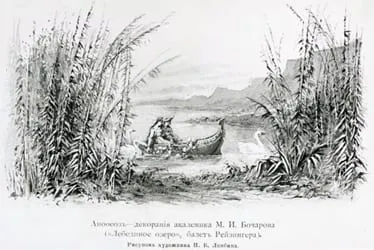
Synopsis
The action takes place in medieval Germany:
Act I. The scene represents part of a magnificent park, with a castle visible in the distance. An elegant bridge crosses a nearby stream. Prince Siegfried and his friends are seated at tables, drinking wine, and celebrating the eve of his coming of age. A crowd of peasants come to congratulate the prince. His elderly tutor Wolfgang invites them to entertain the Prince with their dances. The peasants agree. The prince orders wine for them, and the women are given flowers and ribbons. After a grand waltz, Siegfried's mother arrives unexpectedly, and tells him that he must choose a bride the next day, at a ball to be held for that purpose. Siegfried reluctantly agrees, and his mother departs. The Prince declares that this means an end to their carefree life. His friend Benno, a knight, consoles him. They resume their places and the party continues, with divertissements for the peasants and revellers. Wolfgang decides to join the dancing, but wine and age have fuddled his movements and he falls, leaving others to finish the dance. Evening approaches with the setting sun, and one of the guests proposes that the last dance shall be with their goblets in their hands. A flock of swans appears in the air, and Benno suggests a hunt. Wolfgang proposes to go to bed. The Prince appears to agree with Wolfgang, but as soon as his tutor leaves, he takes his gun and hurries off with Benno in the direction the swans were flying.
Act II opens in a mountain landscape, with forests on all sides. In the background is a lake, shimmering in the moonlight. On the right bank are the ruins of a chapel. A swan wearing a crown on its head leads the other swans as they glide majestically across the surface of the lake. The Prince and Benno enter. Siegfried sees the swans and prepares to fire, but they disappear behind the ruins, which are then illuminated by a magical light. The two men decide to investigate, and as they approach, a young girl comes down the staircase, wearing a white dress and the crown on her head. She asks Siegfried why he wishes to persecute her. She tells him that she is the Princess Odette, the unwanted stepdaughter of an evil sorceress who is trying to kill her. She is protected by her crown, which was given to her by her grandfather. Only the marriage vow can break the spell, which holds her and the other girls bound as swans by day and humans by night. An evil sorceress appears in the guise of an owl and menaces Siegfried. Then a flock of swan maidens and children appear and reproach the young huntsmen. Odette tells them to desist since she considers him to be no threat to them. Siegfried throws away his weapon. The swans dance, and Siegfried confesses the love he has began to feel for Odette. She reminds him of the ball planned for the next day, and its purpose, but Siegfried swears his love despite this. Odette promises him she will attend the ball tomorrow. As dawn breaks. Odette and her friends withdraw into the ruins, and reappear on the lake as swans.
Act III. In the castle ballroom, Wolfgang orders the servants to admit the guests, and they are followed by the Prince's mother, Siegfried and their retinue of pages and dwarves, who perform a dance. The Master of Ceremonies signals the revels to commence, and new guests are announced, including an old count with his wife and daughter, who begins to dance with one of the knights. Six eligible princesses arrive with their parents, and each daughter dances for Siegfried. After several such entrances, the Siegfried's mother instructs her son to make a choice, but he cannot. Annoyed, she calls Wolfgang to talk some sense into him. Fanfares sound anew, and Baron von Rothbart enters with Odile. Siegfried is struck by Odile's likeness to Odette. He even asks Benno to affirm her resemblance to Odette, but his friend sees none. Siegfried delightedly welcomes Odile, and the ball recommences. Dances follow for the visiting Princesses, a Pas de deux for Siegfried and Odile, and dancers from many nations. The Prince's mother is delighted that Siegfried is taken with Odile. He announces that he will marry her, and kisses Odile's hand. The Prince's mother and von Rothbart join their hands. The scene then darkens, and an owl cries out, as von Rothbart is revealed as a demon. Odette appears helplessly at a window as white swan, while Odile laughs loudly. Siegfried is horrified, and flings away the hand of his newly betrothed. Clutching his breast, he rushes out of the castle.
Act IV. Back at the lakeside clearing, the Swan maidens await Odette by the lake, unable to understand where their queen has gone. The young swans dance while they wait. Odette eventually returns in despair and tells the others that she has been betrayed, and no hope remains. Against their advice, Odette lingers to spend one last moment with Siegfried, who rushes in. As a storm rises, Siegfried begs Odette's forgiveness, but she feels powerless to forgive him, and she tries to run away towards the ruins. The Prince catches up with her, grasps her hand and desperately exclaims that she will remain with him forever. Then he takes the crown from her head and throws it into the stormy lake. An owl flies screeching overhead, holding Odette's crown in its claws. Odette dies in the Prince's arms. The sad last song of the swan is heard. Both lovers are engulfed by the overflowing lake. As the waters subside, swans are seen gliding across the calm surface of the lake.[5]
Where the story comes fromShow less
The ballet's libretto was printed for the premiere [1], in which the plot and text correspond to the scenario written by the composer in the manuscript score. However, the authorship of the libretto of Swan Lake has long been in doubt [2]. In his recollections of Tchaikovsky, Nikolay Kashkin names the supposed author of the libretto as Vladimir Begichev. In a letter to Herman Laroche of 9/21 September 1894 [3], Modest Tchaikovsky said that he had heard the same from Pyotr Jurgenson, but that "the Theatre Directorate's copy has the note: "property of Geltser" [i.e. Vasily Geltser, dancer with the Moscow Imperial Ballet]. The latter was probably responsible for writing down the subject". In his biography of the composer, Modest Tchaikovsky named Begichev and Geltser as joint authors of the libretto. The newly discovered materials from the music archive of Bolshoy theatre fully support Nikolay Kashkin's assumption and also give us the name of the dancer for whom the ballet was written, the prima ballerina Lidiya Geyten, who took part in rehearsals until she decided its music was not for her.[4].