Symphony No. 5

Tchaikovsky's Symphony No. 5 in E minor, Op. 64, was composed and orchestrated between May and August 1888.

Genre
Symphonies
Key
E minor
Composed
1888
First performed
5/17 November 1888, Saint Petersburg
Catalogue
TH 29 · Op. 64 · ČW 26

Listen for

The passages people recognise, as simplified melody lines you can play. Underlined musical terms open the terms page.

The motto theme

First movement, the Andante introduction, opening bars. Clarinets, low in their range.

The clarinets play this slow, dark tune low in their range. It is the symphony's motto theme: it comes back in every movement, and in the finale it returns in E major as a march. Listen for the dotted rhythm at the start of the first bars, the same heavy step each time.

Simplified melody line, not the full score. Source: Wikipedia, Symphony No. 5 (Tchaikovsky), CC BY-SA 4.0.

The horn solo

Second movement, Andante cantabile, con alcuna licenza, after a few bars of quiet chords. First horn.

A single horn sings a long, slow tune in D major over soft chords. The marking con alcuna licenza means “with some freedom”: the player may stretch and bend the beat. Each phrase climbs a little higher than the last, to D, then E, then G.

Simplified melody line, not the full score. Source: Wikipedia, Symphony No. 5 (Tchaikovsky), CC BY-SA 4.0.

The waltz

Third movement, Valse (Allegro moderato), the opening. First violins.

A real waltz in three beats, in A major, placed where a symphony usually has a scherzo. Each phrase starts on a long note and then turns in quicker steps. Later in the movement the motto theme slips in quietly on clarinets and bassoons.

Simplified melody line, not the full score. Source: Wikipedia, Symphony No. 5 (Tchaikovsky), CC BY-SA 4.0.

The closing march

Fourth movement, the coda (Molto meno mosso). Trumpets, then horns.

The symphony ends with a march in E major: the trumpets play the tune in octaves and the horns answer with the same notes. It is the main theme of the first movement, now in major and marked ffff. A closing section like this is a coda.

Simplified melody line, not the full score. Source: Wikipedia, Symphony No. 5 (Tchaikovsky), CC BY-SA 4.0.

The story

Tchaikovsky first mentioned a new symphony in a letter from Tiflis in the spring of 1888, and wrote it that summer at Frolovskoye, near Klin. A note beside the first sketches gives it a programme that begins with "total submission before fate". He conducted the first performance himself, in Saint Petersburg on 5/17 November 1888.

Subject

It appears that originally Tchaikovsky envisaged a programme for the Symphony. A scribbled note by the first sketches reads as follows:

Programme: 1st movement of symph[ony].
Intr[oduction]. Total submission before fate, or, what is the same thing, the inscrutable designs of Providence.
Allegro. 1) Murmurs, doubts, laments, reproaches against... XXX
II) Shall I cast myself into the embrace of faith???
A wonderful programme, if only it can be fulfilled.

Another note with a programmatic character appears in sketches for the second movement [29]:

There are also musical ideas for the other movements, with programmatic annotations (e.g. "consolation", "a ray of light", "no, there is no hope", etc). However, most of the musical sketches were subsequently rejected, and it is not possible to say how much of the programmatic concept found its way into the completed Fifth Symphony. Writing to the Grand Duke Konstantin Konstantinovich on 11/23 June 1888, Tchaikovsky specifically stated that "At the present time, I am fairly busy and working diligently on composition of a symphony, without a programme" [30].

It is possible that some of the programmatic content originally envisaged for the Fifth Symphony was transferred to the Symphony in E-flat major which Tchaikovsky began and subsequently abandoned in 1892.

Instrumentation

The Symphony is scored for an orchestra consisting of 3 flutes (3rd doubling piccolo), 2 oboes, 2 clarinets (in A), 2 bassoons + 4 horns (in F), 2 trumpets (in A), 3 trombones, tuba + 3 timpani + violins I, violins II, violas, cellos, and double basses.

Movements and duration

There are four movements:

  1. Andante—Allegro con anima (E minor, 542 bars)
  2. Andante cantabile con alcuna licenza (D major, 180 bars)
  3. Valse. Allegro moderato (A major, 266 bars)
  4. Finale. Andante maestoso–Allegro vivace (E major, 565 bars)
A complete performance of the Symphony lasts approximately 45 to 50 minutes [1].

Composition

Tchaikovsky's ideas for a new symphony probably arose during late March/early April 1888. The composer wrote about it for the first time in a letter to Modest Tchaikovsky from Tiflis, on 28 March/9 April: "in the summer I intend to write a symphony..." [2]. The day before leaving Tiflis, on 13/25 April, he wrote to Nadezhda von Meck: "... I want to spend all summer and autumn at Frolovskoye, and do a great deal of work... I am giving thought to a new symphony" [3].

On 24 April/6 May, now at Frolovskoye, he wrote to her: "After a trip to Saint Petersburg and some visits to Moscow in connection with the conservatory examinations, I intend first of all to compose a symphony..." [4]. In a letter to Yuliya Shpazhinskaya of 23 April/5 May, Tchaikovsky outlined his schedule: "I will be in Saint Petersburg for four days... returning after St. Thomas's week, and then settle down in the village and set about my work, namely I want to write a symphony..." [5]. On 9/21 May, Tchaikovsky told her: "Today I returned from Saint Petersburg, where I have spent the last ten days... Now I can work for days on end, in peace and freedom" [6].

Continue readingShow less 16 more paragraphs

In mid/late May, he wrote: "I've still not yet made a start, because I've been working on various proofs. But I can honestly say that the urge to create has deserted me. What does this mean? Am I really written out? I've no ideas or inspiration whatsoever! But I hope little by little to gather materials for the symphony" [7]. Around this time, evidently, he did begin work on the Symphony: "Now I am gradually, and with some difficulty, squeezing a symphony out of my dulled brain" [8].

While travelling from Tiflis to Moscow, the composer had already recorded a number of themes for the new symphony in one of his notebooks, one of which is dated 15/27 April 1888 [9]. During the course of the summer, Tchaikovsky frequently had to leave Frolovskoye, besides which he took ill during June, although he continued to work on the Symphony during his illness.

The most intensive work on the Fifth Symphony was carried out between 7/19 and 17/29 June, although Tchaikovsky continued to doubt his abilities: "I am working quite assiduously on a symphony, which, if I am not mistaken, will be no worse than its predecessors. But perhaps this is just my opinion now... I may later feel that I am written out, that my head is empty, that my time is past, etc." [10].

On 10/22 June, Tchaikovsky wrote to Nadezhda von Meck: "I must work harder in the future; I want so much to show not only to others, but to myself, that I still haven't expired... I don't know whether I wrote to you that I had decided to write a symphony. At first it was fairly difficult; now inspiration seems to have deserted me completely" [11].

The rough draft was completed on 17/29 June [12]. This draft of the Symphony was later sent by Tchaikovsky to Mikhail Ippolitov-Ivanov, probably in September 1888 [13]. Its whereabouts at the present time are unknown.

The surviving sketches show the gradual evolution of ideas for the Fifth Symphony. The first musical notes are significantly different from the last, and apparently comprise musical materials intended for an original version of the Symphony, which the author later rejected. The evidence suggests that the sketches for this first version were made by Tchaikovsky while he was at Frolovskoye between 9/21 May and 23 May/4 June 1888. Probably, it was this phase of composition that Tchaikovsky referred to when he described his work on the Symphony as "initially fairly difficult" [14].

On 22 June/4 July, Tchaikovsky wrote to Nadezhda von Meck: "I have been working well the whole time; I have already prepared in rough a symphony and an overture to the tragedy Hamlet, which I have had in mind to write for a long time. In the coming weeks I shall set about the instrumentation of both works... although for almost a whole month I have been able to rise to the challenge, despite my poor state of health, yet my indisposition has not really impeded my work. At the moment it is difficult to say how this symphony will turn out when compared with my previous ones, and particularly in comparison to ours. What was previously easy and straightforward has not remained so" [15].

"After the 29th (O.S.) I shall take up the instrumentation", the composer wrote to Modest Tchaikovsky on 26 June/8 July [16]. But on 1/13 July, in a letter to Anatoly Tchaikovsky, he stated: "I am working well. I have finished the symphony and the overture to Hamlet, and set about their instrumentation. Having prepared two large-scale works I am in high spirits, because, you know, I had begun to think that I was played out, since it was initially very difficult" [17].

"My work is now progressing terribly slowly. Time flies, old age draws near, and each moment is precious to me; but in the meantime, despite my efforts, I cannot concentrate on work. However I hope that by the end of the summer to have finished both my symphonic works", he wrote to Yuliya Shpazhinskaya on 6/18 July 1888 from Moscow [18].

After visits to Moscow and Saint Petersburg, Tchaikovsky returned to Frolovskoye on 12/24 July [19], and once again resumed work: "From tomorrow I shall work very assiduously on the instrumentation" [20].

On 25 July/6 August he wrote to Nadezhda von Meck: "I am now working very successfully, and the greater portion of the symphony is already scored"[21]. But on 1/13 August, the composer told Vladimir Shilovsky, "I'm working terribly, because of the need to finish the full score of the symphony as quickly as possible" [22].

Evidently, as soon as the instrumentation of the first movement and finale was complete, Tchaikovsky sent the full scores to Sergey Taneyev, who was to make an arrangement for piano duet (4 hands). Taneyev responded on 6/18 August: "I have received the first movement of the symphony and your letter, in which you wrote that you were sending the Finale" [23].

On 7/19 August, Tchaikovsky wrote to Nadezhda von Meck: "Now, as the symphony nears its end, I can view it objectively, and at the culmination of the work I must say that, thank God, it is no worse than my previous ones. This accomplishment means a great deal to me!" [24].

After the third movement (waltz) in the fair copy of the manuscript score is the note: "9 Aug ‘88. Frolovskoye" (O.S.).

By 14/26 August, all work on scoring the Symphony had been completed: "I am so pleased that my symphony is safely finished" [25]. "My symphony is ready, and I think that I have not miscalculated, that it has turned out well" [26].

While composing the Fifth Symphony, Tchaikovsky constantly doubted his powers of composition [27]. However, after completing the symphony he wrote to Nadezhda von Meck on 24 September/6 October 1888: "Thank God that I still have the will to work. But my urge to produce is so great that even two lifetimes would barely be sufficient to carry out my all my plans" [28].
Performances

On 25 October/6 November 1888, at a concert in the Russian Nobles' Society, Sergey Taneyev and Aleksandr Ziloti performed the second and third movements of the Fifth Symphony in Taneyev's arrangement for two pianos [31].

The first orchestral performance of the Symphony No. 5 took place in Saint Petersburg on 5/17 November 1888 at a concert of the Saint Petersburg Philharmonic Society, conducted by the composer (and repeated in the same city on 12/24 November at the third symphony concert of the Russian Musical Society); the Moscow premiere took place on 10/22 December 1888 at the fifth symphony concert of the Russian Musical Society, also conducted by him.

Continue readingShow less 3 more paragraphs

On 3/15 March 1889, the Fifth Symphony was performed in Hamburg, conducted by Tchaikovsky [32]. For this performance, Tchaikovsky shortened the last movement: "Made cut in fin[ale] of the symph[ony]", he noted in his diary for 24 February/6 March 1889, and on 27 February/9 March he remarked: "Corrected the parts of the symphony" [33].

Other notable early performances included:

  • Prague, 18/30 November 1888, conducted by Tchaikovsky
  • New York, Chickering Hall, 21 February/5 March 1889, conducted by Theodore Thomas
  • Hamburg, 10th Philharmonic Society concert, 3/15 March 1889, conducted by Tchaikovsky
  • Manchester, 21 January/2 February 1893, conducted by Charles Hallé
  • London, 17/29 June 1894, conducted by Arthur Nikisch
  • Vienna, 7th Philharmonic Society subscription concert, 18 February/1 March 1896, conducted by Hans Richter
  • Amsterdam, Concertgebouw, subscription concert, 30 November/12 December 1897, conducted by Willem Mengelberg

Critical reception

The Fifth Symphony was enthusiastically received by Tchaikovsky's friends in Moscow. On 5/17 September, the composer wrote to Anatoly Tchaikovsky: "The symphony has received unanimous approval from all my friends: some even say that it's my best work. It's particularly significant that S. I. Taneyev is wholly enthusiastic" [34]. However, his earlier doubts regarding the Fifth Symphony later resurfaced in letters to Nadezhda von Meck: "My new symphony was played twice in Saint Petersburg and once in Prague [35]. I am convinced that this symphony is not a success. There is something so repellent about such excess, insincerity and artificiality" [36]. "With each day that passes I am increasingly certain that my last symphony is not a successful work, and the realisation that it is unsuccessful (or perhaps that my powers are declining) is very distressing to me. The symphony is too colourful, massive, insincere, drawn out and on the whole very disagreeable... Am I indeed, as they say, written out?... If so, then this is terrible. Whether my misgivings are mistaken or not, regrettably I have concluded that the symphony written in 1888 is poorer than the one written in 1877" [37].

After a performance of the Symphony in Hamburg in March 1889, with which Tchaikovsky was very satisfied, the composer wrote: "The musicians took to the music more and more each time the symphony was played. At rehearsals there was general enthusiasm, flourishes, etc. The concert also went excellently. As a result, I no longer have a bad opinion of the symphony, and like it once more" [38]. "The Fifth Symphony was again performed magnificently, and I have started to love it again; my earlier judgement was undeservedly harsh..." [39].

Publication

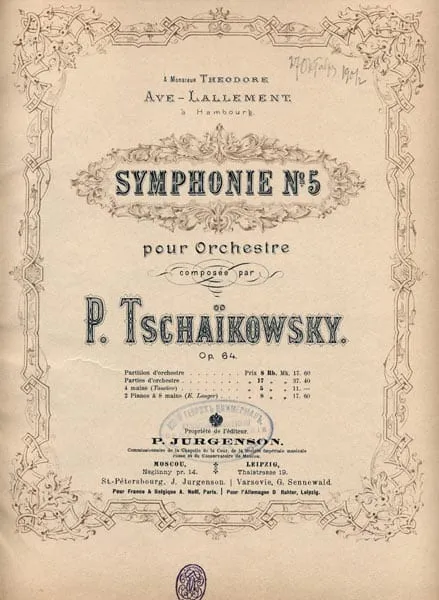
The first edition of the score was published by Pyotr Jurgenson in 1888. As previously noted, an arrangement of the Fifth Symphony for piano duet was made by Sergey Taneyev [40], and was published by Jurgenson at the same time as the full score.

Rahter in Hamburg acted as Jurgenson's agent in western Europe, and also printed their own version of the latter's scores, as well as commissioning several arrangements of their own (mostly of the symphony's second movement).

The full score of the Symphony No. 5 was published in volume 17А of Tchaikovsky's Complete Collected Works, edited by Georgy Kirkor (1963).

Autographs

Tchaikovsky's manuscript score is now preserved in the Glinka National Museum Consortium of Musical Culture in Moscow.

Dedication

The Symphony is dedicated to Theodor Avé-Lallemant, director of the Hamburg Philharmonic Society, whom Tchaikovsky met in Hamburg in January 1888.

On 24 April/6 May 1888, Tchaikovsky told the Norwegian composer Edvard Grieg that he was planning "to write a new symphony and to dedicate it to my good friend Grieg" [43]. However, the published score carries only the inscription to Avé-Lallemant, and Tchaikovsky dedicated the overture-fantasia Hamlet to Grieg instead.

Where he wrote it

May–August 1888: 17 stays in 4 places. Numbered in the order he reached each place, from where he came from to where he went next, traced from the place and date of his letters.

Dates are New Style (N.S.), the calendar used in the West. In Russia, on the Old Style calendar, the date was 12 days earlier.

Composed hereStayed while writingBefore and after

  1. Came fromTiflis8 April – 28 April 1888 · 15 letters
  2. Moscow3 May 1888 · 1 letter
  3. Frolovskoye5 May – 23 May 1888 · 20 letters
  4. Klin23 May 1888 · 1 letter
  5. Frolovskoye24 May – 1 June 1888 · 9 letters
  6. Moscow5 June 1888 · 1 letter
  7. Frolovskoye11 June – 4 July 1888 · 29 letters
  8. Moscow8 July 1888 · 1 letter
  9. Frolovskoye9 July – 13 July 1888 · 6 letters
  10. Moscow18 July 1888 · 1 letter
  11. Saint Petersburg19 July – 23 July 1888 · 2 letters
8 more stays
  1. Frolovskoye24 July 1888 · 8 letters
  2. Klin25 July 1888 · 1 letter
  3. Frolovskoye25 July – 6 August 1888 · 7 letters
  4. Klin10 August 1888 · 1 letter
  5. Frolovskoye11 August – 13 August 1888 · 3 letters
  6. Klin13 August 1888 · 1 letter
  7. Frolovskoye13 August – 26 August 1888 · 15 letters
  8. Went on toMoscow3 September 1888 · 4 letters

As he wrote it

What he said about this work in his letters, from the first mention to the last. Each passage is quoted word for word from the letter; open the letter to read the rest.

While composing, 1888

  1. To Modest TchaikovskyFrolovskoyeRead letter 3573

  2. I do not know whether I wrote to you that I had decided to write a symphony? This progressed quite slowly at first, but now it as though inspiration has struck.

    To Nadezhda von MeckFrolovskoyeRead letter 3588

  3. To Anna MerklingFrolovskoyeRead letter 3592

  4. All this time I have been hard at work, drafting the symphony and an overture to the tragedy "Hamlet", which I have been meaning to write for a long time.

    To Nadezhda von MeckFrolovskoyeRead letter 3600

  5. To Anna MerklingFrolovskoyeRead letter 3601

  6. To Anatoly TchaikovskyFrolovskoyeRead letter 3615

  7. To Mikhail Ippolitov-IvanovFrolovskoyeRead letter 3635

  8. …from fatigue from the excessive efforts to quickly finish the score of the new symphony.

    To Nadezhda von MeckFrolovskoyeRead letter 3637

All 40 letters

While composing, 1888

  1. To Anatoly TchaikovskyFrolovskoyeRead letter 3638

  2. However, this are all trivial illnesses; I am so pleased to have successfully finished my symphony that minor bodily ailments are not worth thinking about.

    To Nadezhda von MeckFrolovskoyeRead letter 3644

  3. To Yuliya ShpazhinskayaFrolovskoyeRead letter 3645

  4. I have completed my symphony, and it is currently being engraved. Moreover, I have written an overture to the tragedy "Hamlet", and at present I am occupied with the orchestration of an overture by Laroche.

    To Grand Duke Konstantin KonstantinovichKamenkaRead letter 3651

  5. To Pyotr JurgensonFrolovskoyeRead letter 3666

  6. Besides this, I am correcting the proofs of the 5th Symphony with feverish haste.

    To Nadezhda von MeckFrolovskoyeRead letter 3669

  7. I've just finished the instrumentation of Laroche's overture, and am now busy with scoring my "Hamlet", and my new symphony is already being printed; my musical friends in Moscow, Taneyev in particular, are delighted with it.

    To Anatoly TchaikovskyFrolovskoyeRead letter 3670

  8. Now I'll sit here for a few days, both to finish "Hamlet", and also to do the proofs of the 5th Symphony. At the end of the month I'll be going to Petersburg.

    To Modest TchaikovskyFrolovskoyeRead letter 3686

  9. The fruits of these labours are a symphony and a symphonic poem. Now both the one and the other are complete, and I shall quite soon have to give up my rural seclusion.

    To Anna BrodskyFrolovskoyeRead letter 3688

  10. I have completed a symphony and a symphonic poem (Hamlet). I am staying here for a little longer.

    To Félix MackarFrolovskoyeRead letter 3690

  11. My Moscow friends are delighted by my Symphony, but how it will fare with the public and in the Petersburg musical world — God alone knows.

    To Anatoly TchaikovskyFrolovskoyeRead letter 3701

  12. To Pyotr JurgensonFrolovskoyeRead letter 3703

  13. I finished the orchestration of my overture to "Hamlet", made countless corrections to the proofs of the symphony, and am now busy preparing to conduct everything that is to be included in my forthcoming concerts.

    To Nadezhda von MeckFrolovskoyeRead letter 3711

  14. To Pyotr JurgensonFrolovskoyeRead letter 3717

  15. Having played my new symphony twice in Petersburg and once in Prague, I came to the conclusion that the symphony was unsuccessful.

    To Nadezhda von MeckFrolovskoyeRead letter 3738

Afterwards

  1. Each time I become more and more convinced that my last symphony is an unsuccessful work, and this awareness of an unexpected failure (and perhaps a decline in my abilities) is very upsetting to me.

    To Nadezhda von MeckFrolovskoyeRead letter 3748

  2. To Julius von BernuthBerlinRead letter 3791

  3. If it is your abiding wish, then I could do the 5th symphony as well — but as it is very complicated and I am not very satisfied with the instrumentation, then I am afraid that it will not be applauded, and that the public will find the…

    To Francesco BergerGenevaRead letter 3808a

  4. The Fifth Symphony had great success. The success in Geneva was enormous — but nobody in Russia reads about me in the newspapers.

    To Pyotr JurgensonHamburgRead letter 3813

  5. To Theodor Avé-LallemantHamburgRead letter 3813b

  6. Yesterday I played my 5th symphony at a Philharmonic concert. Its success was very great!

    To Ernst JedliczkaHamburgRead letter 3813c

  7. The Fifth Symphony was performed superbly, and I've started to love it again — although before I'd formed an exaggeratedly bad opinion of it.

    To Vladimir DavydovHannoverRead letter 3814

  8. My new symphony had enormous success in Hamburg, and everyone there received me as an old and beloved friend.

    To Nadezhda von MeckHannoverRead letter 3815

  9. Like last year, everyone was very friendly towards me, and what was particularly flattering to me was the fact that Brahms stayed in Hamburg an extra day in order to hear the symphony

    To Daniel RahterHannoverRead letter 3816

  10. In Hamburg I decided to play the 5th Symphony, and to my surprise I found that it was not at all as appalling and loathsome as I thought.

    To Aleksandr ZilotiParisRead letter 3820

  11. To Josef SittardParisRead letter 3820a

  12. I'm not playing the 5th symphony here, but rather the first suite, with Sapelnikov playing my first concerto. The day after tomorrow, I'm going early in the morning to Marseille, and thence by sea to Batum.

    To Pyotr JurgensonLondonRead letter 3832

  13. I only know that the 3rd suite in Cologne and Frankfurt, and the 5th symphony in Hamburg were acquired from Rahter. In Berlin the "Serenade" and Francesca were there already.

    To Pyotr JurgensonTiflisRead letter 3846

  14. There have been things that I've written slowly, for example, "The Enchantress" and the 5th symphony, and they were not successful, while I composed the ballet in 3 weeks, and "Yevgeny Onegin" also incredibly quickly.

    To Modest TchaikovskyFlorenceRead letter 4058

  15. The Fifth Symphony was played by two societies for 2 seasons in a row. In general I am a far more important bird here than in Europe.

    To Eduard NápravníkNew YorkRead letter 4370

  16. I thank you cordially for the performance of my 5th Symphony.

    To Theodore ThomasVichyRead letter 4706a

  17. I will go straight-away to Jurgenson (the brother) and fulfil your wish as to my Fifth Symphony. Tomorrow I will go abroad, but I feel incapable of going to Hamburg and Schwerin to go through all the emotions of an opera composer again.

    To William von SachsSaint PetersburgRead letter 4824

Recordings

  1. Leopold Stokowski

    TCHAIKOVSKY: Symphony No. 5 · 1934

  2. Artur Rodzinski

    TCHAIKOVSKY: Symphony No. 5 · 1940

More recordings 4
  1. Oslo‐Filharmonien

    Conductor: Mariss Jansons

    Symphony 5 in E minor, op. 64 · 1984 · Chandos

  2. Polish National Radio Symphony Orchestra

    Conductor: Antoni Wit

    Symphony no. 5, op. 64 / The Storm, op. 76 · 1992 · Naxos

  3. The Cleveland Orchestra

    Conductor: Lorin Maazel

    Symphony no. 5 · 1982 · CBS Records Masterworks

  4. London Symphony Orchestra

    Conductor: Claudio Abbado

    Symphonies Nos. 4 5 6 · 1970 · Deutsche Grammophon

Scores and recordings on IMSLPAll recordings on MusicBrainzSearch YouTubeSearch SpotifySearch Apple Music

Recording details from MusicBrainz and Wikidata, both CC0. Audio from the Internet Archive is used under the licence shown with it.

Hear it live

Concert listings worldwide are on Bachtrack. Upcoming Tchaikovsky concerts on Bachtrack

The world around this work

Who he was writing to and what else was happening in his life, 1888.

Letters that discuss it 40

and 28 more

People around it

Whom he wrote to most in these years, and who appears in the letters about this work.

333 letters survive from these years. Letters of 1888

Meanwhile in his life

  • May 1888 He writes the Symphony No. 5 and the overture-fantasia Hamlet.
  • November 1888 He visits Prague to conduct the Symphony No. 5 and Yevgeny Onegin.
  • 5/17 November 1888 Premiere of the Symphony No. 5 in Saint Petersburg, conducted by Tchaikovsky.
  • 10/22 December 1888 Moscow Premiere of the Symphony No. 5, conducted by Tchaikovsky.
  • 1888 He is granted a lifetime annuity of 3000 rubles by Alexander III.
  • 1888 He conducts two concerts in Prague, and meets Antonín Dvořák.
  • 24 December 1887 / 5 January 1888 His first European conducting tour begins with a concert at the Leipzig Gewandhaus. Meetings with Johannes Brahms, Edvard Grieg and Ethel Smyth.
  • 8/20 January 1888 He conducts at the Conventgarten in Hamburg.
  • 16/28 January 1888 He meets Gustav Mahler.
  • February 1888 He conducts three concerts in Paris, and meets Charles Gounod, Léo Delibes, Pauline Viardot-García, and other French musicians.
  • 23 January / 4 February 1888 He meets Désirée Artôt again in Berlin.
  • 27 January / 8 February 1888 He conducts a Philharmonic Society concert in Berlin.

Chronology 1888

In the world meanwhile

Places in this story

Tiflis · Frolovskoye · Saint Petersburg · Moscow · Hamburg · Prague · New York · London · Vienna · Klin

Letters about this work

Letters cited by Tchaikovsky Research. Those not yet on this site open there.

351135393547355135523553356335683587358935953597360236073609361236243631365736613672367837103818

Listen next

Notes

  1. Tchaikovsky's metronome markings are seldom observed, especially in the first movement, which is almost always taken at a much slower tempo than he directs. ↩︎

  2. Letter 3539 to Modest Tchaikovsky, 28 March/9 April 1888. ↩︎

  3. Letter 3547 to Nadezhda von Meck, 13/25 April 1888. ↩︎

  4. Letter 3553 to Nadezhda von Meck, 24 April/6 May 1888. ↩︎

  5. Letter 3551 to Yuliya Shpazhinskaya, 23 April/5 May 1888. ↩︎

  6. Letter 3563 to Yuliya Shpazhinskaya, 9/21 May 1888. ↩︎

  7. Letter 3568 to Modest Tchaikovsky, 15/27 May 1888. ↩︎

  8. Letter 3573 to Modest Tchaikovsky, 19/31 May 1888. ↩︎

  9. See Notebook No. 4 in Klin House-Museum Archive. In ČW these sketches are attributed to a different, unrealised symphony dating from 1887 or 1888 (ČW 468). ↩︎

  10. See Letter 3587 to Vladimir Nápravník, 7/19 June 1888. ↩︎

  11. Letter 3588 to Nadezhda von Meck, 10/22 June 1888. ↩︎

  12. See Letter 3597 to Modest Tchaikovsky and Letter 3595 to Mikhail Ippolitov-Ivanov, both 17/29 June 1888. ↩︎

  13. See letters from Mikhail Ippolitov-Ivanov to Tchaikovsky, 30 June and 17 October 1888, and Tchaikovsky's replies of 12/24 July (Letter 3612), 4/16 August (Letter 3635) and 27 October/8 November 1888 (Letter 3710). ↩︎

  14. See Letter 3607 to Anatoly Tchaikovsky, 1/13 July 1888. ↩︎

  15. Letter 3600 to Nadezhda von Meck, 22 June/4 July 1888. "Ours" Symphony No. 4. ↩︎

  16. Letter 3602 to Modest Tchaikovsky, 26 June/8 July 1888. ↩︎

  17. Letter 3607 to Anatoly Tchaikovsky, 1/13 July 1888. ↩︎

  18. Letter 3609 to Yuliya Shpazhinskaya, 6/18 July 1888. ↩︎

  19. See Letter 3615 to Anatoly Tchaikovsky and Letter 3612 to Mikhail Ippolitov-Ivanov, both 12/24 July 1888. ↩︎

  20. Letter 3511 to Nikolay and Aleksandra Hubert, 12/24 July 1888. ↩︎

  21. Letter 3624 to Nadezhda von Meck, 25 July/6 August 1888. ↩︎

  22. Letter 3631 to Vladimir Shilovsky, 1/13 August 1888. ↩︎

  23. Letter from Sergey Taneyev to Tchaikovsky, 2/14 July 1888. ↩︎

  24. Letter 3637 to Nadezhda von Meck, 7/19 August 1888. ↩︎

  25. Letter 3644 to Nadezhda von Meck, 14/26 August 1888. ↩︎

  26. Letter 3645 to Yuliya Shpazhinskaya, 14/26 August 1888. ↩︎

  27. See Letter 3588 to Nadezhda von Meck, 10/22 June 1888, and Letter 3587 to Vladimir Nápravník, 7/19 June 1888. ↩︎

  28. Letter 3678 to Nadezhda von Meck, 24 September/6 October 1888. ↩︎

  29. The phrase: "Beneath the reply: No, there is no hope!" could relate to another theme in the bass clef. ↩︎

  30. Letter 3589 to Grand Duke Konstantin Konstantinovich, 11/23 June 1888. ↩︎

  31. See Московские ведемости, 25 October 1888. ↩︎

  32. See Letter 3815 to Nadezhda von Meck, and Letter 3814 to Vladimir Davydov, both 5/17 March 1889. ↩︎

  33. See Дневники П. И. Чайковского (1923), p. 227. ↩︎

  34. Letter 3657 to Anatoly Tchaikovsky, 5/17 September 1888. See also Letter 3670 to Anatoly Tchaikovsky, 14/26 September 1888, and letters 3661 and 3672 to Modest Tchaikovsky, 7/19 September 1888 and 19 September/1 October 1888. ↩︎

  35. i.e. on 5/17 and 12/24 November 1888 in Saint Petersburg, and 18/30 November 1888 in Prague. ↩︎

  36. Letter 3738 to Nadezhda von Meck, 2/14 December 1888. ↩︎

  37. Letter 3748 to Nadezhda von Meck, 26 December 1888/7 January 1889. ↩︎

  38. Letter 3818 to Modest Tchaikovsky, 5/17 March 1889. ↩︎

  39. Letter 3814 to Vladimir Davydov, 5/17 March 1889. ↩︎

  40. See letters from Sergey Taneyev to Tchaikovsky, 2/14 July and 6/18 August 1888. ↩︎

  41. First advertised by Eulenburg in Hofmeister's Musikalisch-literarischer Monatsbericht (September 1901), p. 451.

  42. A revised edition of this collection, edited by Paul Hassenstein, was advertised in Hofmeister's Musikalisch-literarischer Monatsbericht (July 1906), p. 347 (Heft 2).

  43. Letter 3552 to Edvard Grieg, 24 April/6 May 1888. ↩︎

Pictures

Sources

Licence: CC BY-NC-SA 4.0. Tchaikovsky Research (en.tchaikovsky-research.net).

Cite this page

Plain text

Symphony No. 5. Dear Tchaikovsky, https://deartchaikovsky.com/en/works/th29-symphony-no-5/. Last updated 18 November 2026.

Chicago

“Symphony No. 5.” Dear Tchaikovsky. Last updated 18 November 2026. https://deartchaikovsky.com/en/works/th29-symphony-no-5/.

BibTeX

@misc{deartchaikovsky-works-th29-symphony-no-5,
  title = {Symphony No. 5},
  howpublished = {Dear Tchaikovsky},
  url = {https://deartchaikovsky.com/en/works/th29-symphony-no-5/},
  date = {2026-11-18},
}