Liturgy of Saint John Chrysostom (Литургия святого Иоанна Златоуста), Op. 41, is a setting of fifteen numbers from the Russian Orthodox Liturgy for unaccompanied voices, made by Tchaikovsky in 1878.
Genre
Choral music
Composed
1878
Description
Setting of 15 numbers from the Russian Orthodox Liturgy, for unaccompanied voices
1878: 35 stays in 17 places. Numbered in the order he reached each place, from where he came from to where he went next, traced from the place and date of his letters.
Dates are New Style (N.S.), the calendar used in the West. In Russia, on the Old Style calendar, the date was 12 days earlier.
The fifteen numbers are intended to be sung at specific points in the liturgy service.
Amen. Lord Have Mercy (Амин. Господи помилуй) After the exclamation "Blessed is the Kingdom" (После возглашения «Благословенно царство») (50 bars).
Glory to the Father and to the Son (Слава Отцу и Сыну) After the First Antiphon (После первого антифона) (63 bars).
Come, Let Us Worship (Придите, поклонимся) After the Little Entrance (После малого входа) (56 bars).
Alleleuja (Аллилуйя) After the Epistle Reading (После чтения апостола) (15 bars).
Glory to Thee, O Lord (Слава тебе Господи) After the Gospel Reading (После чтения евангелия) (26 bars).
Cherubic Hymn (Херувимская песнь) (98 bars).
Lord Have Mercy (Господи помилуй) After the Cherubic Hymn (После херувимской песни) (16 bars).
I Believe in One God, The Father, The Almighty (Верую во Единаго Бога Отца) The Creed (Символ веры) (92 bars).
Merciful Peace (Милость мира) After the Creed (После Cимвола веры) (42 bars).
We Hymn Thee (Тебе поем) After the exclamation "Thine Own of Thine Own" (После возглашения «Твоя от твоих») (39 bars).
It is Truly Fitting (Достойно есть) After the words "Especially For Our Most Holy" (После слов «Изрядко о пресвятей») (55 bars).
Amen. And With Your Spirit, Lord Have Mercy (Амин. И со духом твоим, Господи, помилуй) After the exclamation "And Grant That With Our Mouths" (После возглашения: «И даждь нам единеми усты») (13 bars).
Our Father (Отче наш) The Lord's Prayer (Молитва Господня) (44 bars).
Praise the Lord from the Heavens (Хвалите, хвалите, Господа с небес) Communion Hymn (Причастный стих) (86 bars).
Blessed is He Who Comes in the Name of the Lord (Благословен грядый во имя Господне) After the Exclamation "In the Fear of God" (После возглашения «Со страхом Божиим») (92 bars).
A complete concert performance lasts around 50 minutes.
Text
Tchaikovsky adapted the text from the Russian Orthodox Liturgy service.
Composition
The idea of composing the Liturgy dates from the end of April 1878 [1]. The Liturgy was composed between 4/16 May and 27 May/8 June 1878 [2], together with four of the Six Romances, Op. 38, and the violin pieces Souvenir d'un lieu cher. The composer's letters between 21 July/2 August and 29 July/10 August the same year show that it was sent together with the other manuscripts to Pyotr Jurgenson[3].
The Cherubic Hymn (No. 6) and Lord's Prayer (No. 13) may both have been revised in 1880, prior to the first public performance of the Liturgy in Moscow.
Arrangements
Tchaikovsky made a piano arrangement of the score which was intended to be published as an aid to rehearsals only, and not for separate performance.
Performances
The first performance of the Liturgy took place in Kiev University Church in June 1879. In Moscow, it was first heard in a private concert of church music at the Conservatory in November 1880, and later at a special concert of the Russian Musical Society at the Nobles' Club on 18/30 December 1880, performed by Pyotr Sakharov's Chudovsky Chorus. Its success with the public was great, although the opinion of the press was divided [4].
Tchaikovsky also conducted the Lord's Prayer (No. 13) on his American tour, at the Carnegie Music Hall in New York on 26 April/8 May 1891.
Publication
On 1/13 and 2/14 November 1878, while stopping in Moscow on his way from Saint Petersburg to Kamenka, Tchaikovsky corrected the proofs of the Liturgy [5]. When the Liturgy appeared in print early in 1879, its appearance on sale in Moscow and Saint Petersburg caused protests from the offices of the Director of the Imperial Chapel Choir, Nikolay Bakhmetyev, who began legal proceedings against Jurgenson, accusing him of publishing the Liturgy without the approval of the director of the chapel, and of violating a number of government and synodal decrees. Jurgenson had 143 of his plates of the Liturgy confiscated. and Bakhmetyev prosecuted him for allegedly breaking the law.
Although in June 1879 the Chief Administration for Printed Matter (Главное управление по делам печати) in Moscow authorized Jurgenson to publish the Liturgy, subject to the approval of the city's church censor, Nikolay Bakhmetyev continued to protest. Then Pyotr Jurgenson took legal action against Bakhmetyev. Nevertheless, the continued circulation of the composition hindered Bakhmetyev and his supporters among the clergy. The judgement of the Interior Minister was finally made in December 1879, and this was also in favour of Jurgenson. Eventually, the confiscated plates were released in November and December 1880 on the orders of the Synod, who enacted a decree allowing the Moscow church censor to approve the publication of church music without reference to the Director of the Imperial Chapel Choir.
Continue readingShow less2 more paragraphs
In 1887, Pyotr Jurgenson published the choral parts of the Liturgy; the choral score had been printed in 1885 [6]. A second edition of the Liturgy appeared in 1896 [7].
The Liturgy (omitting the piano reduction) was published in volume 63 of Tchaikovsky's Complete Collected Works (1990), edited by Lyudmila Korabelnikova and Marina Rakhmanova. The choral score and piano reduction were both included in Series V, Volume 1 of the Academic Edition of the Complete Works, edited by Archbishop Hilarion Alfeyev (2016).
Autographs
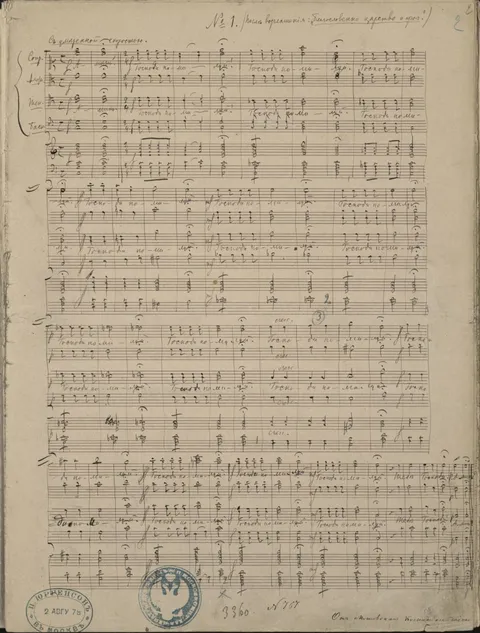
Tchaikovsky's manuscript score (which includes his piano reduction for rehearsal purposes) is now preserved in the Glinka National Museum Consortium of Musical Culture in Moscow.
As he wrote it
What he said about this work in his letters, from the first mention to the last. Each passage is quoted word for word from the letter; open the letter to read the rest.
While composing, 1878
It may very well be that I shall decide to set the whole Liturgy of Saint John Chrysostom to music. Then I shall have all of these in order by July.
I worked a little this morning, and finished the sketches for a few numbers from the Liturgy that I am writing. I now have a whole mass of sketches in my case.
Next I shall set about the collection of pieces for children, copy out the Mass, and then I shall rest (as you advise), and will gradually come up with something new and substantial.
I have written a sonata for piano, 3 violin pieces, 12 small piano pieces, 24 little piano pieces for children, 6 romances, and an entire Liturgy of Saint John Chrysostom for mixed chorus.
From what I've seen of the Liturgy, if the rest is just as well engraved, then you can do without me. The piano reduction of the symphony will be proofread by Taneyev, and I trust him.
I read in the "Kievian" that my Mass was sung several times in Kiev at the University Church. This made me indescribably happy, because I was beginning to fear that it wasn't destined to find its way into the church.
It turns out that I cannot leave before the beginning of next week; on Friday there's to be a solemn performance of my mass at the Conservatory, and I gave my word I would be there.
The Moscow directors of the Musical Society are very interested in my Liturgy, and one of them (Alekseyev) gave it to the best choir in Moscow to study, for a decent fee, naturally.
That same evening my 1st quartet was performed at the Assembly, with the Andante repeated and more calls. Today (2 hours ago), there was a special spiritual concert at the Musical Society with my mass.
But the All-Night Vigil will be far less European than my mass; however, this will partly be because here (in the vespers) there are fewer occasions where I can become carried away and compose.
In the Liturgy, I surrendered myself utterly to my own artistic urges. The Vespers will be an attempt to return property which had once belonged to our church, but was removed from it by force.
The letter which you sent me was written by some amateur chamber musician, who calls himself a profound old man; he's asking me to arrange the liturgy for string quintet.
May 1878 He returns to Russia and spends time at Kamenka, before moving on to the Brailov country estate of Nadezhda von Meck, who is absent. Here he writes the Souvenir d'un lieu cher as a memento of his stay, and the Liturgy of Saint John Chrysostom.
January 1878 He travels to San Remo, where he completes the Symphony No. 4 and Yevgeny Onegin.
13/25 January 1878 Death of his half-sister Zinayda.
10/22 February 1878 Premiere of the Symphony No. 4.
March 1878 At Clarens in Switzerland with Iosif Kotek, he writes his Violin Concerto.
August 1878 He starts work on the Suite No. 1.
September 1878 He returns to the Moscow Conservatory to resume teaching.
7/19 October 1878 He leaves the Moscow Conservatory for good.
December 1878 He travels to Italy and settles in Florence, where he starts work on The Maid of Orleans.
In 1883, the violinist Ivan Gavrushkevich asked Tchaikovsky if he could arrange the Liturgy for string quintet with two cellos, or for a quintet of three violins and two cellos. Evidently Tchaikovsky declined this proposition (see letter from Ivan Gavrushkevich to Tchaikovsky, 8/20 January 1883 — Klin House-Museum Archive — and Letter 2218 from Tchaikovsky to Pyotr Jurgenson, 4/16 February 1883). ↩︎
Licence: CC BY-NC-SA 4.0. Tchaikovsky Research (en.tchaikovsky-research.net).
Cite this page
Plain text
Liturgy of Saint John Chrysostom. Dear Tchaikovsky, https://deartchaikovsky.com/en/works/th75-liturgy-of-saint-john-chrysostom/. Last updated 18 November 2026.
Chicago
“Liturgy of Saint John Chrysostom.” Dear Tchaikovsky. Last updated 18 November 2026. https://deartchaikovsky.com/en/works/th75-liturgy-of-saint-john-chrysostom/.
BibTeX
@misc{deartchaikovsky-works-th75-liturgy-of-saint-john-chrysostom,
  title = {Liturgy of Saint John Chrysostom},
  howpublished = {Dear Tchaikovsky},
  url = {https://deartchaikovsky.com/en/works/th75-liturgy-of-saint-john-chrysostom/},
  date = {2026-11-18},
}
May we count visits?
We use Google Analytics to see which pages people read. It sets cookies only if you accept. Privacy