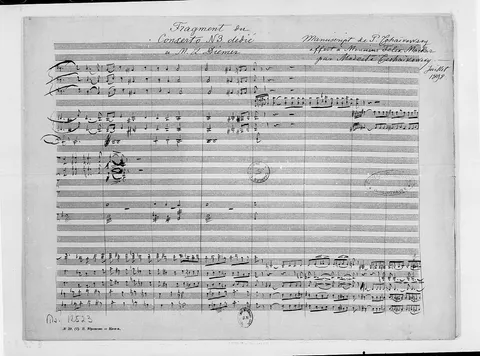
Tchaikovsky's Piano Concerto No. 3 in E-flat major, Opus 75, was begun in May 1893, and remained unfinished at the time of the composer's death on 25 October/6 November that year.
May 1893: 3 stays in 3 places. Numbered in the order he reached each place, from where he came from to where he went next, traced from the place and date of his letters.
Dates are New Style (N.S.), the calendar used in the West. In Russia, on the Old Style calendar, the date was 12 days earlier.
The first movement is scored for solo piano and an orchestra consisting of 3 flutes (3rd doubling piccolo), 2 oboes, 2 clarinets (in B-flat), 2 bassoons + 4 horns (in F), 2 trumpets (in B-flat), 3 trombones, tuba + 3 timpani + violins I, violins II, cellos, and double basses.
Movements and duration
Tchaikovsky originally planned the concerto in three movements, each of which was adapted from the abandoned Symphony in E-flat major he had sketched the previous year:
At the time of the composer's death only the first movement had been completed, with the other two left in sketch form. The latter were subsequently completed by Sergey Taneyev and published as a separate work — the Andante and Finale, Op. 79.
The first movement lasts around 15 to 20 minutes in performance, and all three movements together last approximately 35 to 40 minutes.
Composition
The origins of the concerto can be traced back to the Symphony in E-flat major, on which Tchaikovsky worked in 1891 and 1892, but later abandoned. By the spring of 1893 it seems that he had decided to rework three movements from the abandoned symphony into a piano concerto; however, this process was not begun until he had completed sketches for the Symphony No. 6. On 15/27 May 1893, the composer told his brother Modest of his intention to orchestrate both the new symphony and the concerto during the summer [1].
The following month, Tchaikovsky started to convert his earlier sketches for the abandoned symphony into the new piano concerto. According to dates in the manuscripts he began working on the first movement on 23 June/5 July, and completed it on 1/13 July at Grankino. The other two movements were completed in outline at Ukolovo on 10/22 July 1893.
Continue readingShow less2 more paragraphs
On 1/13 August, Tchaikovsky told Aleksandr Ziloti that the concerto "hasn't turned out too badly as music—but it's a thankless task! If that should be Taneyev's opinion then, perhaps, I shall destroy it forthwith" [2]. On 8/20 October in Moscow, Tchaikovsky showed the concerto to Sergey Taneyev, but despite the latter's harsh criticism that the concerto was not sufficiently virtuosic, all the same he did not destroy it [3].
However, he had already begun to have doubts about the length of the work, about which he wrote to Aleksandr Ziloti on 25 September/7 October 1893: "Since it has turned out to be disgracefully long, I have decided to restrict it to just the first movement, and to call it Allegro de concert or Conzertstück" [4]. Two days later, Tchaikovsky began to orchestrate the opening Allegro brillante [5], the completed score of which is dated 3/15 October. We may never know the composer's final intentions, since immediately after completing this movement, he left directly for Moscow, and then for Saint Petersburg, where he died on 25 October/6 November 1893. However, just eight days before his death, the pianist Adele Aus der Ohe recalled that Tchaikovsky "seemed especially anxious to revise his Third Pianoforte Concerto" [6].
Arrangements
Tchaikovsky also arranged the first movement for two pianos (4 hands) simultaneously with the orchestration in September and October 1893.
Performances
It had been intended that Taneyev should play the completed first movement from the concerto on the first anniversary of Tchaikovsky's death, but evidently the performance could not take place because the full score and parts were still not ready. It was eventually performed for the first time on 7/19 January 1895 at the second Russian Musical Society concert in Saint Petersburg, with Sergey Taneyev, conducted by Eduard Nápravník. In his diary for 7/19 January 1895, Taneyev noted: "Played well, but had little success. Called back only once" [7].
The concerto was not published during Tchaikovsky's lifetime. In late June/early July 1894, Sergey Taneyev, at Modest Tchaikovsky's request, began to review the manuscripts that Tchaikovsky had left behind [8]. In September the same year, an agreement was concluded with Pyotr Jurgenson to publish the completed Allegro brillante as a concerto one movement. By 3/15 October it had been engraved [9], and on 18/30 December 1894, Sergey Taneyev wrote to Modest Tchaikovsky: "The full score of the Concerto No. 3 is ready (I have one copy)" [10].
Besides the full score, Pyotr Jurgenson published an arrangement for two pianos and four hands in November 1894, and the orchestral parts in March 1895.
In 1954, the full score and two-piano arrangement of the completed movement were published in volumes 29 and 46Б respectively of Tchaikovsky's Complete Collected Works, edited by Aleksandr Goldenweiser.
Autographs
Tchaikovsky's manuscript score of the Allegro brillante (which includes his piano reduction of the orchestral parts) is now preserved in the Glinka National Museum Consortium of Musical Culture in Moscow.
Dedication
The manuscript score carries an inscription (not in Tchaikovsky's hand) to Louis Diémer (1843–1919), French pianist, and professor at the Paris Conservatory.
What he said about this work in his letters, from the first mention to the last. Each passage is quoted word for word from the letter; open the letter to read the rest.
While composing, 1893
The concerto is also ready in draft. I'm looking forward to your changes to my 2nd concerto.
Regarding the 3rd Concerto, rest assured that I shall not publish it without showing it to you. But, anyway, I have not even begun to orchestrate it yet.