Reading his letters
How a letter page works: the original beside the translation, who translated it, the two calendars, what was happening around the letter, letters read aloud, the letter of the day, word trends, the letter map and the manuscripts.
Tchaikovsky’s letters are the best way to hear him in his own voice: worried, funny, tired, delighted with a new piece, furious with a critic. The site has 5,387 of them, and every one has its own page. This article walks through a letter page from top to bottom, then the tools for reading many letters at once.
A good letter to try everything on is letter 763, written in Florence in 1878 to his patron Nadezhda von Meck, in which he explains what his Fourth Symphony is about.
The top of a letter page
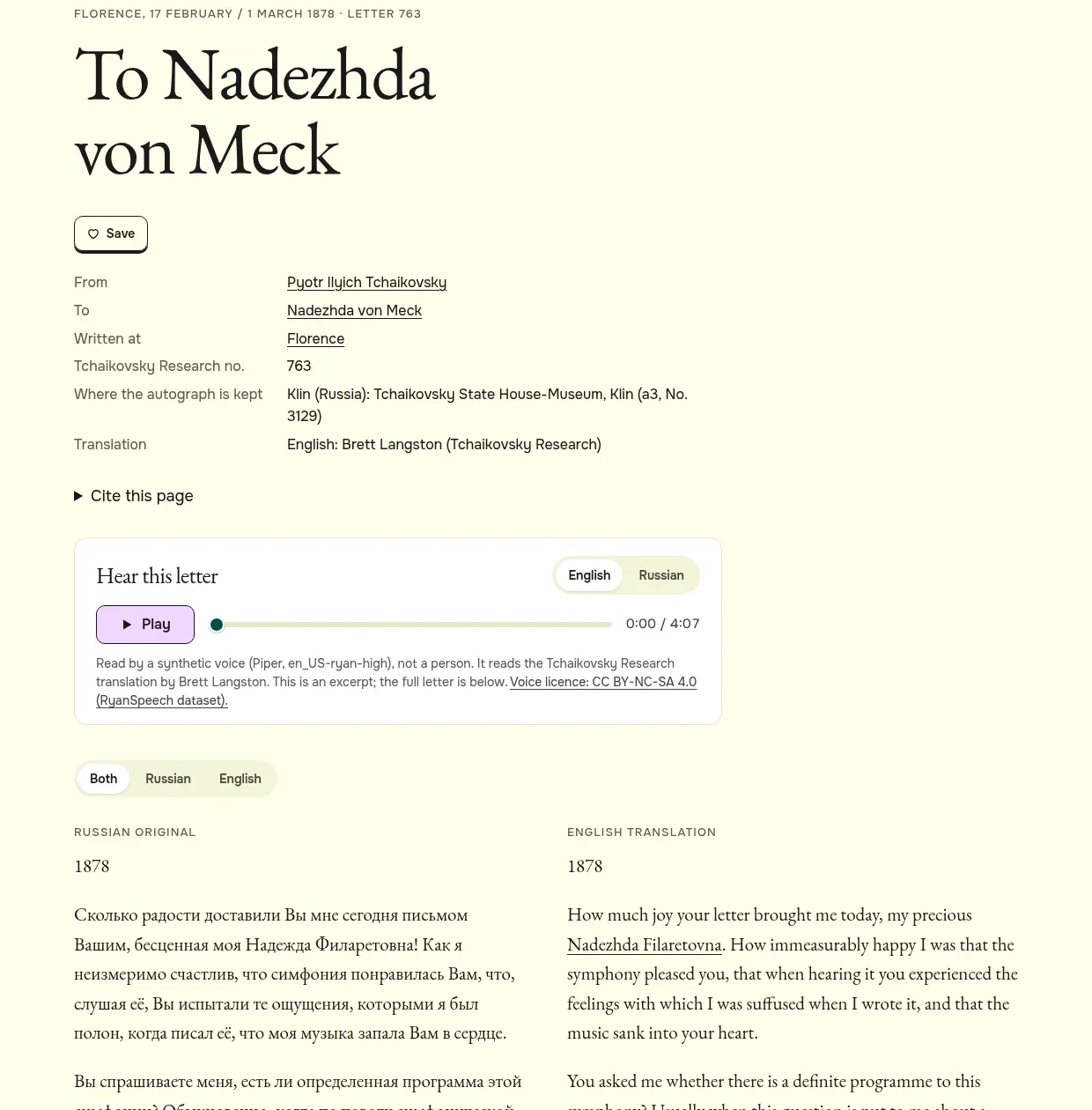
The first line gives the place, the date and the letter’s number. The number is the one Tchaikovsky Research gives it, so it matches the source and the printed catalogues.
Under the heading you find a Save button (see Make it yours) and a short list of facts: who wrote it, to whom, where, where the original is kept today, and who translated it. Names and places are links, so one click takes you to von Meck’s page or to Florence.
The original and the translation
The text comes in two columns: the original on the left, a translation on the right. Most letters are in Russian. Over 400 are in French or German, and for those the original column shows the French or German.
Above the columns are three buttons: Both, and one for each language. Press one to read a single text at full width. The site remembers your choice for the next letter. On a phone the columns are stacked, and the page starts on one language so you are not scrolling through two texts at once.
How to read one language at a time
- Open any letter, for example letter 763.
- Find the buttons Both, Russian and English just above the text.
- Press “English” to hide the Russian, or “Both” to compare a sentence in the two languages.
Who translated what
Translations come from two places, and the page always says which.
- Tchaikovsky Research. Most English translations were made by the volunteers of Tchaikovsky Research. The page names the translator, for example “English: Brett Langston (Tchaikovsky Research)”. Thirty-five translators are named across the site.
- Made for this site. Where no translation existed, the site made one: English for 557 letters that existed only in Russian, and Russian for 401 letters he wrote in French or German. These columns are headed “Translation made for this site”. They were made with the help of an AI model, working from the original. Read them as a guide, and quote the original, which is always beside them.
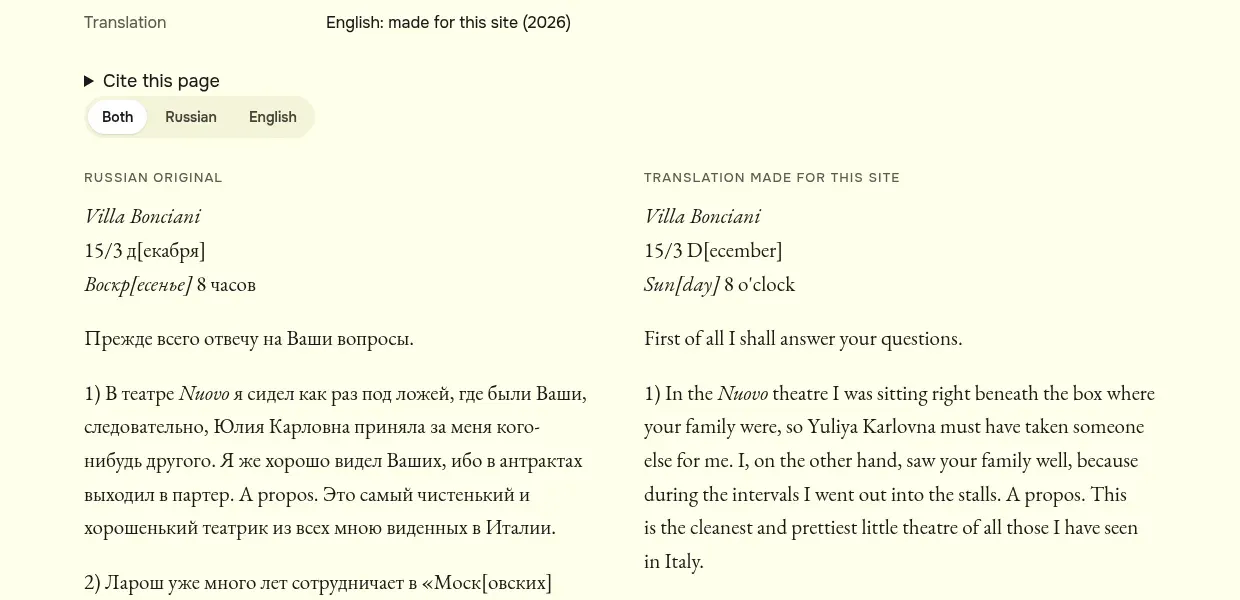
A few dozen letters still have no English text. On those pages you see the Russian alone and a short notice saying so.
Two dates: Old Style and New Style
Russia kept the old Julian calendar until 1918, while most of Europe used the Gregorian one. In his lifetime the Russian date ran twelve days behind. Tchaikovsky usually dated his letters in the Russian way, and when he was abroad he often wrote both.
The site does the same. “17 February / 1 March 1878” means 17 February in Russia and 1 March in Florence: the same day. When both dates fall in the same month you see “5/17 March”. A date shown on its own is in the Western, New Style calendar, and lists and timelines are always sorted by it, so events stay in the order they happened.
Around this letter
Below the text, the box “Around this letter” sets the letter in its weeks:
- Before, here, after: where he had been, where he was when he wrote it, and where he went next, with a small map of the route. These stays are worked out from where his letters were written.
- Named in this letter: the people, works and places the letter mentions.
- Letters from the same weeks: up to ten other letters from ten days either side, to anyone.
- On his desk at the time: the works he was composing that year.
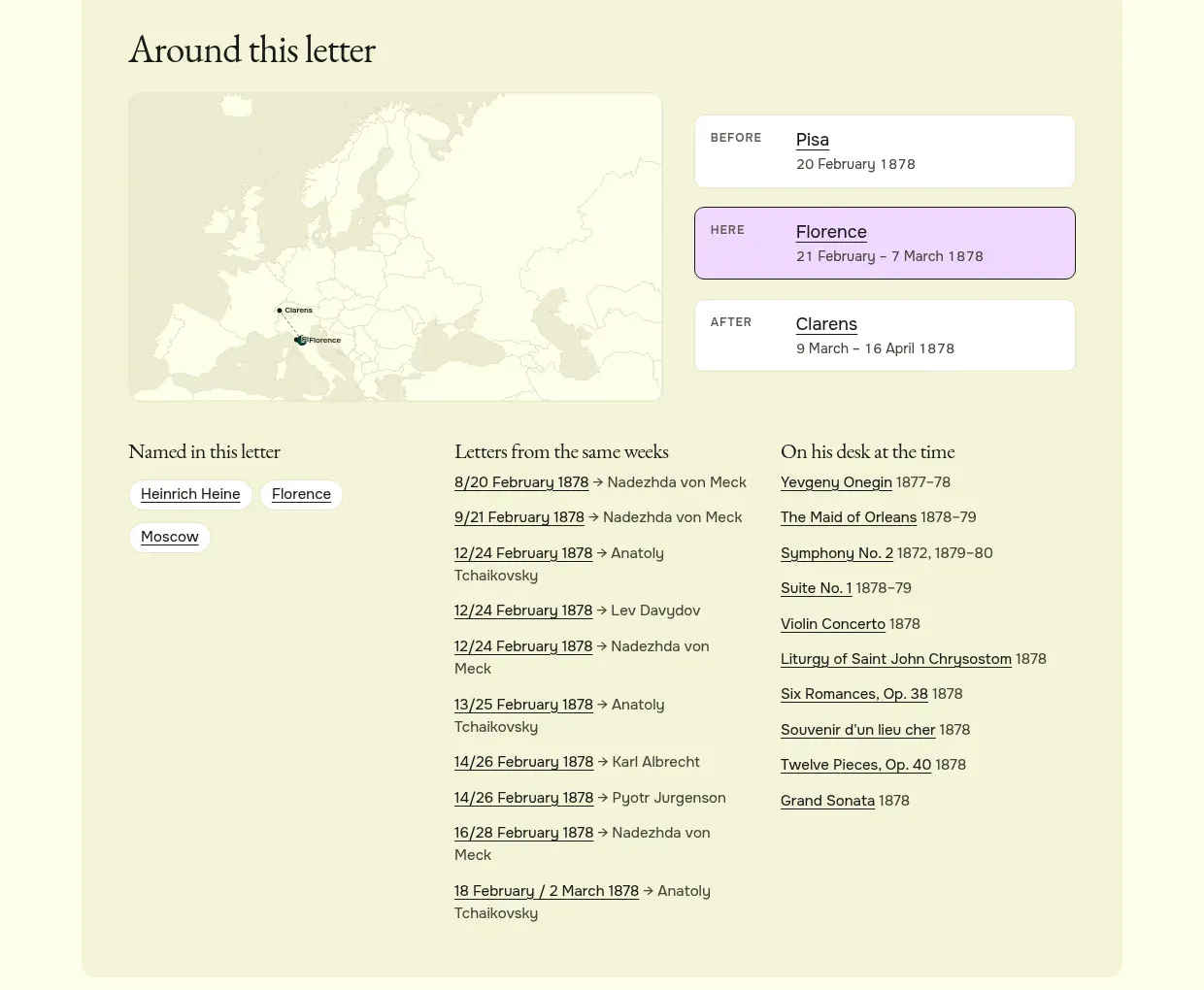
At the very bottom, the arrows lead to the previous and next letter by date, and to the previous and next letter to the same person, so you can follow one correspondence like a novel.
Hearing a letter read aloud
Thirty letters can be heard as well as read, each in Russian and in English. Look for the “Hear this letter” box near the top. Choose the language and press Play; nothing plays on its own. The voices are synthetic, made with a speech engine called Piper, and the box says so, along with whose text it reads. Some readings are excerpts and are marked as such. All of them are listed on Letters read aloud.
A letter a day
Today’s letter shows one letter written on today’s day and month, in whichever year. The same date always gives the same letter, so you and a friend see the same one. To get it without visiting, add the RSS feed to a feed reader: it holds the letter of the day for the last two weeks.
Reading many letters at once
The Letters page lists every year with its number of letters, and his 24 most frequent correspondents. Each year page has a calendar of the year, shaded by how many letters he wrote each day, and the letters in date order with a line from each.
Word trends
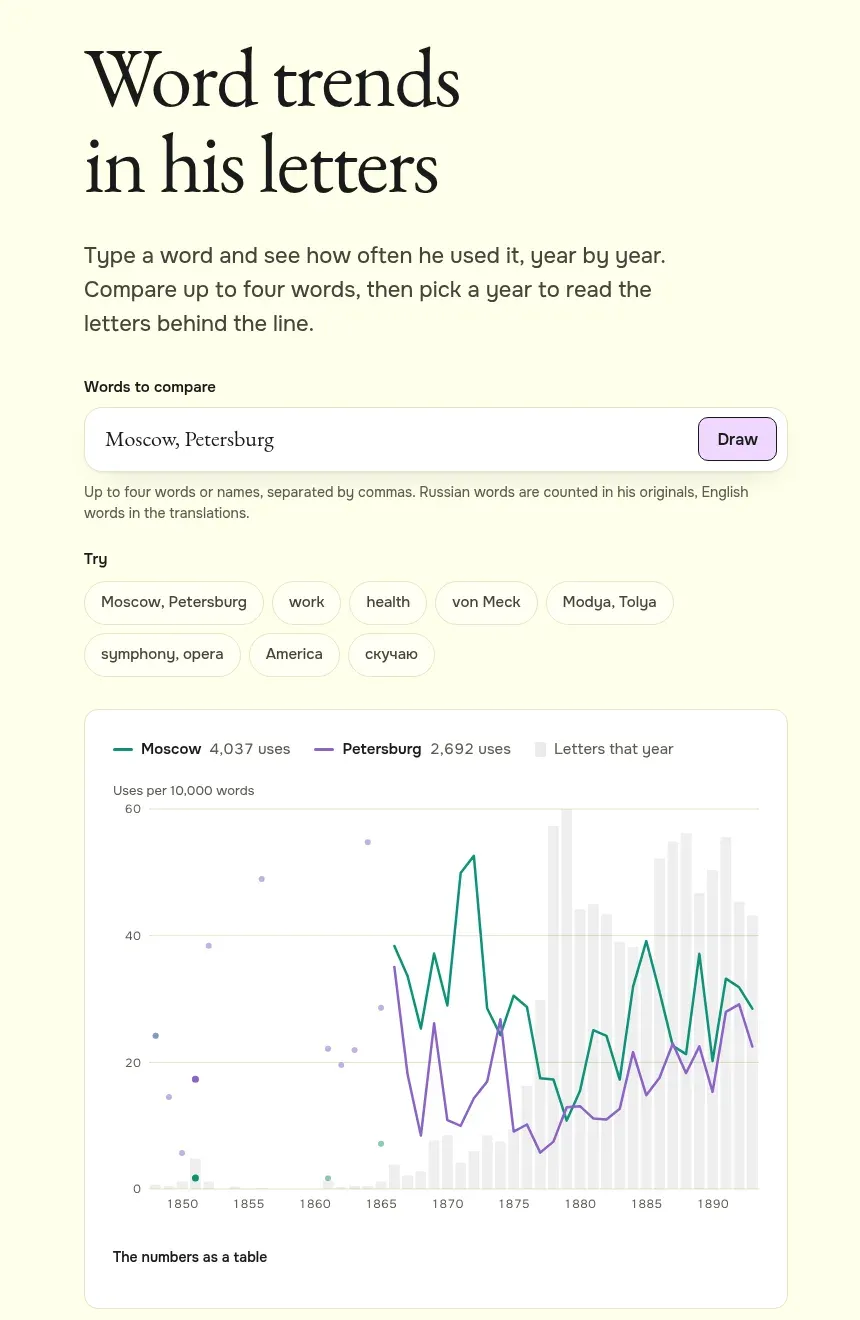
Word trends counts how often he used a word, year by year. Type up to four words separated by commas and press Draw. Russian words are counted in his Russian originals, English words in the translations, and the counts are per 10,000 words so busy years do not drown quiet ones. Pick a year on the chart to list the letters behind the line.
Letters on the map
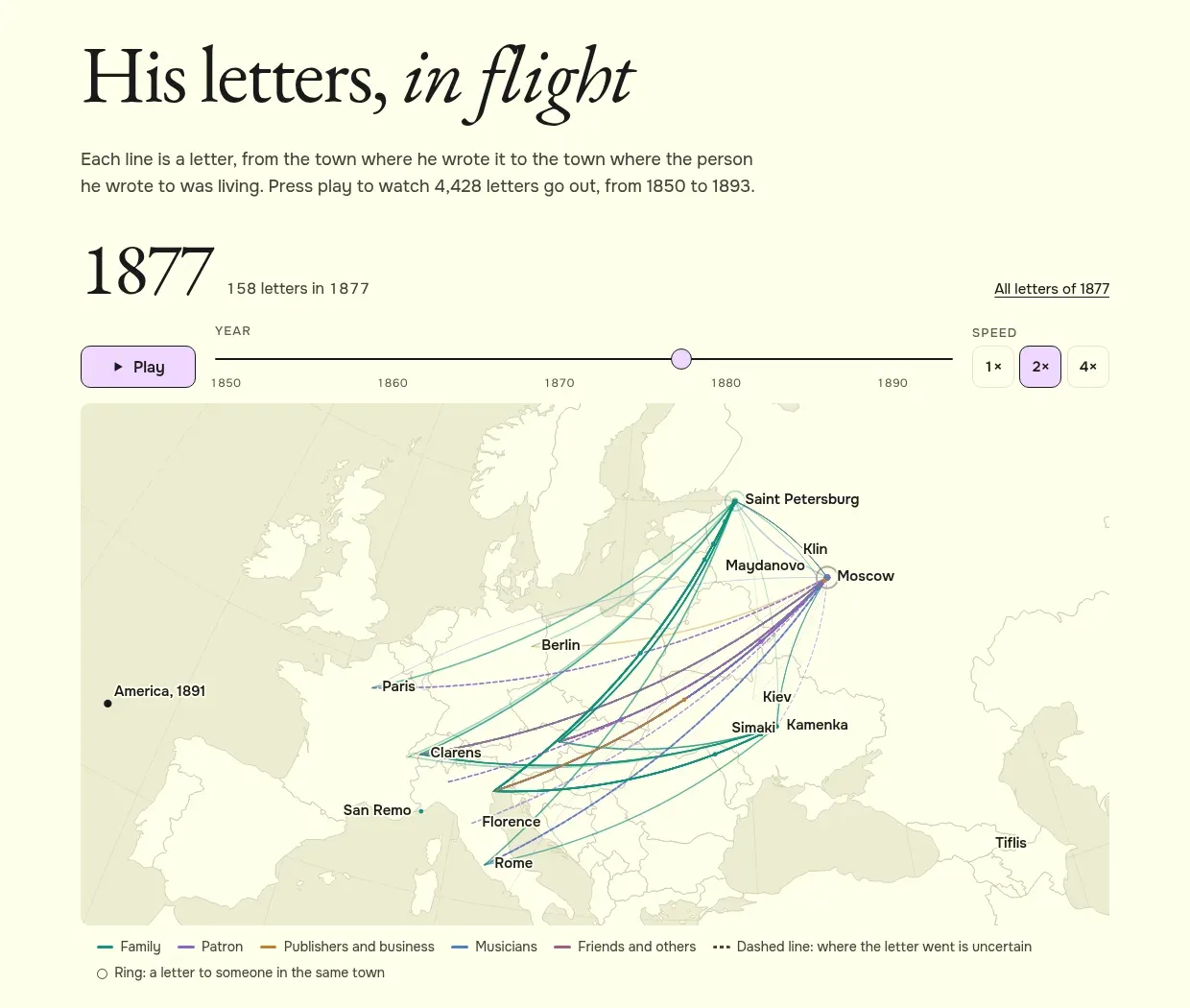
Letters on the map draws each letter as a line from the town where he wrote it to the town where its reader was living. Press Play to watch the years go by, or drag the year slider. Click a line to see the letter and open it. Dashed lines mark letters whose destination is uncertain; a ring marks a letter to someone in the same town.
Manuscripts
Manuscripts has twelve scans in his own hand: letters to Saint-Saëns, Dvořák and his French publisher, and score pages such as a draft of the Sixth Symphony. Zoom with the mouse wheel, a pinch or the + and − keys. Beside the scan is a clean transcription. On many pages, pointing at a paragraph lights up the matching lines on the scan.
Try it. Open the Fourth Symphony letter, press “English” to read the translation alone, then scroll to “Around this letter” and follow the arrow to the next letter he sent to von Meck.