Exploring a work
What a work page holds and how to move around it: the facts, the section bar, where he wrote it, the themes to listen for, the story and its footnotes, recordings and comparisons, premieres, keys, forms and the ballet and opera stories.
Every one of his 258 works has a page: the famous ones like Swan Lake and the Piano Concerto No. 1, and the small ones too, such as a single song or a piano piece written for a friend. The best-known pages are long, so this article shows how they are built and how to find your way in one. The examples use the Symphony No. 4.
The facts at the top
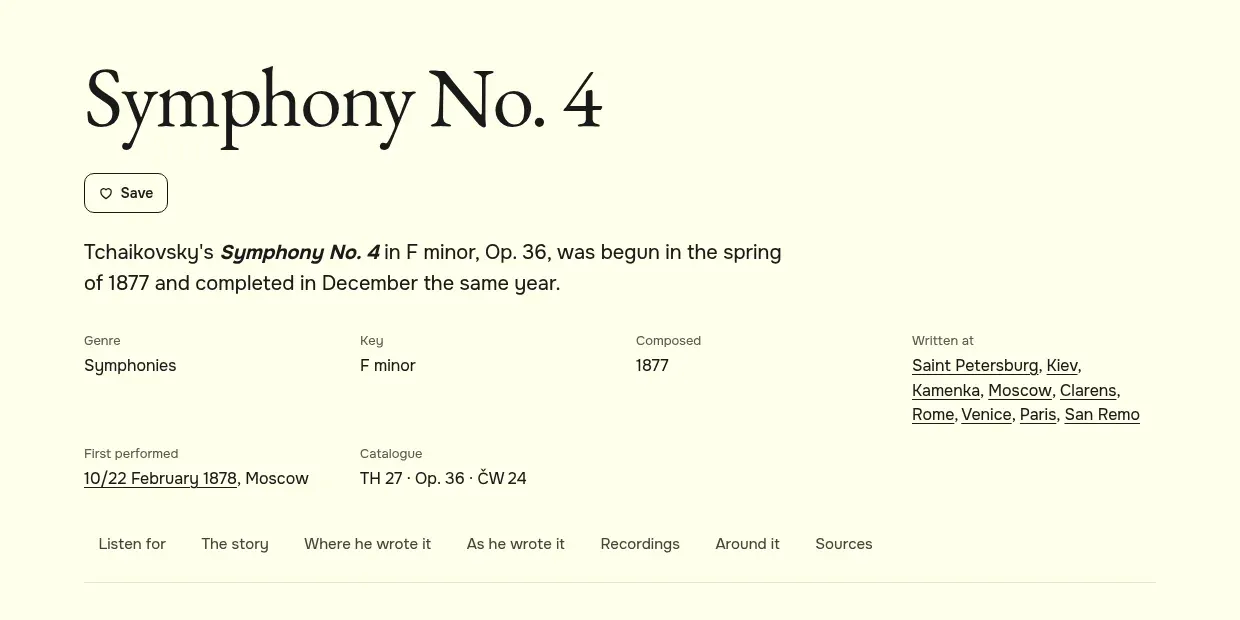
The page opens with the title, a Save button, a one-sentence summary and a grid of facts. You will see some or all of these:
- Genre and Key, for example “Symphonies” and “F minor”.
- Composed: the years he worked on it.
- Written at: the places where he wrote it, each a link to its place page.
- First performed: the date and city of the premiere, both calendars when the source gives both.
- Dedicated to, when there is a dedication.
- Catalogue: its numbers in the main catalogues: TH (The Tchaikovsky Handbook), the opus number and ČW (the Russian thematic catalogue).
The section bar
Under the facts is a bar of links to the parts of the page: Listen for, The story, Where he wrote it, As he wrote it, Recordings, Around it, Sources. It stays at the top of the screen as you scroll and underlines the part you are reading. A work only shows the parts it has, so a small song may have just two or three.
Listen for
Eight famous works, from Swan Lake to the Violin Concerto, have a “Listen for” section with the tunes people recognise. Each card says where the passage comes in the piece, what to listen for in plain words, and often what Tchaikovsky himself said about it, quoted from a letter.
Under the text is the melody in notation, with a Play button. The notes light up as they sound. “Piano” plays it on a piano; “As written” plays it on the instrument he wrote it for, such as horns or a flute. The tempo slider goes from half speed to one and a half times. These are simplified melody lines, not the full score, and each card says where the notation comes from.
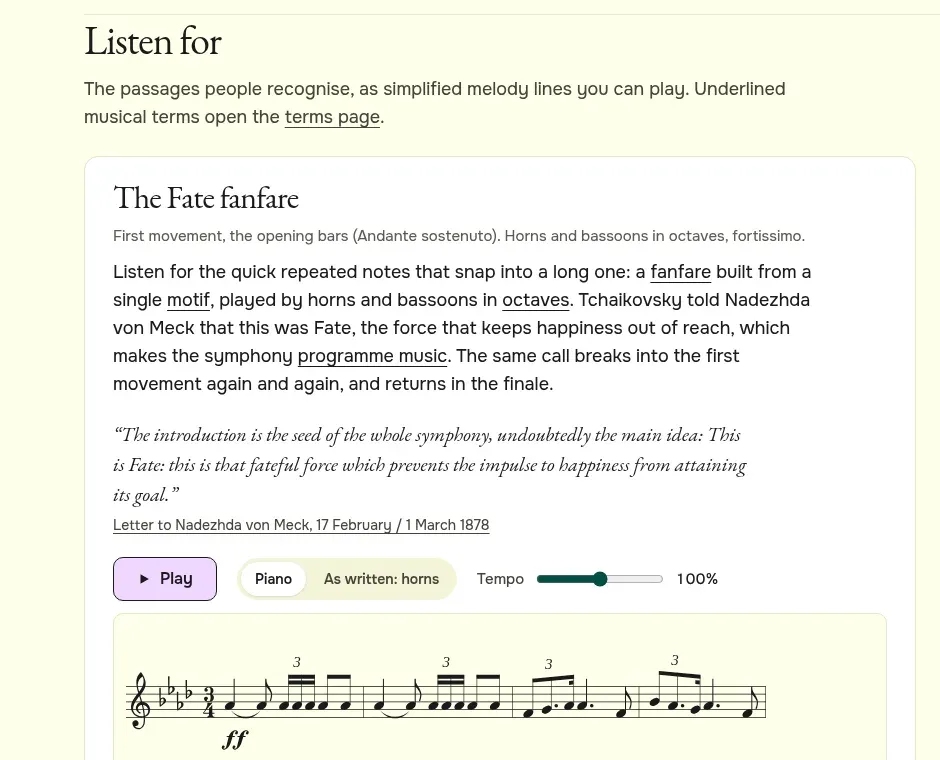
Underlined words such as fanfare or motif open the glossary of terms.
How to hear a theme the way he scored it
- Open a work with themes, for example the Symphony No. 4.
- In a “Listen for” card, press “As written” to switch from piano to the instrument he chose.
- Press Play. Move the tempo slider to the left to slow it down and follow the notes.
The story
“The story” is the history of the work, from Tchaikovsky Research: what it is about, how it was written, the first performances and what the critics said, publication, where the manuscripts are, and the dedication. Long sections show their first paragraphs and fold the rest behind “Continue reading”. For ballets and operas the plot comes first.
Small numbers in square brackets are footnotes. Click one to jump to the note at the bottom of the page; click the arrow at the end of the note to come back to where you were.
Where he wrote it
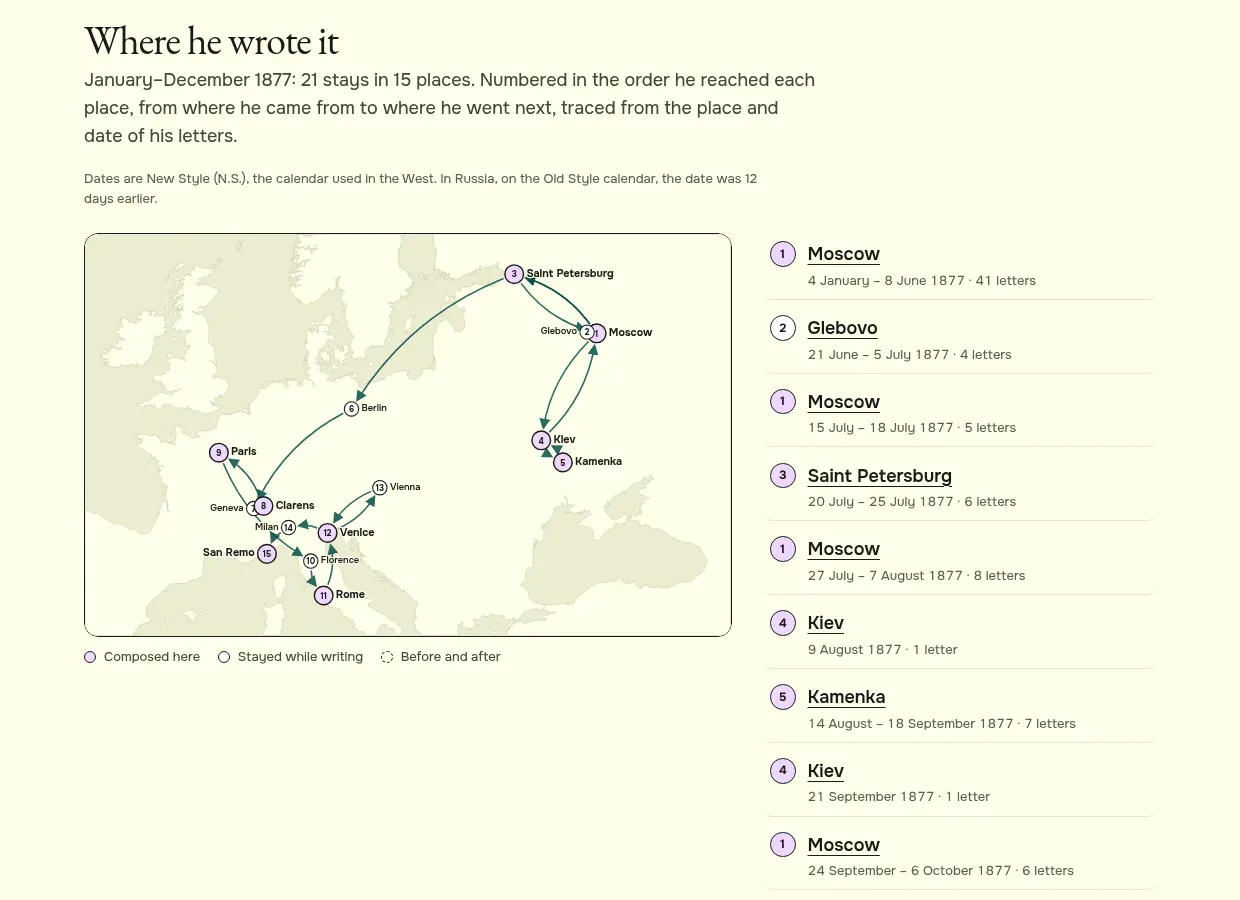
This map follows him through the months he was writing the work. For the Fourth Symphony, that is 1877: 21 stays in 15 places, from Moscow to Kamenka in Ukraine and on to Clarens, Venice and San Remo. The places are numbered in the order he reached them, the arrows show where he went next, and the places where he actually worked on the piece are drawn larger. The list beside the map gives the dates and the number of letters from each stay.
“As he wrote it” comes next: every letter that mentions the work, in date order, grouped into before, during and after, with the passage that talks about it. It is the closest thing to a diary of the piece.
Recordings and comparing performances
“Recordings” lists recordings you can play on the page, then others in a folded list. Players load only when you press them, so nothing from YouTube or the Internet Archive is fetched until you choose to listen. There are also links to the score on IMSLP and searches on Spotify, Apple Music and YouTube, and “Hear it live” looks for concerts.
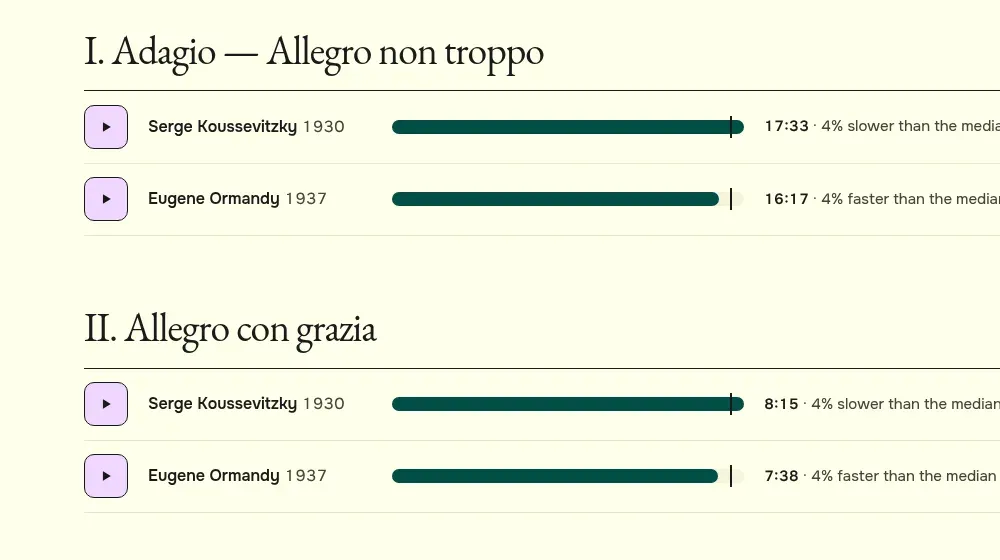
For nine works there is a comparison page. Compare recordings of the Sixth Symphony, for example, puts two historic recordings side by side, movement by movement. Each bar is as long as that performance, the line marks the middle value, and the text says how much faster or slower each one is. Play them one after the other and you can hear how much a conductor can change.
Around the work
“Around it” shows what else was going on: the letters that discuss the work, the people he wrote to most at the time, events in his life and in the world. At the bottom, “Listen next” suggests related works.
More ways into the music
- Premieres: 108 first performances on a timeline and a map, with who conducted. Filter by kind of work or by city.
- Works by key: the keys arranged on a circle, with how many works are in each. The search understands English, German and Russian key names, so “F minor”, “f-Moll” and “фа минор” all find the same key.
- Musical forms: fifteen forms he wrote in, from the symphony to the piano cycle, each with a diagram of its usual shape and what he did with it.
- Stories in pictures: Swan Lake, The Nutcracker, Yevgeny Onegin and The Queen of Spades told scene by scene in plain words, with paintings and the music to listen for in each scene.
- Scores you can play: four works, among them The Seasons and the Children’s Album, have a score you can open on the page and hear played on a piano, at your own speed.
Try it. Open the Symphony No. 4, play the Fate fanfare “as written” for horns, then use the section bar to jump to “Where he wrote it” and see how far he travelled that year.