His life, year by year
How to follow Tchaikovsky's life on the site: the Life page with its age slider, ribbon and eight chapters, the year and day pages, his life in five minutes, a day at Klin and the world around him.
Tchaikovsky lived for 53 years, from 1840 to 1893. The site lets you look at that life from far away, as one picture of all the years, or very close up, as a single day. This article goes from the widest view to the closest.
The Life page
Press Life in the menu to open his life in eight chapters. The page has three parts.
What was he doing at your age?
The green panel near the top has a slider and two buttons, − and +. Pick an age from 0 to 53 and the panel shows that year of his life: a photograph when one exists, where he was, the works he began, how many of his letters survive, a few events, and a button to the full year page.
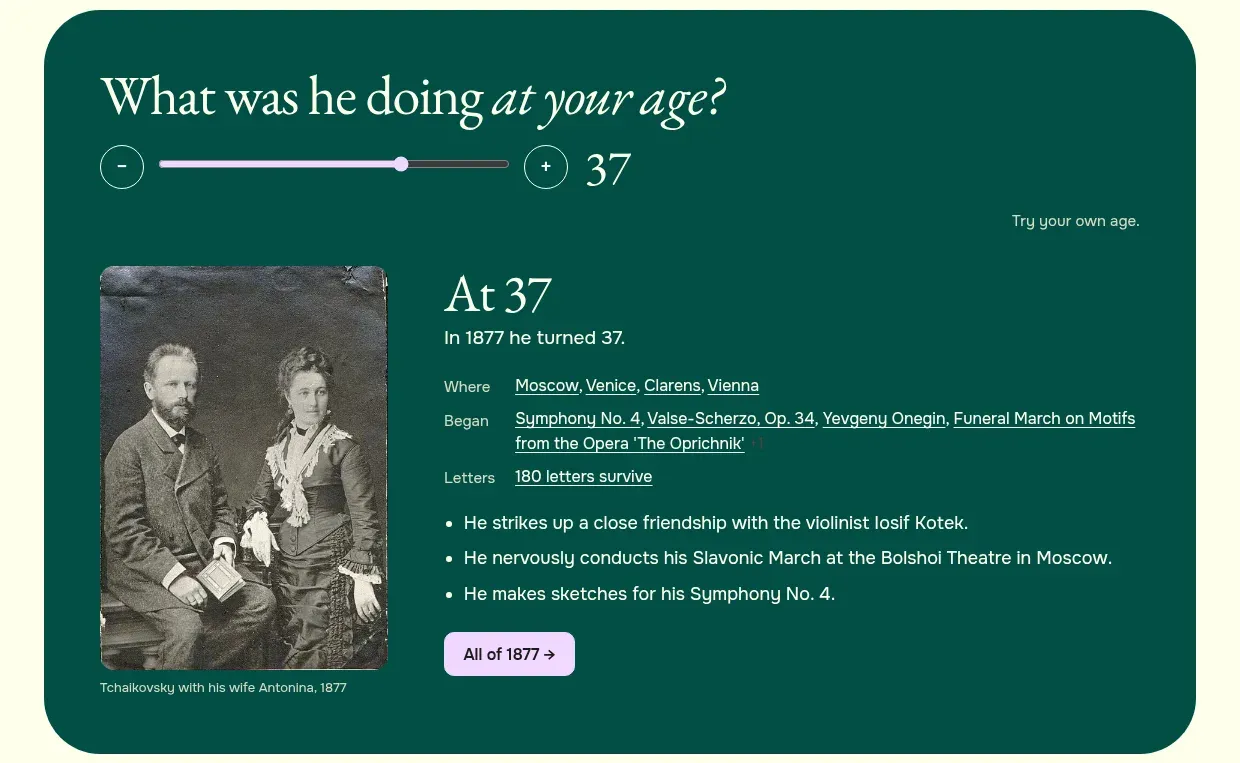
How to compare his life with yours
- Open the Life page.
- Drag the slider, or press + and −, until the number shows your age.
- Read the panel, then press “All of” that year for the whole year.
- Copy the address to send that exact age to someone: it ends in
#age-and the number.
The ribbon of the years
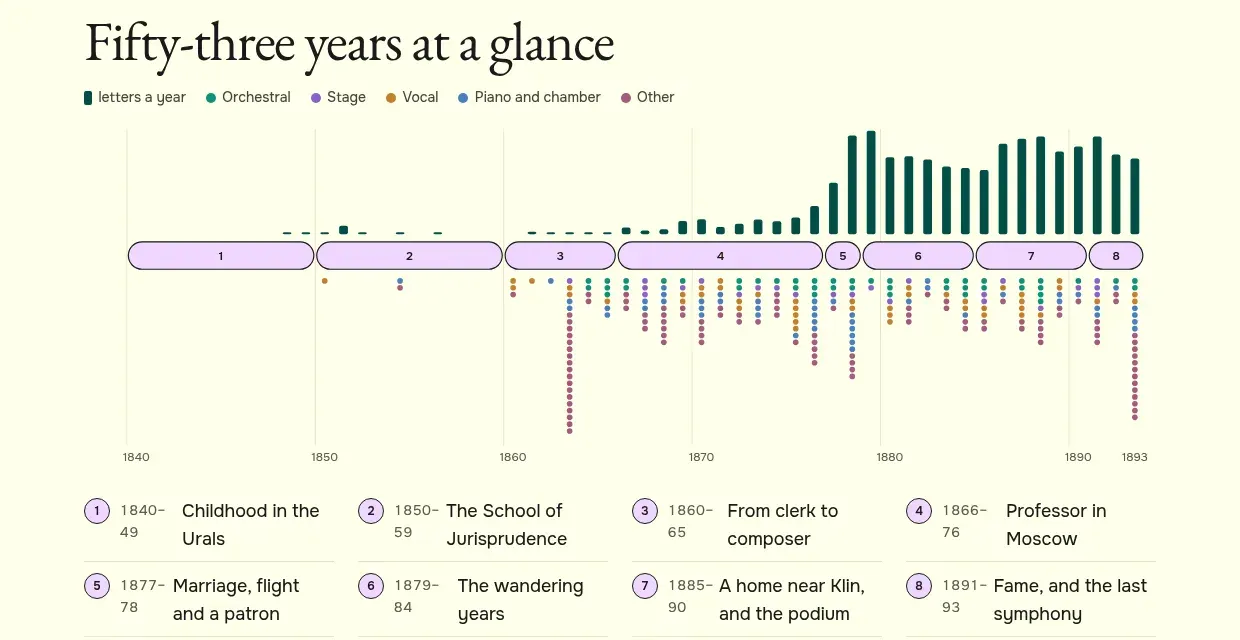
“Fifty-three years at a glance” draws his whole life on one line. Green bars above the line show how many letters survive from each year: almost none from his childhood, more than two hundred a year from 1878 on. The numbered bands on the line are the eight chapters. Below the line, each dot is a work he began that year, coloured by kind: orchestral, stage, vocal, piano and chamber, or other. Point at a year to see its numbers, and click it to open the year.
The eight chapters
Below the ribbon the page tells his life in eight chapters, from “Childhood in the Urals” to “Fame, and the last symphony”. Each chapter gives its years and his age, how many letters, works and places it covers, a few paragraphs, its key works, and one picture.
A page for every year
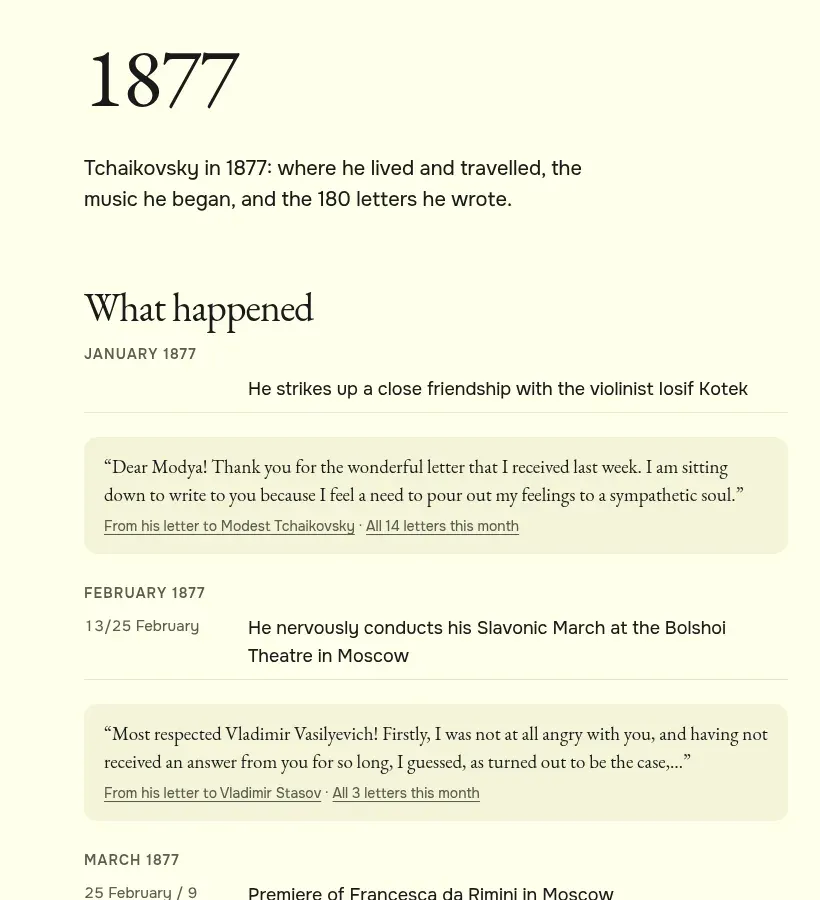
Every year with an event or a letter has its own page, for example 1877. It lists what happened month by month, with a line from one of his letters that month and a link to all the letters from that month. Further down are “In the world” (what was happening around him), a map and list of where he stayed, the works he began, and links to the years before and after.
There is a second set of year pages for the letters alone: Letters by year opens a calendar of each year, with every day shaded by how many letters he wrote on it.
A page for every day
A day in his life shows all 366 days of the calendar, 29 February included. Darker days have more surviving letters. Today is marked. Open any day to see everything that happened on that date in any year: events, the letters he wrote, grouped by year, and where his letters place him on that date year after year. Your birthday is a good place to start.
His life in five minutes
His life in five minutes plays the years one after another, a little over five seconds each: the year, where he was on a map, what happened, a line from his letters and, where we have it, a recording of music he began that year.
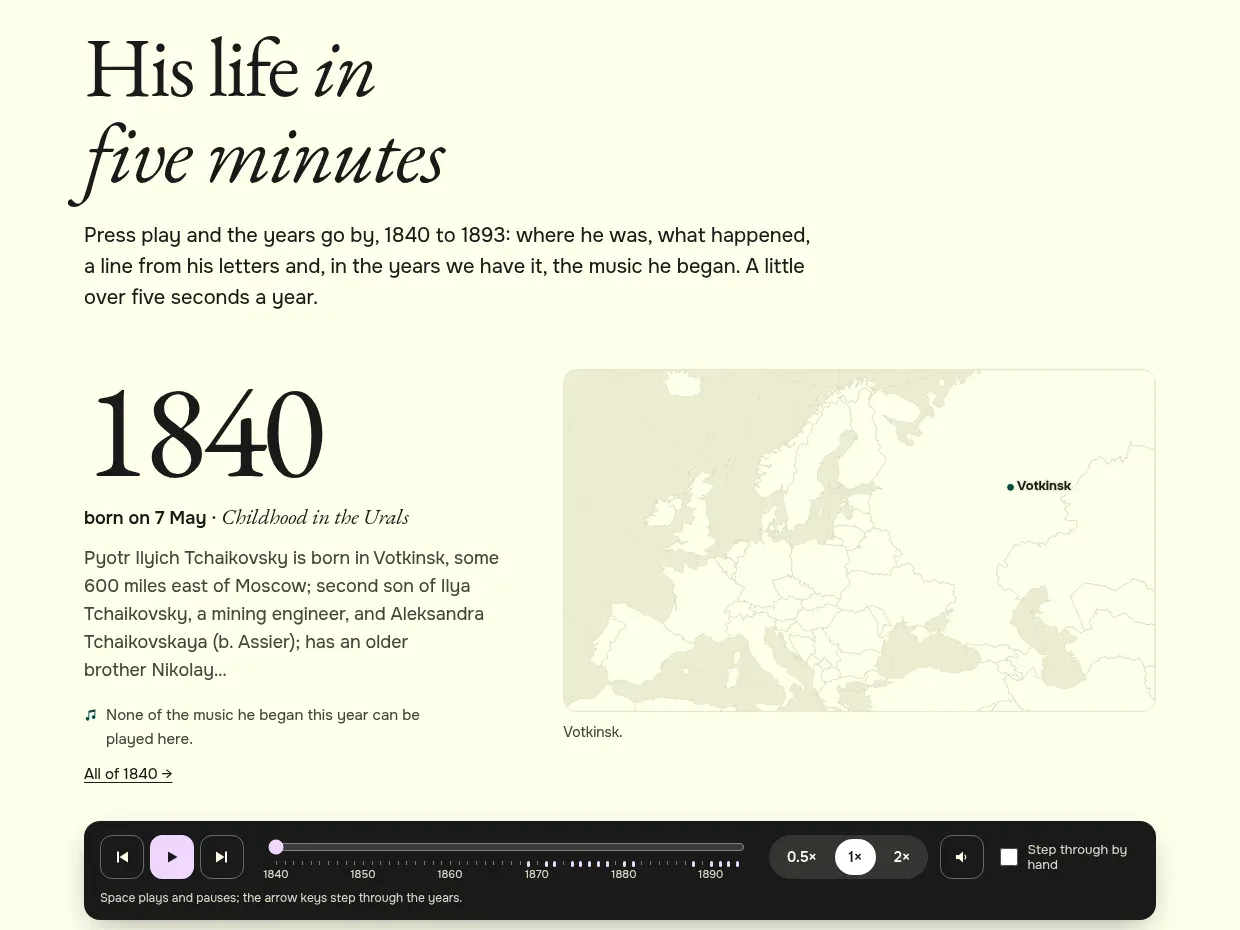
Press Play to start. Space plays and pauses, and the arrow keys move one year at a time. The speed buttons slow it down or double it, the speaker button turns the music off, and “Step through by hand” stops the automatic advance so you move only when you choose. If your device asks for reduced motion, the player does not move on its own.
A day at Klin
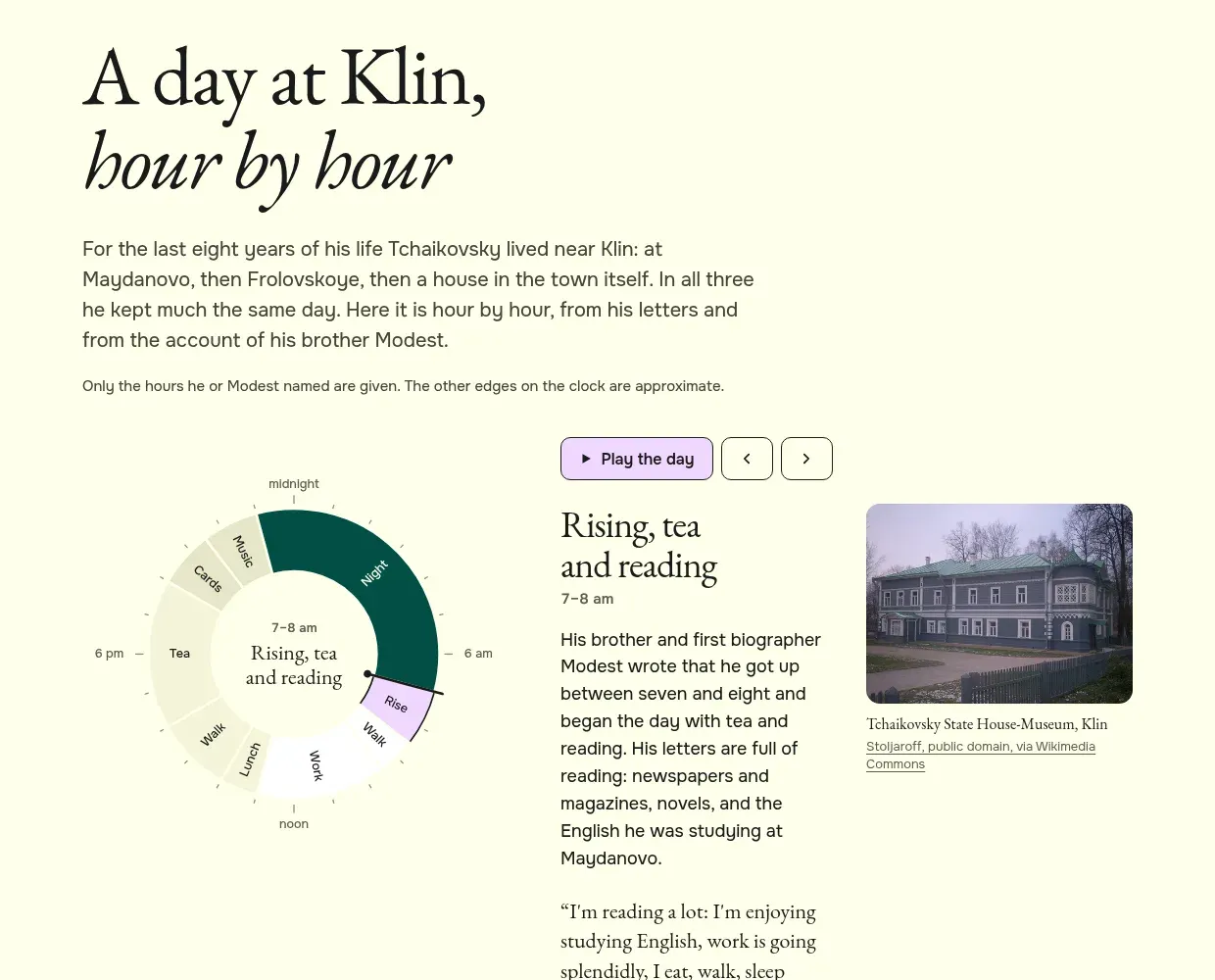
For the last eight years of his life Tchaikovsky lived near the town of Klin, outside Moscow, and kept much the same routine every day. A day at Klin draws that day as a clock: rising and tea, a walk before work, the morning’s work, lunch at one, the long walk, tea at four, supper and cards, music, and night. Click a part of the day, or press Play the day, and the page tells you what he did then, quoting his letters or his brother Modest’s account. Only the hours they named are given; the other edges of the clock are approximate.
The world around him
His life also ran alongside wars, reforms, inventions and other people’s music. The world around him lists 81 events from 1840 to 1893, such as the end of serfdom in 1861 and Russia’s war with Turkey in 1877, grouped by the chapters of his life. Where an event touched him, the entry says how, often with a line from his letters. When the sources only show that two things happened at the same time, the entry says “Possible link” instead of claiming more. Filter by kind of event, or tick “Only what touched him”.
The same events appear on each year page under “In the world”, and on work pages under “The world around this work”.
Try it. Find your birthday on the calendar and see what Tchaikovsky wrote on that day, in whichever years his letters survive.