People and places
How to use the person and place pages, his circle by year, the family tree, the graph of connections, the composers he knew, the cities of his time, then and now, In his footsteps with its audio guides, and the map of his journeys.
Tchaikovsky’s life was full of people and of travel. He wrote more than 1,200 letters to his brothers Modest and Anatoly, more than 700 to his publisher, and for thirteen years wrote to a patron he agreed never to meet. He moved between Moscow, Saint Petersburg, his sister’s estate in Ukraine, Italy, Switzerland and France, and late in life conducted in Germany, England and America. This article covers the pages for the people and the places.
A person’s page
Every one of the 626 people has a page. Open Nadezhda von Meck to see a full one:
- the name, with “Also written” for other spellings, such as “fon Mekk”, so search finds them however you spell them;
- life dates, how they were connected to him, a short biography and a portrait when one exists;
- the works dedicated to them, and the works whose history mentions them;
- Letters: every letter he wrote to them, with a chart of letters per year;
- Mentioned in letters: letters to other people that name them.
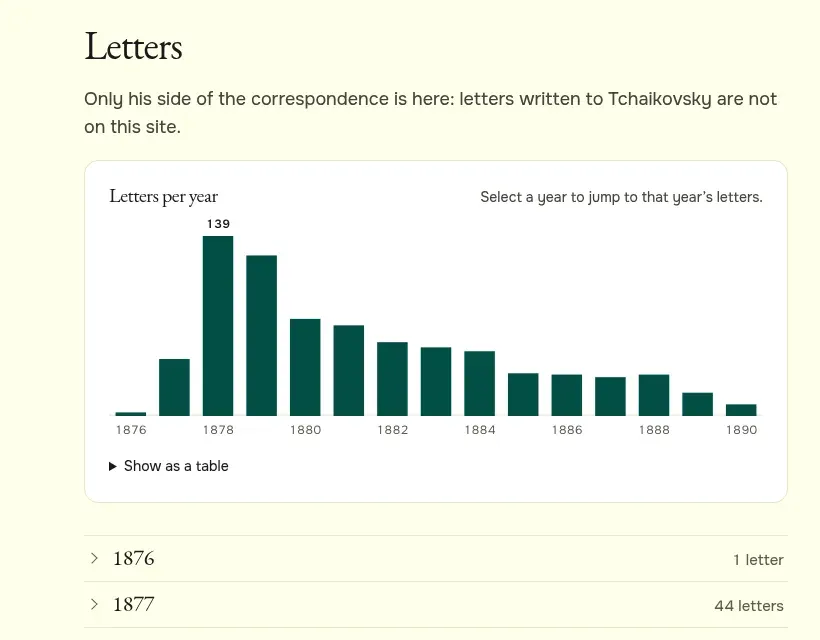
Only his side of each correspondence is on the site: these are his letters, not the replies. When a list has more than twelve letters, it folds into one row per year. “Show as a table” under a chart gives the same numbers as text.
His circle, his family, his connections
The People page ranks everyone he wrote to by the number of surviving letters. Von Meck, his publisher Pyotr Jurgenson and his brothers Modest and Anatoly are far ahead of everyone else. Three more pages show the same people in other ways.
- His circle by year puts each correspondent on a circle around him, closer to the middle the more letters he sent them that year. Move the year slider or press play to watch the circle change from year to year.
- Family tree: his parents, brothers and sisters, their husbands and wives, nephews and nieces, each with the number of letters he wrote to them. It can also be read as a plain list.
- His world of people: a map of connections between the 180 people his letters reach most often.
How the connections graph is counted
In the graph, two people are joined when his letters connect them. A link scores one point for each letter that names them both, or that goes to one and names the other; five points for a family tie; and two points for each work they share, such as a dedication or a premiere. A line is drawn when it reaches eight points, or when it is one of a person’s four strongest links. Tchaikovsky himself sits in the middle, but since every letter is his, his own lines appear only when you select him.
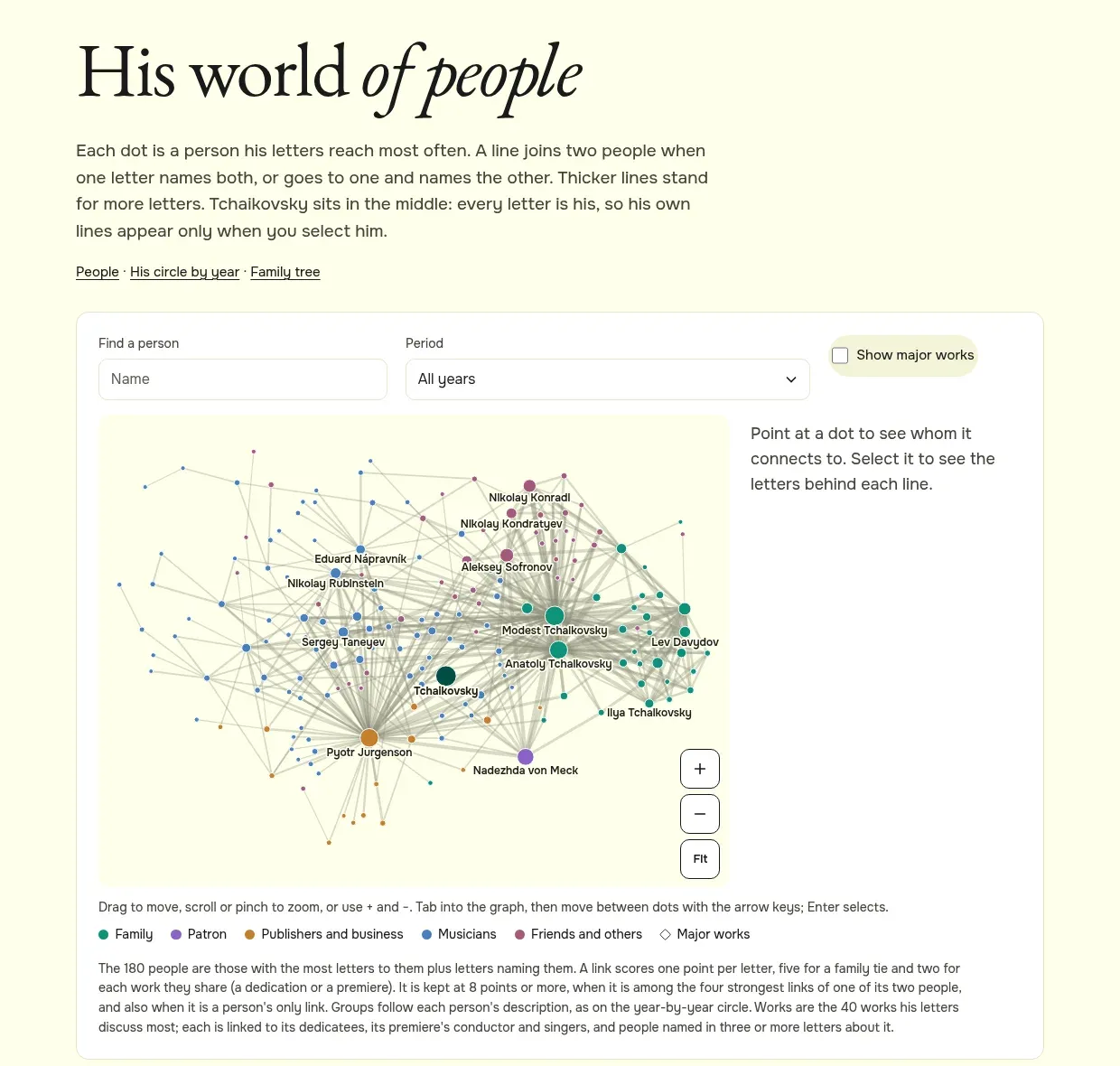
How to see who connects two people
- Open His world of people.
- Type a name in “Find a person”, or click a dot.
- The panel lists that person’s strongest links. Select one to see the letters behind it.
- Choose a chapter of his life under “Period” to see only those years, or tick “Show major works” to add his best-known pieces to the picture.
With a keyboard, tab into the graph and move between dots with the arrow keys; Enter selects. Under the graph, “The graph as a list” gives each group’s people and their strongest links as text.
Composers is a separate page for 27 composers: those he revered, such as Mozart; those he knew, such as Brahms, Grieg and Dvořák; and those who came after. Each card tells where they met, quotes what he wrote about them and what they said about him.
A place’s page
Each of the 152 places has a page too. Klin is a good full example. At the top is what the place meant to him, then a map drawn for that place: dashed arrows show where he arrived from, solid ones where he went next, thicker for journeys he made more often. Places beyond the edge of the map are pinned to the edge with an arrow pointing their way.
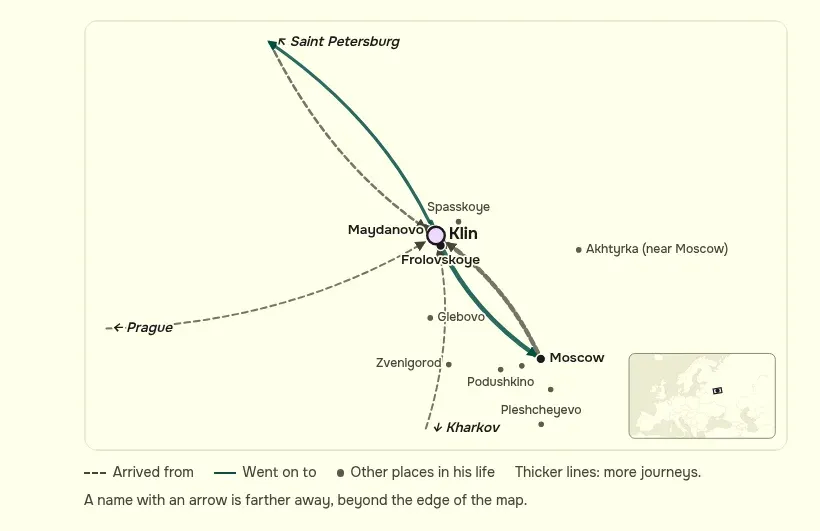
Further down:
- Before and after: a table of every stay he made there, with where he came from and where he went, the newest first.
- In his time: twelve cities, among them Moscow, Saint Petersburg, Klin, Florence and Paris, have an illustrated portrait of the city as he knew it, with old pictures and his own words about it. They are collected on Cities in his time.
- Then and now: for some places, an old photograph and a new one of the same view, one over the other. Drag the divider, or use the arrow keys, to wipe from one to the other. All of them are on Then and now.
- Works written here, Letters written here and Mentioned in letters.
In his footsteps
In his footsteps is a guide for visitors: 22 places linked with him that you can still visit, from his house-museum in Klin and his birthplace in Votkinsk to the theatres of his premieres, his grave in Saint Petersburg and Carnegie Hall in New York. Each entry says what happened there, what you will find today, the address and how to get there.
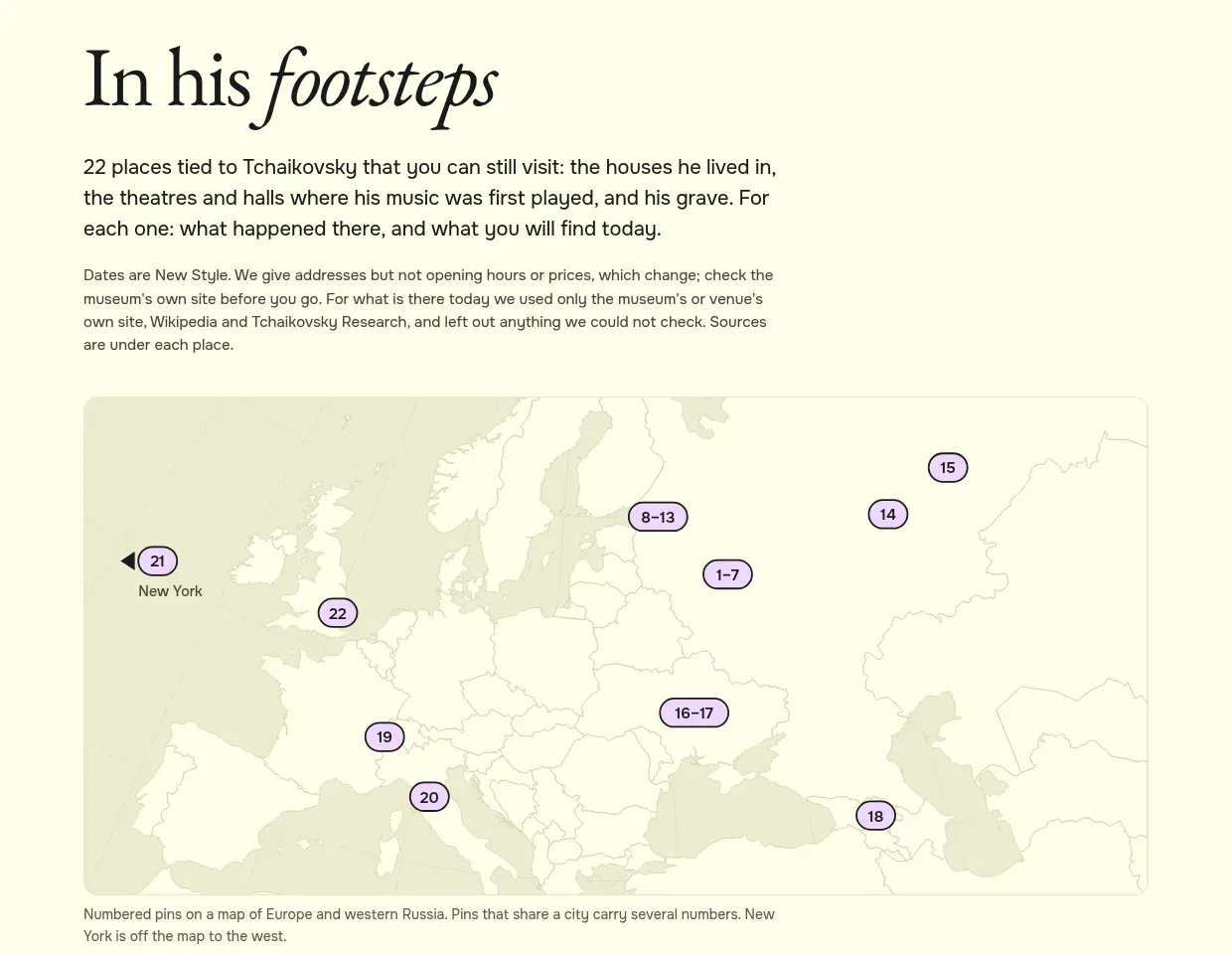
Each site has a short audio guide: press Play to hear what happened there, read by a synthetic voice, with the full text under the player. They are collected on Audio guides, handy on a phone when you are standing in front of the building. The guide gives no opening hours or prices, which change; check the museum’s own site before you go.
The map of his journeys
The Map page shows every place on maps of Europe and America, sized by how many works he wrote there. Above them is the journey of a single year: his stays in order, numbered, with the route between them. Drag the year slider, or press Play to step through the years. The year is kept in the address, so /en/map/#1878 opens on 1878.
Try it. On his circle by year, press play and watch who moves to the middle in 1877 and 1878, the years of his marriage and of the first letters to von Meck.