How the site is made
Where the letters, pictures, recordings and scores come from, how they are imported and checked, how translations are stored, what is made with AI or by machine and how it is labelled, and how corrections work.
This article explains where everything on Dear Tchaikovsky comes from, how it gets onto the pages, what was made by machine, and what to do if you find a mistake. The About page has the same policy in shorter form.
Who makes it
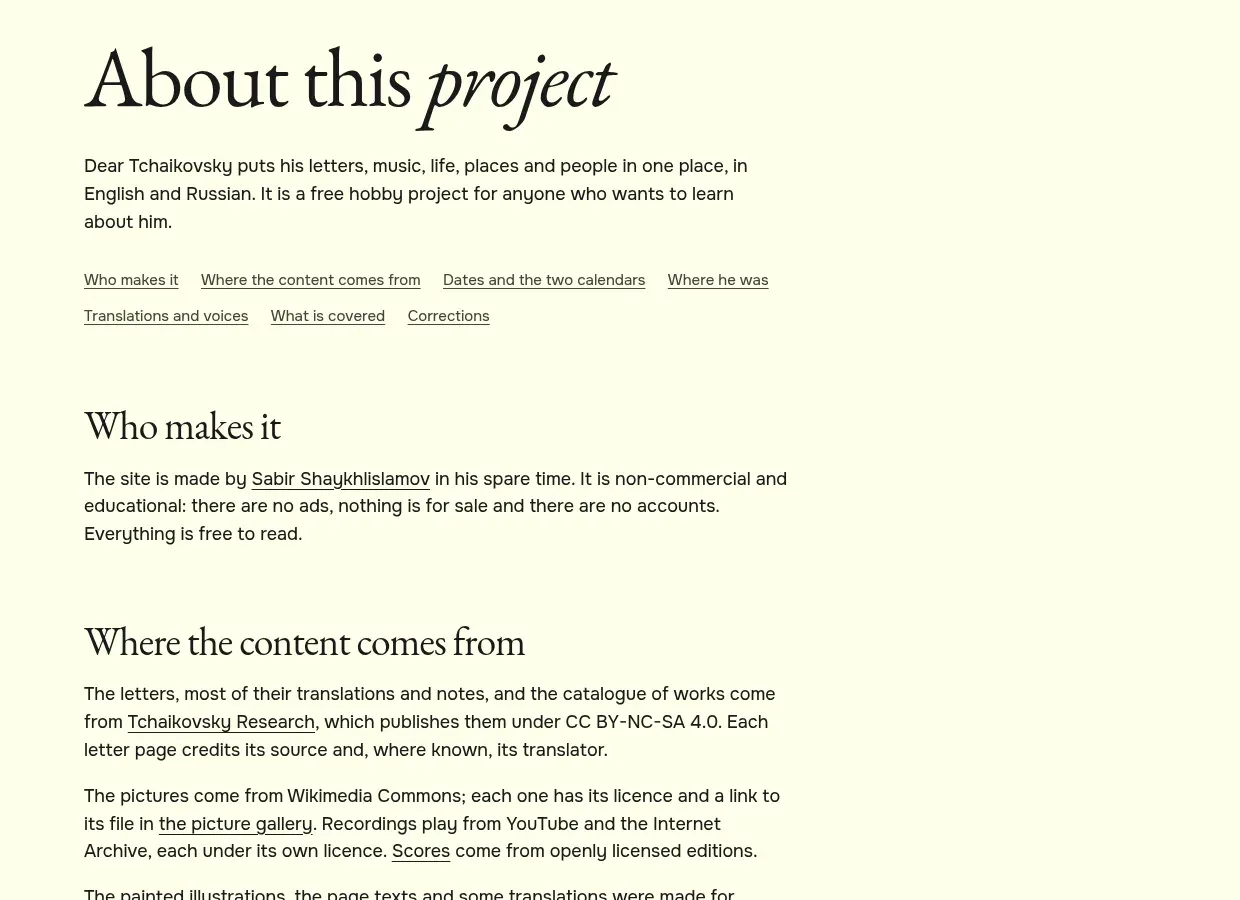
The site is made by Sabir Shaykhlislamov in his spare time. It is non-commercial and educational: there are no ads, nothing is for sale and there are no accounts. Everything is free to read.
Where the content comes from
- Tchaikovsky Research. The letters, most of their English translations and notes, the catalogue of works with their histories, and the chronology of his life come from Tchaikovsky Research, a scholarly wiki, which publishes them under the Creative Commons licence CC BY-NC-SA 4.0. Every letter and work page names it as the source, with a link to the original page.
- Wikimedia Commons. Photographs, portraits and manuscripts come from Wikimedia Commons, and only when the file is public domain or under an open licence (CC0, CC BY or CC BY-SA). Each of the 206 pictures has its own page in the gallery with its author, date, licence and source.
- The Internet Archive and YouTube. Recordings are not stored on the site. They play from the Internet Archive and YouTube, and only after you press play. Recordings played inside the site’s own player are freely licensed, and each shows its licence.
- Scores. The playable scores come from OpenScore and the Mutopia Project, which are public domain or CC0.
- Wikipedia and Wikidata fill in some facts, such as the world events and the composers he knew, and each such entry lists its sources.
How it gets onto the pages
The site is built by a set of import scripts. In plain words, they:
- read Tchaikovsky Research through its public interface, slowly, with a pause between requests, and keep a copy so that nothing is fetched twice;
- turn the wiki text into clean web pages, keeping only safe formatting;
- link names they recognise to the site’s own pages, so “Jurgenson” in a letter leads to his page;
- attach to every entry its source, its licence and its attribution.
Some things the source gets wrong or leaves out: a misspelt name, a wrong Russian title, an event dated to the wrong year. These are fixed by hand in a separate file of corrections, which is applied again after every import, so a fix is never lost when the data is refreshed.
From the imported data the site works some things out itself. The most important are his stays: letters written one after another from the same place make one stay, from the first letter there to the last. Maps, journeys and the “Before and after” tables all come from these stays. So a stay shows when he wrote from a place, not exactly when he arrived or left, and a short trip with no letters does not show.
The whole site is then built as plain pages, in English and Russian, and served by Cloudflare. Search runs in your browser from an index made at the same time, so there is no search server. The code is public on GitHub.
How translations are stored and checked
Translations made for the site are kept apart from the Tchaikovsky Research texts, in their own files. Each translation is stored together with the exact text it was translated from. When the site is rebuilt, a translation is used only if the original still matches word for word. If the source text has changed, the old translation is not shown at all, rather than shown out of date. Automatic tests check this rule.
Quotations get the same care. Every quote card, every quotation on the city and composer pages and every line on the worksheets is checked by a test against the letter it claims to come from. If the words are not in that letter, word for word, the test fails and the quotation has to be fixed.
What is made by machine, and how it is labelled
Some of the site was made with the help of AI models or generated by computer. All of it is labelled where it appears.
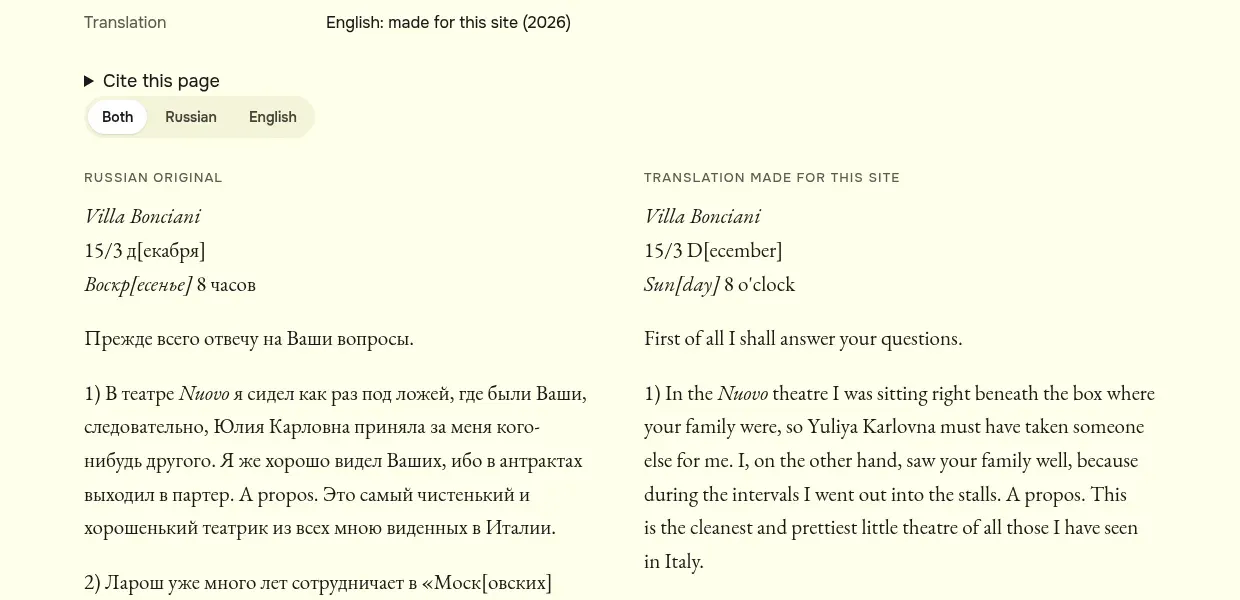
- Translations made for this site. English for 557 letters that existed only in Russian, and Russian for 401 letters written in French or German, were made with the help of an AI model, working from the original. They are headed “Translation made for this site”, and their citations say so.
Russian versions of the work histories are translated from the English in the same way, and the page says so. Read them as a guide; quote the original.
- Synthetic voices. The letters read aloud and the audio guides are read by synthetic voices made with the Piper speech engine, not by actors. Every player says so and names the voice and its licence.
- Painted illustrations. The colourful pictures of swans, stages and desks are drawn by a program written for the site, with brush-like strokes from the p5.brush library. They are not period art, and each is credited “Painted for Dear Tchaikovsky”.
- Ask the letters. Ask the letters answers questions with an AI model that may use only passages from his letters, and cites every letter it uses. Check the letter before you quote an answer.
Dates and names
Every date is stored in the Western calendar, so everything sorts in order, and shown in both calendars when the source gave the Russian one (see Reading his letters). Names follow Tchaikovsky Research’s English spelling, with other spellings listed as “Also written”.
Corrections
Found a mistake? Every page has Report an error in its footer. It opens a new issue on GitHub with the page address already filled in; describe what is wrong. Fixes are made as soon as possible, and the issue records what changed. A correction to a text from Tchaikovsky Research is made in the site’s copy; the original page may still differ.
How to report an error
- Scroll to the footer of the page with the mistake.
- Press Report an error. A GitHub issue opens with the page address in it.
- Write what is wrong and, if you can, where the right information comes from.
- Submit the issue. You need a free GitHub account to do this.
Licence and privacy
The site’s own texts, its translations, the painted illustrations and the data downloads are under CC BY-NC-SA 4.0, the same licence as Tchaikovsky Research: you may reuse them for non-commercial purposes if you credit the source and share alike. Pictures, recordings and scores keep their own licences, listed on Copyright and credits.
There are no accounts and nothing is sold. Visitor statistics are collected only if you accept them in the cookie card, and you can change your mind with “Cookie settings” at the bottom of any page. What you save in My Tchaikovsky stays in your browser. The privacy page has the details.
Try it. Open any letter and find the three things that tell you where its text comes from: the translator line at the top, the column heading over the translation, and the sources at the bottom.