For teachers and young readers
The page for young explorers aged 9 to 12, the teacher's kit with three printable 45-minute lessons, other pages that work well in class, and how pupils should cite the site in school work.
Tchaikovsky is often the first composer children hear by name, thanks to The Nutcracker and Swan Lake. Two pages on the site are made for school: one for children to read on their own, one for teachers to plan a lesson. This article describes both, suggests other pages that work in class, and shows how to cite the site.
For young explorers (ages 9 to 12)
Tchaikovsky for young explorers is written for children of about 9 to 12, in short sentences, with every fact checked. It has:
- Quick facts: when he was born and died, what his job was, what he is famous for.
- His life in short: six chapters, from “A boy from Votkinsk” to “Home near Klin”, each with one picture.
- Ten true facts, each with a link to where it comes from. For example, that he trained as a lawyer before he became a musician.
- Listen to these five first: the Dance of the Sugar Plum Fairy, the swan theme, the March of the Wooden Soldiers, The 1812 Overture and the waltz in five from the Sixth Symphony, each playable on the page.
- Eight music words with a little drawing each: composer, orchestra, conductor, symphony, concerto, ballet, opera and celesta.
- For your school project: tips on using the site for homework, and how to say where you found something.
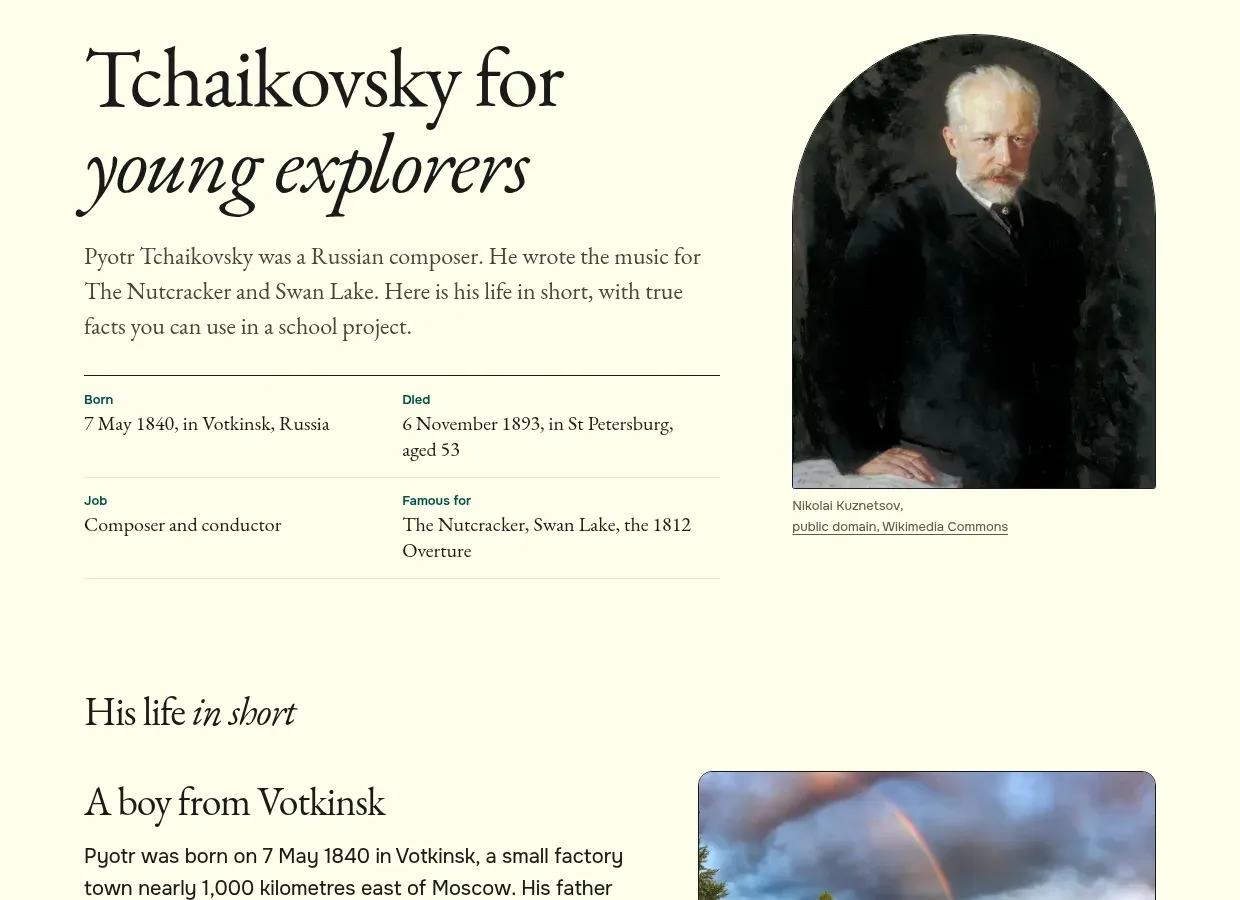
Every picture on the page says who made it, right underneath, so children can credit pictures too.
The teacher’s kit (ages 8 to 16)
The teacher’s kit has three lessons of 45 minutes each:
- The Nutcracker and the celesta (ages 8–12): the story, the new instrument he brought back from Paris, and the Sugar Plum Fairy. Activity: pupils draw what the music looks like to them while it plays.
- Tchaikovsky’s life through his letters (ages 10–16): reading short passages of real letters. Activity: pupils write a letter to a friend about a concert.
- What is a symphony? (ages 10–16): the four movements and how he bent the rules. Activity: pupils clap the first beat of each bar, first in an ordinary waltz, then in his waltz in five.
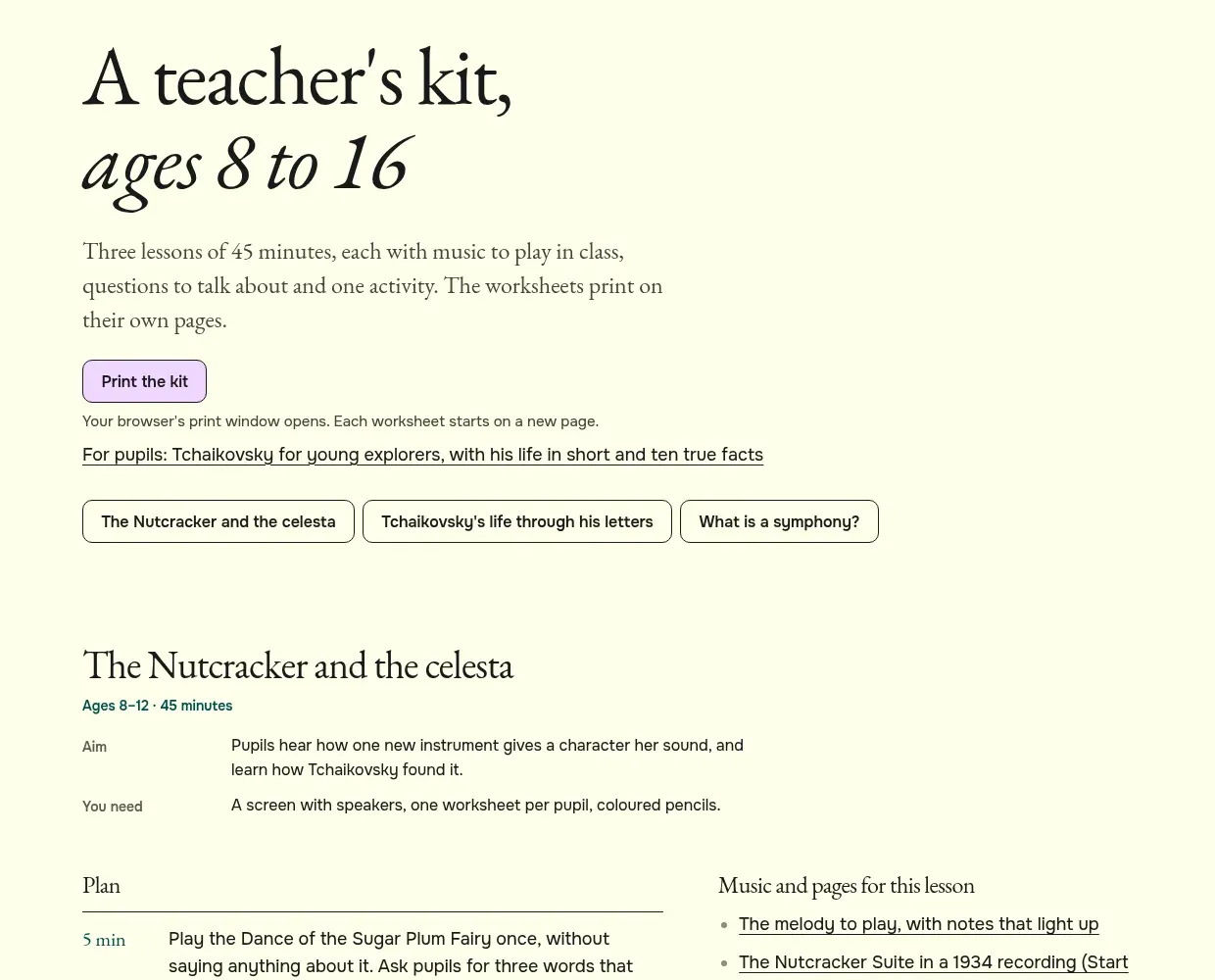
Each lesson gives the ages, the aim, what you need, a minute-by-minute plan that adds up to 45 minutes, the music to play with links, questions to talk about, one activity and a worksheet.
Printing the lessons
The kit is made to print. Press Print the kit (or use your browser’s own print command): the site’s menu, footer and buttons are left out, each lesson and each worksheet starts on a new page, and every link is printed with its full address, so pupils can type it in later.
How to print one worksheet
- Open the teacher’s kit.
- Press Print the kit. Your browser’s print window opens.
- In the print window, choose the pages you need: each worksheet starts on its own page.
- Print, or save as PDF to share with the class.
Other pages that work well in class
- Stories in pictures: Swan Lake, The Nutcracker, Yevgeny Onegin and The Queen of Spades told scene by scene, with a painting for the key scenes and the music to listen for in each. Read a scene aloud, then play its music.
- Play a theme: pupils play the swan theme on an on-screen piano, one lit key at a time. See Play and learn.
- Conduct a theme: tap the beat and the music follows; a quick way to show what tempo means.
- Instruments: twenty instruments with their sound and a famous moment for each.
- The listening path For children: a short route of pieces with notes on what to listen for.
- What was he doing at your age?: pupils set the slider to their own age.
- My Tchaikovsky: save the letters and works for a lesson and send the class one link. See Make it yours.
How to cite the site for school
Children need something simpler than a university citation. The young explorers page suggests four things: the name of the page, the name of the site, the web address, and the day you looked at it. Like this:
“The Nutcracker”, Dear Tchaikovsky, https://deartchaikovsky.com/en/works/th14-the-nutcracker/, seen on 18 November 2026.
Older pupils can use the Cite this page box at the bottom of pages for letters, works, people and places, which gives the same information in Chicago style and others. A few points worth teaching:
- Quote his letters in quotation marks, and say who wrote the letter, to whom and when. The letter page gives all three at the top.
- Say who translated a letter. The page names the translator, or says the translation was made for this site.
- Credit pictures with the name under them.
Try it. Open the teacher’s kit, choose “What is a symphony?” and play the waltz in five from the list of music. Can you clap the first beat of each bar?