Tchaikovsky and Camille Saint-Saëns
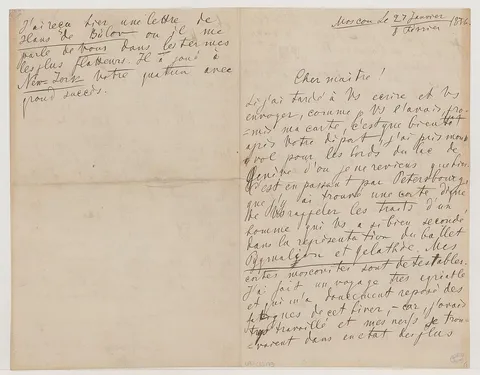
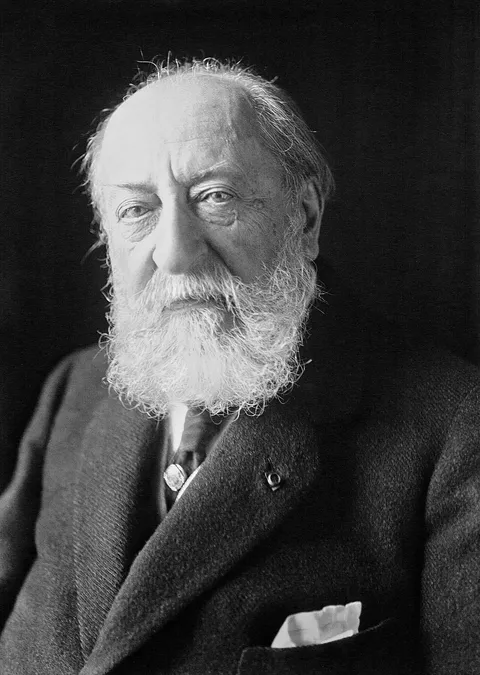
They took to each other when Saint-Saëns came to Moscow on a concert tour in November 1875; Tchaikovsky liked his briskness and wit, and Saint-Saëns advised him to give a concert of his own works in Paris. In private Tchaikovsky also measured himself against the more famous Frenchman. They met again only in 1893, in London and at Cambridge, where both received honorary doctorates on 13 June.
Dates and places
November 1875 · Moscow
Modest Tchaikovsky tells how the two, then 35 and 40, improvised a little ballet, Galatea and Pygmalion, at the Conservatory: Saint-Saëns played the statue, Tchaikovsky the sculptor, and Nikolay Rubinstein at the piano was the orchestra. Nobody else saw it.
Letters: 425
1 June 1893 · London
At a Philharmonic Society concert Tchaikovsky conducted his Fourth Symphony, and Saint-Saëns played in the second half. The next day the Society gave the two of them a dinner at the Westminster Club.
Letters: 4940
12 June 1893 · Cambridge
At the Guildhall concert Tchaikovsky conducted Francesca da Rimini and Saint-Saëns played the piano part of his Africa. The next day both received honorary doctorates, with Arrigo Boito and Max Bruch.
In his letters
“I got along very well with Saint-Saëns, a famous and bright Frenchman, who can render me a great service by spreading my fame in Paris.”
“It would be unbearable for me to have to stand humbly in front of Saint-Saëns, say, and sense his patronising glance directed at me when in my heart of hearts I consider myself to be a whole Alpine mountain higher than him.”
“The concert went off brilliantly, i.e. by unanimous opinion I had a real triumph, such that Saint-Saëns, who appeared after me, suffered somewhat as a consequence of my extraordinary success.”
In their words
“[Tchaikovsky], the gentlest and most affable of men here gave free rein to a frenzied storm and showed no more clemency towards the musicians and his listeners than Satan towards the sinners in hell.”
“His death is a great loss for the art of music, since he had many years of creative work ahead of him, perhaps even his finest years”